
Reaction Time vs Reflex Time: Key Differences, Speed & Examples

Reaction Time vs Reflex Time

Quick Answer

Reaction time is a conscious, voluntary response that requires the brain to detect a stimulus, process information, and decide on an action. Reflex time is an automatic, involuntary response routed through the spinal cord to protect the body, often bypassing conscious brain processing. 

The key difference lies in decision-making: reaction time involves perception and choice, while reflex time prioritizes speed and safety. Because reflexes follow a shorter neural pathway with fewer processing steps, they are typically faster than reactions. This distinction explains why reflexes handle immediate threats while reactions support flexible, goal-directed behavior.

This page covers

  • The exact difference between reaction time and reflex time
  • Why reflexes are faster from a neural perspective
  • Clear, real-world examples of each response type

This page does NOT cover

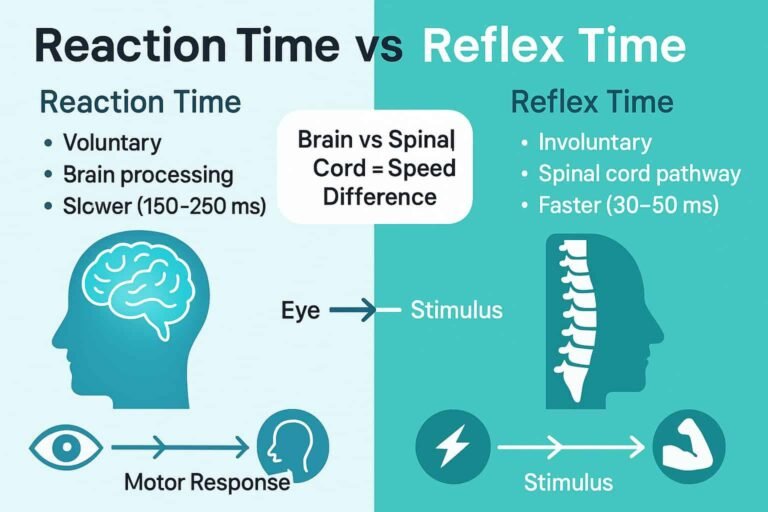
Infographic: Reaction Pathway vs Reflex Arc

Reaction time vs reflex time infographic showing brain processing pathway versus spinal reflex arc.
Reaction vs Reflex Pathways: A clear comparison of how the brain creates reactions and how the spinal cord triggers reflexes.

Reaction Time vs Reflex Time — Comparison Table

Feature Reaction Time Reflex Time
Response type Voluntary Involuntary
Conscious control Yes No
Control center Brain (cortex) Spinal cord
Typical speed Slower Faster
Decision required Yes No
Purpose Interaction & choice Protection
Can be trained Yes No
Examples Driving, gaming Blinking, pain withdrawal

What Is Reaction Time? (Voluntary Response)

Reaction time refers to how quickly a person consciously responds after detecting a stimulus. It includes both mental processing and physical movement, which is why reaction time is central to tasks that involve perception, choice, and controlled movement.

Reaction pathway (simplified)

Stimulus → Sensory receptors → Brain processing → Decision → Motor command → Movement

A key reason reaction time varies is that not all reactions require the same level of choice. When a task adds decision steps (left vs right, stop vs go), reaction time changes. That difference is explained by simple vs. choice reaction time.

What Is Reflex Time? (Automatic Response)

Reflex time describes the speed of automatic protective responses that occur without conscious decision-making. Reflexes operate through a reflex arc, allowing the body to react rapidly to potential harm.

Key clarification: Reflexes bypass conscious brain processing before action occurs, although signals may still reach the brain after the response.

(Not medical advice; this page is an educational comparison, not diagnosis.)

Why Reflexes Are Faster Than Reactions

Reflexes are faster because they:

  • Travel a shorter neural pathway
  • Involve fewer synapses
  • Skip decision-making delays
  • Are evolutionarily optimized for injury avoidance
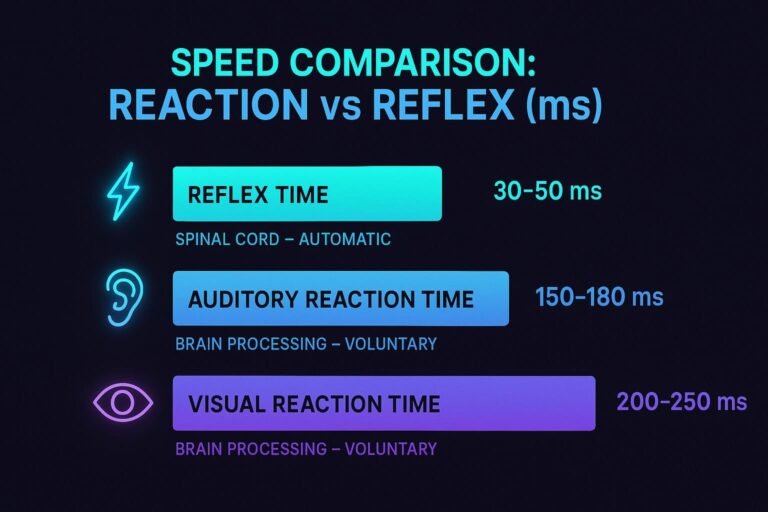
Visual comparison of reflex time and reaction time speeds in milliseconds, showing faster spinal reflex responses compared to slower voluntary auditory and visual reactions.

Speed Comparison Snapshot

Response Approximate Speed
Blink reflex ~10–20 ms
Pain withdrawal ~40–60 ms
Auditory reaction ~150–180 ms
Visual reaction ~200–250 ms

Values are approximate and vary with age, fatigue, attention, and context.

If you’re curious why cognitive load and attention switching can slow reactions (without changing reflexes), see does multitasking ruin reaction time.

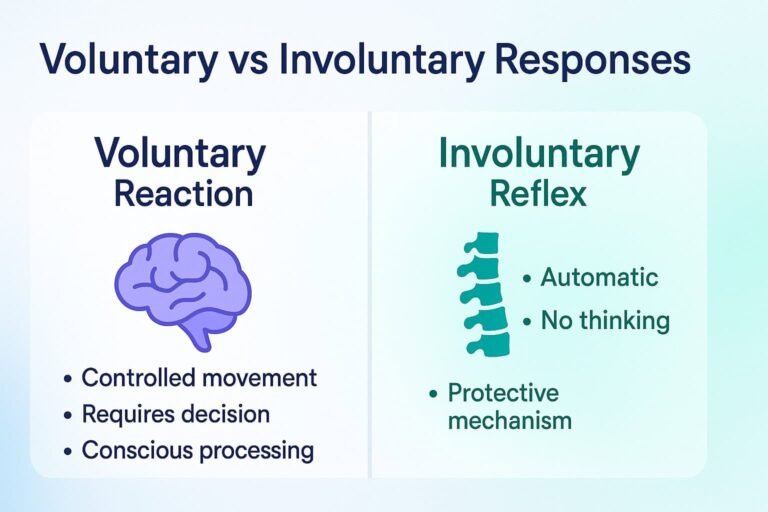
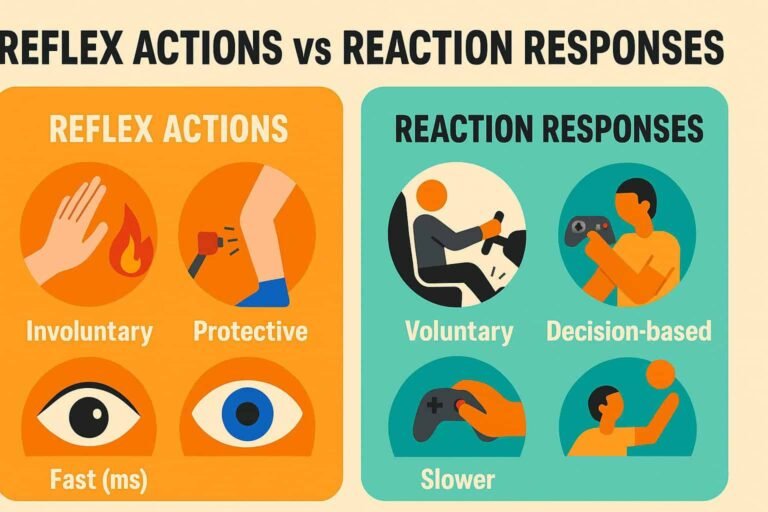
Infographic comparing reflex actions and reaction responses, highlighting involuntary protective reflexes versus voluntary decision-based reactions.

Real-World Examples (Clear Separation)

Reaction Time Examples

  • Pressing a button after a signal
  • Catching a ball
  • Braking while driving

Reflex Time Examples

  • Blinking when something approaches the eye
  • Pulling a hand away from heat
  • Knee-jerk response

This separation is why people often say “good reflexes” when they actually mean faster reactions.

Can Reaction Time Be Improved? What About Reflexes?

  • Reaction time: can improve with familiarity, practice, and task exposure
  • Reflex time: cannot be trained; reflexes are biologically hard-wired

Training methods are intentionally kept outside this comparison page to avoid intent mixing. If you want the training path, go to how to improve reaction time.

Common Myths About Reaction vs Reflex Time

  • “Reflexes are thinking faster.” ❌
    Reflexes act without conscious thought.
  • “Reflexes use the brain first.” ❌
    Action occurs via the spinal cord before conscious processing.
  • “Fast gamers have better reflexes.” ❌
    They typically have faster reaction times, not reflexes.

For interpreting whether a score is “good” or “average,” use the benchmark page: What is a good reaction time?

FAQs

What is the difference between reaction time and reflex time?
Reaction time involves conscious decision-making, while reflex time is automatic and protective.

Why are reflexes faster than reactions?
They follow shorter neural pathways and bypass decision delays.

Can reflexes be improved with training?
No. Reflexes are innate and not trainable.

How fast is a good reaction time?
It depends on modality; auditory reactions are generally faster than visual ones.

Measure Your Reaction Time 

Once the difference is clear, the next step is measurement.

👉 Try the Reaction Time Test
(This tool measures reaction speed, not reflexes.)

Final Takeaway

Reaction time and reflex time serve different biological purposes. Reflexes prioritize speed and protection, while reactions enable conscious choice and flexibility. Understanding this distinction explains why reflexes are faster—and why reaction time matters in everyday human behavior.

Author Bio - MemoryRush
Touheed Ali
🧠

Touheed Ali

Founder and Editor

Touheed Ali is the founder and editor of MemoryRush, an educational cognitive science platform. He builds and maintains interactive tools focused on memory, attention, and reaction time.

His work centers on translating established cognitive science concepts into clear, accessible learning experiences, with an emphasis on transparency and responsible design.

MemoryRush

Educational Cognitive Science Platform • Memory • Attention • Reaction Time

⚠️
Educational Use Only

MemoryRush is created for learning and self-exploration and does not provide medical, psychological, or clinical evaluation.

2 thoughts on “Reaction Time vs Reflex Time: Key Differences, Speed & Examples”

Comments are closed.