
Chimp Test vs Visual Memory
- Exactly what cognitive ability the Chimp Test measures (and what it doesn’t)
- Why chimpanzees excel at this specific ultra-fast spatial task
- How human visual memory operates differently in practical scenarios

What the Chimp Test Actually Measures
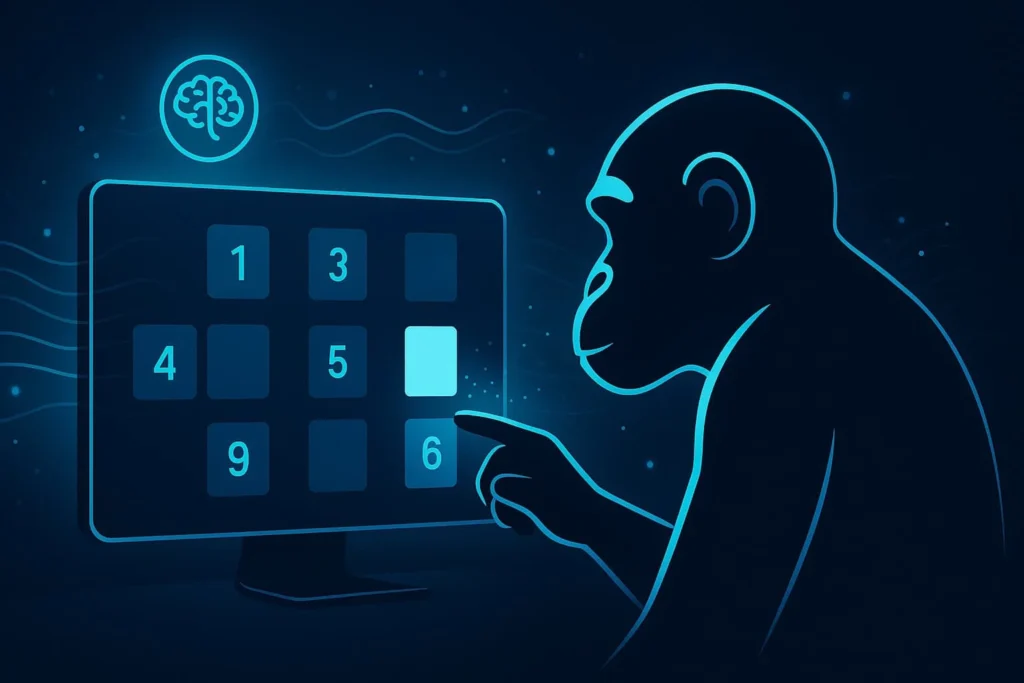
The Chimp Test (formally, the “Spatial Span Task” from Kyoto University’s Primate Research Institute) presents numbers 1-9 in random screen locations for 200-300 milliseconds, then replaces them with blank squares. The subject must touch squares in ascending numerical order based on their remembered positions.
The Critical Measurement Window
This isn’t about general memory—it’s about iconic memory (millisecond-scale retention) transitioning into visual working memory under extreme time pressure. The 210 ms display window prevents verbal rehearsal, forcing reliance on pure visual-spatial snapshotting.
| Measures | Does NOT Measure |
|---|---|
| Ultra-fast spatial snapshot recall | Overall intelligence |
| Iconic → visual working memory transfer | Long-term visual memory |
| Performance under <300ms time pressure | Strategy-based learning |
| Raw visual processing speed | Meaning comprehension |
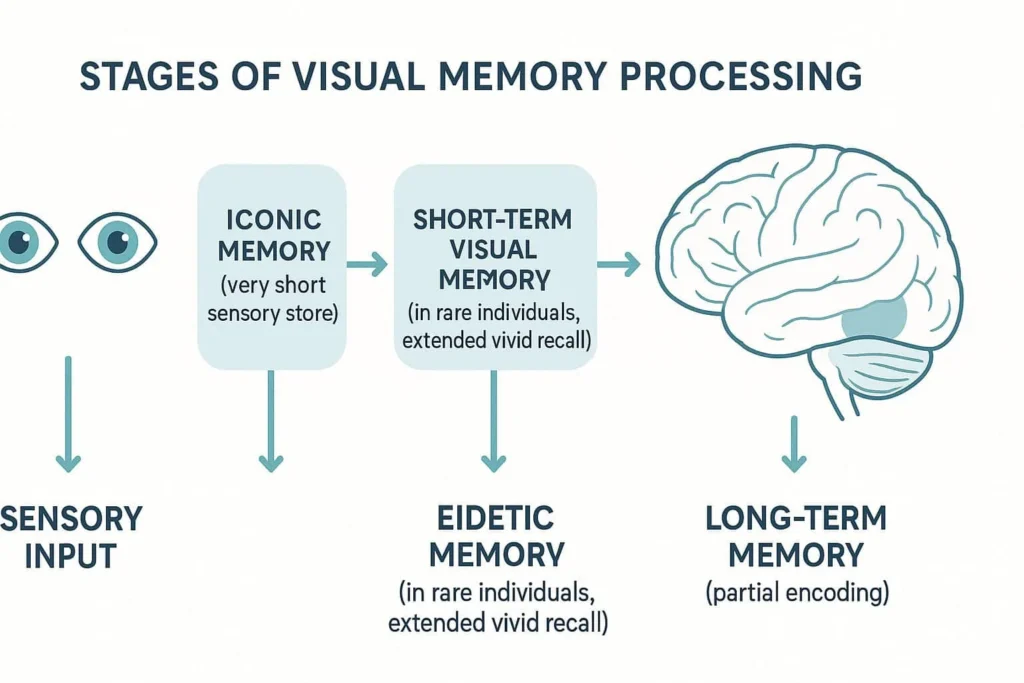
Visual Memory’s Three Layers
Visual memory isn’t monolithic. The Chimp Test targets only the first transition point:
1. Iconic Memory (<500 ms)
The initial sensory buffer. Chimps like Ayumu excel at extracting spatial data from this fleeting window before it fades.
2. Visual Working Memory (Seconds)
Brief mental holding of visual data. The test measures how much spatial information survives the iconic→working transition under time pressure.
3. Long-Term Visual Memory (Days/Years)
Consolidated visual knowledge. Not tested at all in the Chimp Task.
Why Young Chimps Excel at This Specific Task
Ayumu’s advantage stems from three optimized systems working in concert:
1. Faster Sensory Gating
Chimp visual systems may process raw spatial data more directly, with less “symbolic conversion” overhead than humans.
2. Specialized Neural Pathways
Research suggests chimpanzees possess enhanced dorsal stream processing for rapid spatial localization—an evolutionary adaptation for arboreal navigation and threat detection.
3. Intensive Task-Specific Training
Laboratory chimps receive thousands of trials, developing highly specialized—not general—skills. As noted in our analysis of the chimpanzee memory experiment, this training effect is substantial.
The Human “Disadvantage” Is Actually a Cognitive Trade-Off
Humans typically convert “5” from a spatial position into a symbolic concept (“five”), then back to spatial for tapping. This symbolic processing, while slower under 210 ms, enables our unique cognitive strengths:
The Symbolic Conversion Cost
Human brains automatically extract meaning—we can’t help but read numbers as symbols. This adds milliseconds that prove decisive in the Chimp Test but are irrelevant (or beneficial) in real-world memory tasks.
Evolutionary Trade-Off Theory
Researchers hypothesize that as humans evolved language and complex symbolic thought, we may have partially “traded” raw visual snapshot speed for flexible, meaning-based cognition. This explains why humans outperform chimps on virtually all memory tasks involving strategy, meaning, or delayed recall.
Performance Curve Under Varying Display Times
Conceptual Graph:
X-axis: Display Time (ms) [100 → 1000]
Y-axis: Accuracy (% (correct)(correct)
Chimp Curve: High accuracy even at 200 ms,(correct)200 ms, plateaus quickly
Human Curve: Lower at ms,200 ms,ms, rises steeply, matches/exceeds chimps by msms,ms
Key Insight: The “chimp advantage” exists only below ~400 msms display time.
What the Results Actually Prove
The Chimp Test demonstrates task-specific superiority, not general cognitive supremacy.
Myth
- “Chimps have photographic memory…”memory.”
- “Humans have worse visual memory.” “
- “The test measures intelligence.”
- “Practice can’t close the gap.”
Reality
- They have a strong, brief snapshot ability that fades normally
- Humans excel at meaning-based, strategic visual memory
- It measures one specific visual-spatial parameter
- Humans improve significantly with strategy training
Chimp Test vs Real-World Visual Memory
Practical visual memory—recognizing faces, navigating cities, reading—relies on completely different systems:
Everyday Visual Memory Uses:
- Meaning integration (That’s my friend’s face → name → memories)
- Long-term consolidation (Your route to work)
- Strategic chunking (Reading words, not individual letters)
None of these are measured by the Chimp Test. For broader visual memory discussions, see our comparison of pattern memory vs. visual memory.
Can Humans Improve? The Training Reality
Yes, but with important caveats:
Effective Strategies:
- Reduce verbal labeling (Train yourself to see positions, not numbers)
- Develop spatial chunking (Group positions into patterns)
- Gradual exposure reduction (Systematically decrease display time)
The Hard Limit:
At the shortest display times (~210 ms), even trained humans may not match Ayumu-level performance due to fundamental processing differences.
Training vs Natural Ability
As with many cognitive tasks, initial aptitude varies, but strategic improvement is possible. This parallels findings in working memory vs. short-term memory research.
Key Limitations & Scientific Context
- Device variability: affects online test scores (screen refresh rates, input lag)
- Laboratory vs wild differences: (Ayumu is extensively trained)
- Age effects: Young chimps outperform adults; similar patterns may exist in humans
- Not diagnostic of individual ability or intelligence
Learn more: For the foundational concepts behind this test.
Experience the Cognitive Difference
To directly experience the cognitive trade-offs discussed here, try our interactive test.
Frequently Asked Questions
What kind of memory does the Chimp Test measure?
Do chimps have photographic memory?
What is a good Chimp Test score for humans?
Can humans ever match Ayumu’s performance?

Touheed Ali
Touheed Ali is the founder and editor of MemoryRush, an educational cognitive science platform. He builds and maintains interactive tools focused on memory, attention, and reaction time.
His work centers on translating established cognitive science concepts into clear, accessible learning experiences, with an emphasis on transparency and responsible design.
MemoryRush
Educational Cognitive Science Platform • Memory • Attention • Reaction Time
Educational Use Only
MemoryRush is created for learning and self-exploration and does not provide medical, psychological, or clinical evaluation.
3 thoughts on “Chimp Test vs Visual Memory: What It Really Proves”
Comments are closed.