
Why Some People Are Better at Pattern Recognition
Quick Answer:
Pattern recognition ability varies because of differences in core cognitive systems: the control of attention, the capacity of working memory, the speed of visual processing, and the depth of prior experience. These factors determine how efficiently the brain detects features, matches them to stored templates, and predicts structure. Individual neurocognitive profiles and domain-specific expertise further shape this capacity.
This page covers:
- The four core cognitive drivers behind pattern recognition skill.
- How the brain builds and uses “templates” to identify patterns faster.
- The link between neurodivergence, expertise, and specific pattern-recognition strengths.
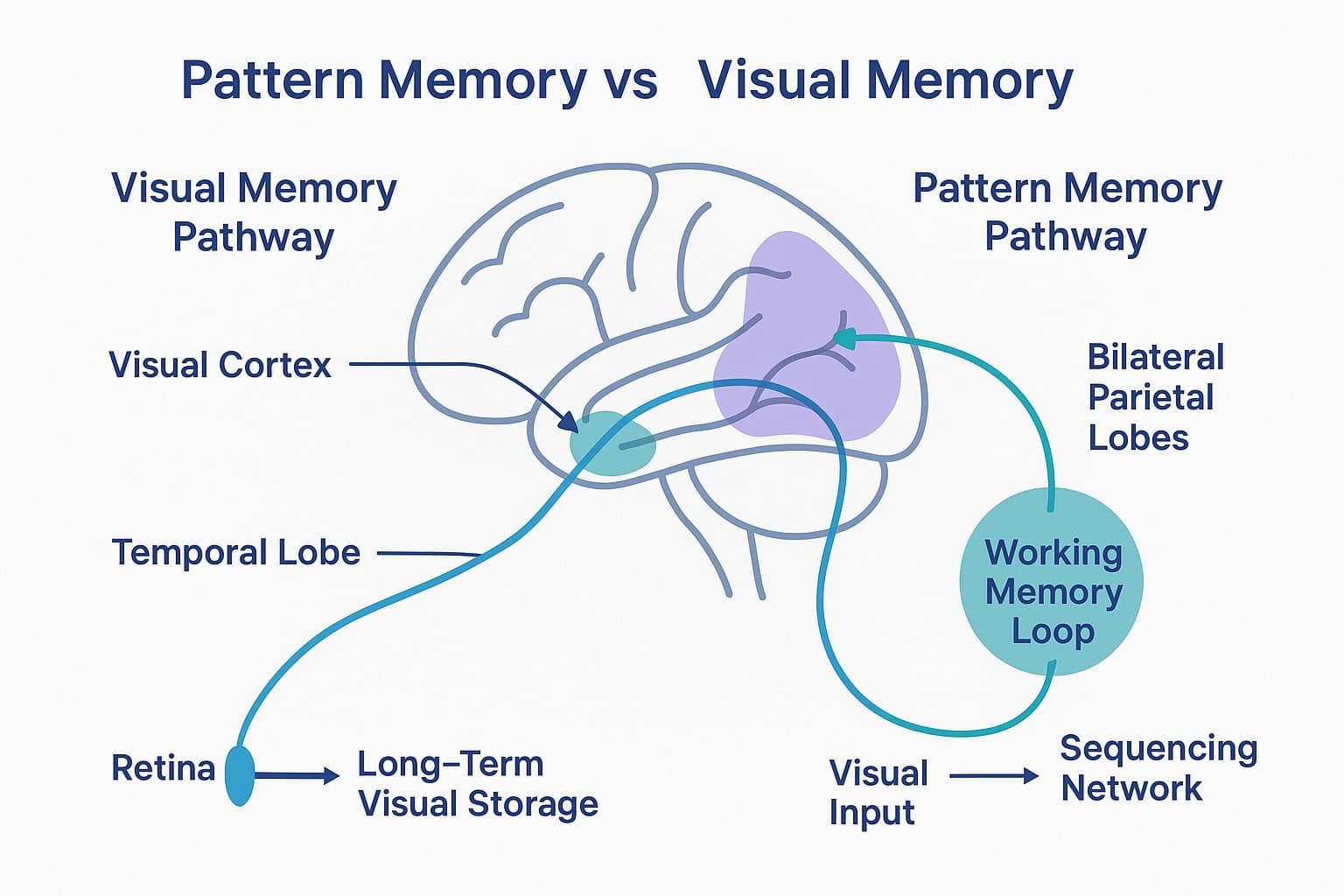
Pattern recognition isn’t a single skill but the output of several interacting cognitive systems. Strength in any of these areas confers an advantage.
1. Attentional Control: Filtering Signal from Noise
This is the brain’s ability to focus on relevant features while suppressing distractions. Strong attentional control allows someone to isolate the key elements of a pattern (e.g., the repeating sequence in a number string) without being derailed by irrelevant details.
2. Working Memory Capacity: Holding the Pieces
Working memory is your mental workspace. A larger capacity lets you hold more pattern elements (digits, shapes, and concepts) simultaneously for comparison, making it easier to spot relationships and sequences. This is directly measurable with tools like our Number Memory Test.
3. Perceptual & Processing Speed
This is the raw speed at which your visual and cognitive systems encode and manipulate information. Faster processing allows for more comparisons per second, leading to quicker pattern identification, crucial in time-sensitive contexts.
4. Prior Experience & Template Library
The brain learns patterns and stores them as “templates.” Extensive experience in a domain (e.g., chess, coding, music) builds a rich library of templates, allowing for near-instant recognition—what we call expertise.
Cognitive Drivers Framework
| Driver | What It Optimizes | Real-World Manifestation | Common Limitation |
|---|---|---|---|
| Attentional Control | Signal-to-Noise Ratio | Spotting a trend in a noisy chart; ignoring visual clutter. | Distractibility in high-noise environments. |
| Working Memory | Mental Comparison Scope | Remembering the beginning of a sequence to compare it to the end. | Losing earlier elements before the pattern completes. |
| Processing Speed | Iterations Per Second | Beating a reaction-time game; rapid visual scanning. | Time-pressure errors. |
| Experience (Templates) | Matching Efficiency | A chess master instantly recognizing a board position. | Domain-specific; doesn’t transfer directly. |

Recognition follows a cognitive cycle: Encode → Compare → Predict.
The Encoding Step: Feature Extraction
The brain first breaks down input into basic features (lines, angles, sounds, quantities). The quality of this encoding sets the stage for everything that follows.
Comparison to Stored Templates
These features are matched against a vast library of stored patterns from past experience. A strong match triggers recognition. This process is studied in experiments like the Chimpanzee Memory Experiment, which highlights template-based recall.
Prediction and Confirmation
Once a potential match is found, the brain predicts what should come next. If the prediction is confirmed, the pattern is “locked in” and the template is reinforced.
Why Neurodivergence Can Lead to Specific Strengths
Some neurocognitive profiles are associated with atypical pattern processing. It’s critical to note these are non-universal, non-diagnostic tendencies.
ADHD and Broad-Spectrum Scanning
Some individuals with ADHD traits may exhibit low latent inhibition, taking in more environmental details. This can lead to spotting unconventional connections but may also increase cognitive load. For more on working memory constraints, see our note on ADHD and working memory limits.
Autism and Systemizing
A strong drive to systemize can enhance the detection of rule-based, predictable patterns in systems (e.g., math, code, schedules), while possibly making flexible, social pattern recognition more demanding.
The Expert Advantage: Why Practice Looks Like Talent
Deep, deliberate practice in a field doesn’t just add knowledge—it physically alters neural pathways, creating highly efficient, specialized templates. A musician hears chord progressions; a programmer sees code structures. This is domain-specific pattern recognition honed by repetition.

High ability in one area can introduce specific error patterns.
Overfitting: Seeing Patterns That Aren’t There
A rich template library and a strong predictive drive can lead to apophenia—perceiving meaningful connections in random noise (e.g., in gambling, stock charts).
Confirmation Bias and Rigid Templates
Once a pattern template is activated, there’s a tendency to seek confirming evidence and ignore disconfirming data, cementing a potentially incorrect interpretation.
Key Limitations of This Discussion
- Device Variability: Online test scores (e.g., reaction time) are influenced by hardware, software, and input lag.
- State-Dependent: Fatigue, stress, and motivation cause significant intra-individual variability.
- Not Diagnostic: These are explanations of general cognitive mechanics, not assessments of any individual’s neurology or intelligence.
Learn More: To understand the foundational concepts, visit our page on what pattern memory is.
Apply This Understanding
To see these cognitive drivers in action and measure aspects of your own pattern processing, try our interactive test.

3 thoughts on “Why Some People Are Better at Pattern Recognition”
Comments are closed.