
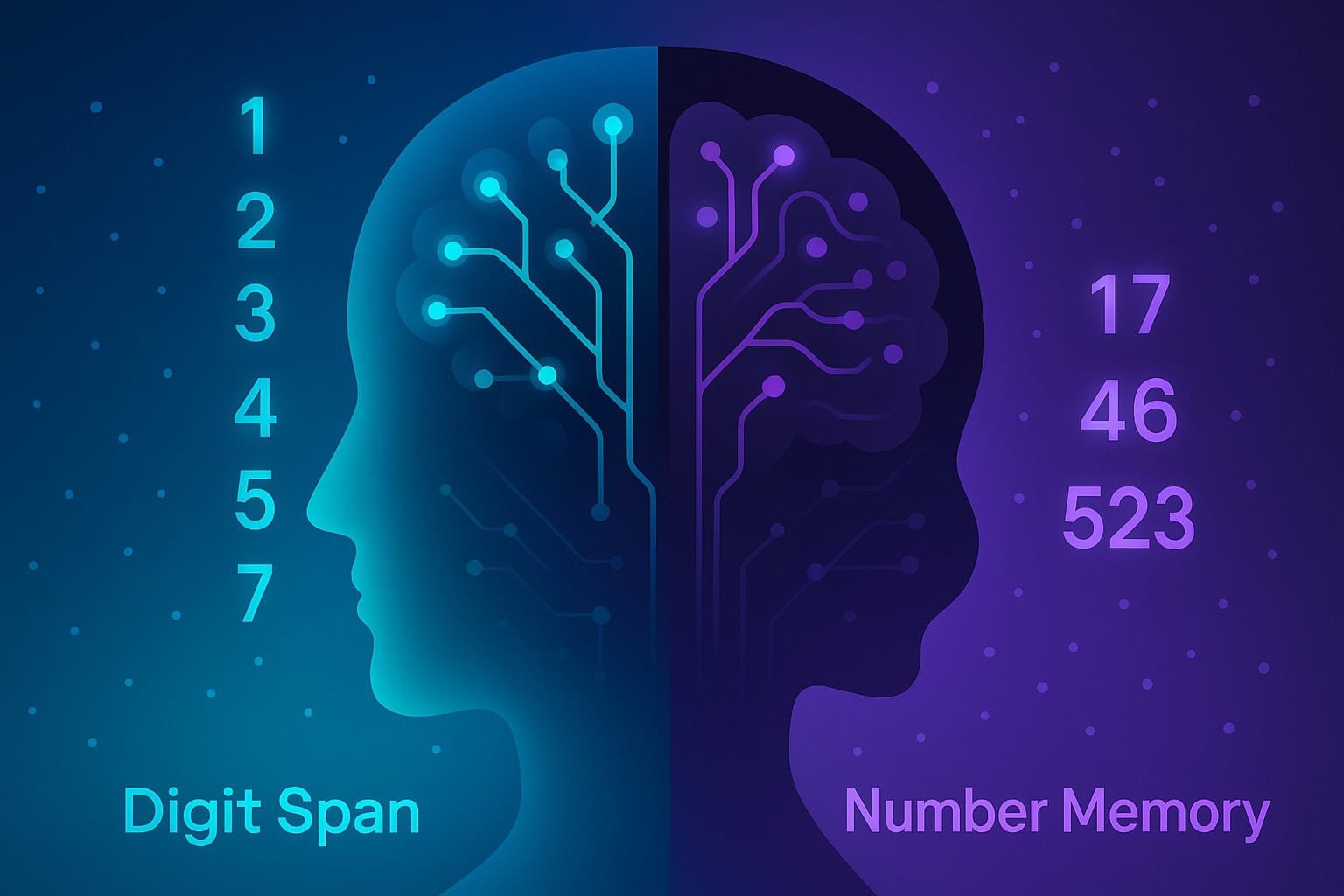
Digit Span vs Number Memory
Quick Answer:
Digit span is a standardized test format used to measure short-term and working memory capacity through immediate recall of digit sequences. Number memory is a broader skill related to remembering numeric sequences in real life and can involve strategies, repetition, and long-term storage. They look similar but rely on different goals and memory systems.
Both involve remembering numbers, but they answer completely different questions about your mind. One is a clinical snapshot of your working memory’s raw capacity. The other is a practical skill you use daily for phone numbers, PINs, and codes.
This page clarifies the difference and helps you interpret results. It explains the “Capacity vs. Skill” model, provides a decision tree for your goals, and explains why test scores can seem contradictory. This is not a training guide or benchmark report—it’s your guide to understanding these two related but distinct concepts.
What Is Digit Span?
Digit span is a specific cognitive test, often part of standardized assessments like the WAIS (Wechsler Adult Intelligence Scale). Its goal is to measure the capacity of your working memory.
- Forward Digit Span: Repeat digits in the order presented. Measures basic storage and attention.
- Backward Digit Span: Repeat digits in reverse order. Adds a layer of mental manipulation, taxing executive function more heavily.
The key is immediate recall under controlled conditions, typically minimizing the use of strategies.
What Is Number Memory?
Number memory is the broader, everyday ability to retain numeric information. It’s the skill you use to remember a phone number, an OTP code, or a locker combination.
- It can span from seconds to days or longer.
- It often benefits from strategies like chunking, repetition, or creating meaningful associations.
- It’s less about raw capacity and more about effective encoding and retrieval over time.
For a deeper dive into this skill, see our parent page: What Is Number Memory?
The Core Difference: Capacity vs. Skill
This model is the key to cutting through the confusion. Here’s how they compare at a fundamental level:
| Feature | Digit Span | Number Memory |
|---|---|---|
| Primary Goal | Measure working memory capacity | Remember numeric sequences for practical use |
| Time Window | Seconds (immediate recall) | Longer (minutes → days+) |
| Allowed Strategies | Typically minimized or controlled | Often encouraged or naturally used |
| What It Values | Raw holding power & manipulation | Encoding effectiveness & retrieval accuracy |
| What Breaks It | Attention drop, cognitive load | Poor encoding, lack of meaning/repetition |
| Best Use Case | Cognitive assessment & research | Everyday life & practical tasks |

What Each One Actually Measures
What Digit Span Measures
- Immediate Holding Capacity: The “size” of your mental workspace for numbers.
- Attention Stability: Your ability to focus on the sequence without distraction.
- Working Memory Manipulation (Backward Span): Your brain’s ability to not just store but actively reorder information—a key executive function.
What Number Memory Reflects
- Longer-Term Retention: Ability to move digits from short-term to longer-term storage.
- Encoding Strategy: How effectively you use techniques like chunking or visualization.
- Recall Consistency: Reliability of retrieving the sequence after a delay or distraction.
Which One Matters for You? A Decision Tree
Start: What’s your main focus?
→ Are you taking a formal cognitive assessment or studying working memory?
You need to understand digit span. It’s about your baseline cognitive capacity.
→ Are you trying to remember phone numbers, codes, or IDs in daily life?
You’re working on Number Memory. It’s about building a practical skill.
Next: Are you confused by test results?
→ Is your digit span score high, but you forget numbers easily in real life?
This is common. It suggests strong raw capacity but underdeveloped encoding strategies for long-term retention.
→ Can you remember long numbers with tricks but score average on digit span?
This shows strong skill application (using strategies) that bypasses raw capacity limits measured by strict tests.
Why Someone Can Be Good at One and Not the Other
This explains the frustration you might see in forums. It’s not an error—it’s the system working as designed.
- High Digit Span, Poor Real-World Recall: This person has a great “mental whiteboard” (working memory) but doesn’t know how to “take a picture” of what’s on it (encode to long-term memory).
- Lower Digit Span, Strong Number Memory: This person might have a smaller immediate capacity but is excellent at using mnemonic strategies, repetition, or chunking to work around that limit for practical purposes.
The former is like having a large, empty warehouse. The latter is like being an expert at packing a small van very efficiently.

How Each Is Commonly Measured
Digit Span Tasks: Typically administered in quiet settings. Sequences start short (e.g., 3 digits) and increase by one digit after each correct trial. You must repeat them exactly, forward or backward, immediately after hearing/seeing them.
Number Memory Tests: Often found online (like our Number Memory Test). They may allow more viewing time, use visual presentation, and track how many digits you can recall in order across multiple trials. They often blend capacity with the application of simple strategies.
What This Page Does NOT Cover
To maintain clear focus and guide you to the right information:
- How to improve your digit span or number memory: → See our dedicated training and techniques guide
- What is a good digit span or number memory score? → Refer to our score interpretation guide
- Detailed benchmarks or norms by age → Covered in specialized clinical resources
- Deep dives into mnemonic systems like the Major Method → See our advanced techniques page
- The neuroscience of working memory → Explore our page on working memory vs. short-term memory
Quick Comparison Answers
Is digit span the same as number memory?
No. Digit span is a specific test of working memory capacity. Number memory is the broader cognitive skill of remembering number sequences, which digit span attempts to measure one part of.
Is backward digit span a test of working memory?
Yes, especially. While forward span tests simple storage, backward span requires manipulation of the information (reversing it), which is a core function of working memory.
Why do I mix digits up (like 58 becoming 85)?
This is often an ordering error, common in digit span tasks when capacity is strained. In number memory, it might happen if you encode the digits as a whole (“fifty-eight”) but recall the components in the wrong sequence.
Can using memory strategies “cheat” a digit span test?
Most standardized tests are designed to minimize strategy use for a pure capacity measure. However, in real-world number memory, strategies aren’t cheating—they’re the essence of the skill.

This page serves as a bridge, connecting the clinical concept of digit span with the everyday skill of number memory.

3 thoughts on “Digit Span vs Number Memory: Full Comparison & Brain Science”
Comments are closed.