

Pattern Recognition Speed vs Accuracy: The Complete SAT Framework
Introduction: Why Speed vs Accuracy Defines Pattern Recognition
Pattern recognition sits quietly behind almost every intelligent action—whether a human identifies a face in a crowd or an AI detects a pedestrian in three milliseconds. Yet beneath this seemingly effortless process lies a fundamental tension: the faster we try to recognize a pattern, the more accuracy we tend to lose, and the more accuracy we demand, the slower our recognition becomes.
This tension is known as the Speed–Accuracy Trade-Off (SAT), one of the most deeply studied principles in cognitive psychology, neuroscience, and modern machine learning. SAT governs how the brain balances rapid intuition with careful evaluation, and how AI engineers design models that can respond instantly without misclassifying the world.
What makes this topic fascinating—and why it matters for both humans and AI—is that speed and accuracy are not enemies. They are levers. They shift depending on context, cognitive load, real-world constraints, and computational resources.
Understanding how SAT works allows you to enhance human performance, train yourself to think faster under pressure, design better AI systems, and understand why some people (and algorithms) excel in rapid pattern environments while others thrive in meticulous, slow analysis.
In short: mastering SAT means mastering intelligence under constraints.
What the Speed–Accuracy Trade-Off Really Is
The speed–accuracy trade-off is often oversimplified: people say “go slow to avoid mistakes” or “act fast when needed.” But SAT is a quantifiable cognitive and computational law that describes how decision systems—biological or artificial—must allocate limited resources.
The Core Mechanism
Every decision has a threshold — a point at which the system says “I have enough information to choose.”
- Lower the threshold → faster, riskier decisions
-
Raise the threshold → slower, more accurate decisions
The Universal Constraint
Humans adjust this threshold instinctively. AI adjusts it mathematically. But the rule remains the same. Whether in biological neurons or artificial neural networks, finite resources create inevitable trade-offs.
The SAT Curve: Mathematical Foundation
The relationship between speed and accuracy isn’t linear—it’s logarithmic, meaning that initial increases in reaction time produce dramatic accuracy gains, but eventually reach diminishing returns.
The SAT Curve Characteristics
Fast Zone
- High speed, low accuracy
-
Threshold: Very low
Optimal Zone
- Balanced performance
-
Maximized efficiency
Accurate Zone
- High accuracy, low speed
-
Threshold: Very high
This curve appears in: visual recognition experiments, memory recall tests, object detection algorithms, speech recognition systems, and decision-making tasks under pressure.
The Three SAT Operating Modes
Speed Priority (Low Threshold Operation)
- System fires quickly with minimal evidence
- Higher false positive rate
- Used in emergencies, sports, rapid detection
- Human equivalent: System 1 thinking
Accuracy Priority (High Threshold Operation)
- Waits for clearer evidence
- Lower error rates
- Used in medical, safety, financial decisions
- Human equivalent: System 2 thinking
Expert Mode (Optimized Balance)
- Pattern chunking reduces cognitive load
- Both speed and accuracy enhanced
- Neural efficiency through practice
- Shifts the SAT curve upward
Human Pattern Recognition Under Time Pressure
System 1: Fast & Intuitive
Characteristics:
- Rapid pattern matching
- Relies on heuristics
- Minimal energy consumption
- Excellent for familiar patterns
- Poor with ambiguity
SAT Profile: Low threshold, high speed, variable accuracy
System 2: Slow & Analytical
Characteristics:
- Careful evidence accumulation
- Logical reasoning
- High cognitive load
- Great for novel/complex problems
- Too slow for emergencies
SAT Profile: High threshold, high accuracy, lower speed
The Neuroscience Behind Recognition Under Pressure
1. Reduced Evidence Accumulation
The prefrontal cortex gathers less detailed information before making a decision under time pressure, leading to higher error rates and faster responses.
2. Pattern Template Reliance
The brain falls back on memory-generated “templates” or chunks, which are fast but can misfire when applied to novel situations or ambiguous patterns.
3. Stress Hormone Effects
Cortisol and adrenaline shift the brain toward fast evaluation modes, lowering decision thresholds and prioritizing speed over careful analysis.
4. Neural Efficiency in Experts
Experts show reduced brain activation because patterns are stored in compressed form, allowing both faster and more accurate recognition through optimized neural pathways.
How Cognitive Load Shapes Speed & Accuracy
Cognitive load—the amount of mental effort being used—affects SAT dramatically. When working memory gets saturated, both speed and accuracy suffer, but accuracy collapses first.
High Cognitive Load
- Working memory saturated
- Attention fragmented
- Pattern matching becomes noisy
- Result: Slower + Less Accurate
Low Cognitive Load
- More capacity for evidence processing
- Better focus
- More reliable recognition templates
- Result: Faster + More Accurate
This is why multitasking destroys pattern recognition accuracy, and why tasks involving deep focus (like coding, problem-solving, gaming) depend heavily on managing cognitive load.
Expertise: Breaking the SAT Barrier
Experts often seem to violate SAT—performing tasks both quickly and accurately. This isn’t magic; it’s the result of cognitive restructuring.
Expert vs Novice Pattern Recognition
| Aspect | Novice | Expert |
|---|---|---|
| Pattern Storage | Individual elements | Compressed chunks |
| Processing Speed | Slow, deliberate | Fast, automatic |
| Accuracy | Variable, error-prone | Consistent, reliable |
| Cognitive Load | High mental effort | Low mental effort |
| Neural Activation | Widespread, inefficient | Focused, efficient |
ADHD & Pattern Recognition: Unique SAT Profile
ADHD introduces distinctive variations in SAT performance that are often misunderstood as deficits rather than different operating modes.
Strengths
- Hyper-fast pattern detection
- Strong intuitive leaps
- Rapid anomaly recognition
- Enhanced divergent thinking
- High creativity under stimulation
- Excellent at connecting disparate patterns
Challenges
- Variable accuracy under low stimulation
- Impulsive threshold lowering
- Difficulty sustaining analytical focus
- Higher sensitivity to noise
- Reduced working memory stability
- Inconsistent performance across contexts
Key Insight: ADHD doesn’t mean “bad pattern recognition.” It means non-linear pattern recognition performance—brilliant in certain contexts, inconsistent in others.
Emotional State: The SAT Modifier
Stress & Anxiety
Activates amygdala, triggering speed-first processing. Suppresses prefrontal cortex evaluation. Result: Faster decisions, lower accuracy, higher false positives.
Confidence & Calm
Supports balanced SAT control. Reduces hesitation while maintaining evidence accumulation. Result: Optimal speed-accuracy balance.
Fear of Mistakes
Creates paralyzing accuracy bias. Raises thresholds too high. Result: Decision paralysis, slow responses, cognitive exhaustion.
How Humans Misrecognize Patterns
False Positive: Recognizing What Isn’t There
- Caused by low thresholds
- Triggered under speed pressure
- Common in noisy environments
- Dominant in anxiety-driven states
- Example: Seeing faces in clouds
False Negative: Missing What Is There
- Caused by high thresholds
- Common in fatigue or overload
- Frequent in perfectionism
- Example: Missing typos in own writing
Template Misapplication: Wrong Pattern Match
- Brain applies wrong template
- Common in chess miscalculations
- Frequent in misreading expressions
- Example: Diagnosing common cold as serious illness
AI Pattern Recognition: The Computational SAT
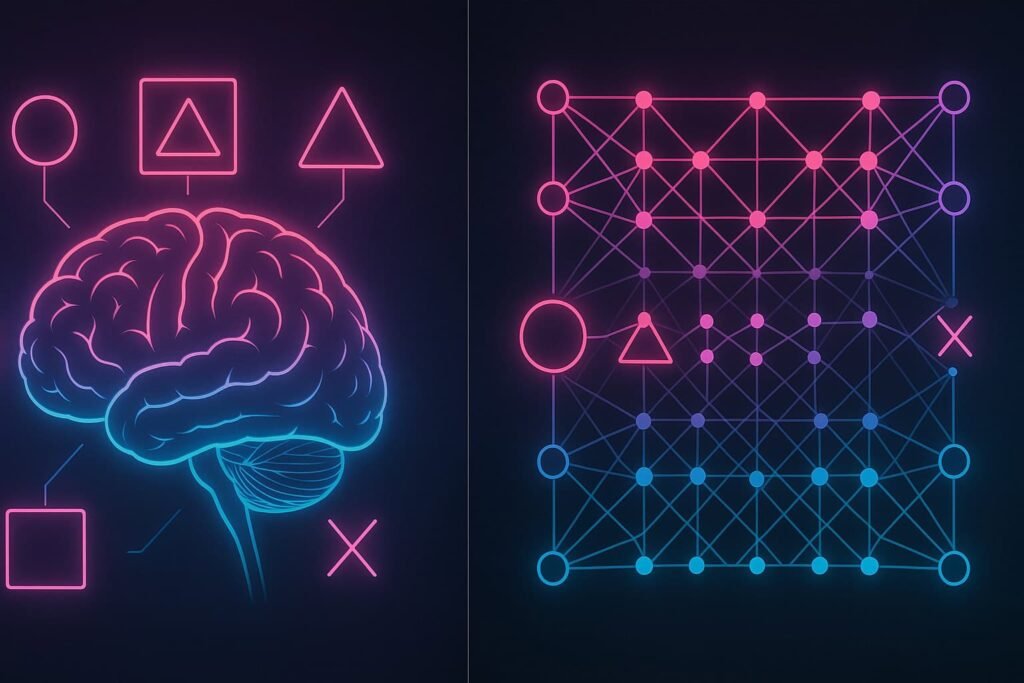
AI systems recognize patterns using mathematical models that face the same fundamental constraints as human cognition, just through different mechanisms.
AI Model Categories by SAT Focus
| Category | Speed Focused | Accuracy Focused | Balanced |
|---|---|---|---|
| Examples | MobileNet, YOLO-Nano | Transformers, ResNet-152 | EfficientNet, BERT-base |
| Architecture | Lightweight, shallow | Deep, complex | Optimized depth |
| Accuracy | Moderate | Very High | High |
| Speed | Very Fast | Slow | Fast |
| Use Cases | Real-time detection | Medical imaging | General applications |
How AI Balances Speed & Accuracy
1. Model Pruning
Remove unnecessary weights and neurons to reduce computation. Result: 20–70% faster inference with minimal accuracy loss.
2. Quantization
Convert weights from 32-bit → 16-bit → 8-bit (or even 4-bit). Result: Massively reduced latency with slightly lower precision.
3. Knowledge Distillation
Large model trains a smaller one to mimic its behavior. Result: Small, fast model retains 90–95% of original accuracy.
4. Neural Architecture Search
Automated search finds optimal architectures. Result: Custom designs that push SAT boundaries for specific tasks.
How to Improve Both Speed & Accuracy
A. Speed Training
Timed pattern drills, threshold adjustment exercises, focused attention cycles (Pomodoro method). Trains intuitive speed and rapid threshold calibration.
B. Accuracy Training
Slow, deliberate pattern analysis, error logging & correction, comparative pattern evaluation. Strengthens fine-detail recognition and discrimination.
C. Chunking Practice
Break complex patterns into meaningful, reusable units. Builds expert-level recognition templates that bypass slow analytical processing.
D. Alternating Cycles
Practice 30 seconds fast recognition → 30 seconds slow evaluation. Trains switching between System 1 and System 2 processing modes.
Edge vs Cloud: Strategic SAT Architecture
Edge Processing (Speed)
- Instant inference
- Low latency (<50ms)
- Limited accuracy ceiling
- Small models only
- Works offline
- Use: Wake-word detection, real-time AR
Cloud Processing (Accuracy)
- High accuracy
- Large model capability
- Significant latency
- Requires connectivity
- Expensive at scale
- Use: Medical diagnosis, complex analysis
Hybrid Approach: Edge makes quick detection → Cloud verifies accuracy when needed. This mirrors human intuition-first, analysis-second processing.
Real-World SAT Applications
Chess: Blitz vs Classical
Blitz chess (3-minute games) prioritizes speed with pattern intuition. Classical chess (hours) emphasizes accuracy with deep calculation. Grandmasters excel at both by mastering SAT switching.
Autonomous Vehicles
Must process within 10-40ms latency budget. Uses hybrid models: fast edge detection for immediate response, accurate cloud verification for safety decisions.
Voice Assistants
Tiny wake-word models (<50ms response) catch “Hey Siri.” Larger speech-to-text models handle accuracy. Two-tier SAT architecture for optimal user experience.
Medical Diagnosis
Rapid triage (speed) identifies urgent cases. Detailed analysis (accuracy) confirms diagnoses. Doctors train to balance speed in emergencies with accuracy in complex cases.
Frequently Asked Questions
Can humans improve both speed and accuracy simultaneously?
Yes, through targeted training like chunking, repeated exposure, and mixed-mode practice, the SAT curve shifts upward, allowing gains in both dimensions. Experts demonstrate this through compressed pattern recognition and efficient neural pathways that optimize both speed and accuracy simultaneously.Why does accuracy drop under time pressure?
The brain lowers its decision threshold, collecting less evidence before acting to meet time constraints. This increases false positives and rushed decisions as the system prioritizes completion over perfection in pattern matching, effectively trading accuracy for speed.How do AI models choose between speed and accuracy?
Through architecture design decisions like model size, quantization levels, threshold settings, and optimization techniques that balance computational cost with precision requirements based on application needs and resource constraints. Engineers select specific tradeoffs for each use case.Which AI model is best for balancing both speed and accuracy?
Models like EfficientNet, YOLO-medium variants, BERT-base, and Whisper-medium are specifically designed for balanced SAT performance, offering reasonable latency while maintaining strong accuracy for real-world applications that require both responsiveness and precision.Do emotions really affect pattern recognition performance?
Yes, significantly. Stress lowers accuracy by pushing the brain into fast, intuitive modes, while confidence supports balanced SAT control. Emotional state directly influences decision thresholds and evidence accumulation processes, modifying how patterns are recognized.Is ADHD associated with stronger pattern recognition?
Often yes—ADHD individuals can show fast anomaly detection, rapid intuition, and creative pattern linking, though accuracy may fluctuate with cognitive load. Their performance is typically non-linear and context-dependent, excelling in high-stimulation environments.What’s the main difference between human and AI SAT management?
Humans adjust thresholds psychologically through experience and emotion, while AI uses mathematical parameters. Both face resource constraints, but humans excel at contextual adaptation while AI excels at consistent large-scale processing across identical tasks.Can SAT be eliminated entirely in future systems?
No, SAT is a fundamental constraint of any decision system operating with finite resources. Future improvements will push the curve upward but not eliminate it, as perfect instant recognition would require infinite computational power or processing time.How does expertise change the SAT equation?
Expertise shifts the entire SAT curve upward through chunking and neural efficiency. Experts maintain higher accuracy at faster speeds because they recognize compressed patterns rather than analyzing individual elements, effectively rewriting their cognitive constraints.Why do AI and humans follow the same SAT rules?
Because both systems operate under finite computational resources—whether biological neurons or artificial processors. Any system that must make decisions with limited time or energy inevitably faces the speed-accuracy tradeoff as a fundamental constraint of intelligence.Scientific References & Additional Resources
-
Wickelgren, W. (1977). Speed–accuracy tradeoff and information processing. Journal of Mathematical Psychology. https://doi.org/10.1016/0022-2496(77)90002-9
-
Subramanian, A. et al. (2025). Benchmarking the speed–accuracy tradeoff in object recognition. Journal of Vision. https://doi.org/10.1167/jov.25.1.1
-
Benjamin, A. S., et al. (2009). Time pressure reduces recognition accuracy. Memory & Cognition. https://doi.org/10.3758/MC.37.1.52
-
Redmon, J., & Farhadi, A. (2018). YOLOv3: An Incremental Improvement. arXiv. https://arxiv.org/abs/1804.02767
-
He, K., et al. (2016). Deep Residual Learning (ResNet). CVPR. https://arxiv.org/abs/1512.03385
-
Hinton, G., et al. (2015). Distilling the Knowledge in a Neural Network. arXiv. https://arxiv.org/abs/1503.02531
-
Vaswani, A., et al. (2017). Attention Is All You Need. NeurIPS. https://arxiv.org/abs/1706.03762
-
Ericsson, K. A. (2018). Expertise and chunking in pattern recognition. Cambridge Handbook of Expertise. https://doi.org/10.1017/9781316480748.007
-
O’Reilly, R. C. (2006). Computational principles of working memory. Scholarpedia. http://www.scholarpedia.org/article/Working_memory
Final Conclusion: SAT as Intelligence Design Principle
The speed–accuracy trade-off is not a limitation—it is a design principle of intelligence. Whether in humans or artificial systems, performance depends on strategically managing time, computational resources, and decision thresholds.
Humans excel at compressed, context-rich pattern recognition through flexible threshold adjustment and emotional intelligence. AI excels at massive-scale, high-volume consistent detection through mathematical optimization and parallel processing. But both follow the same mathematical and cognitive constraints.
Mastering SAT—through training, architecture design, or hybrid human–AI collaboration—creates systems that are not only fast or accurate, but optimally intelligent under real-world conditions. This closes the loop: To understand pattern recognition, you must understand SAT. To improve pattern recognition, you must strategically manipulate SAT. And to build the future of intelligent systems, you must embrace SAT as the operating law of cognition itself.


Master Your Pattern Recognition Skills
Apply the neuroscience of pattern ranking with our specialized tools and guides. Test your abilities, understand the science, and improve your cognitive performance.
Interactive Pattern Test
Challenge your brain's pattern ranking system in real-time with scientifically designed memory tests.
Take the TestComplete Pattern Guide
Understand pattern memory fundamentals and how it differs from visual memory processing.
Read GuideTraining & Improvement
Practical strategies to enhance your pattern recognition speed, accuracy, and overall ability.
Train NowDive deeper into pattern recognition science with our comprehensive resource library:

Touheed Ali
Touheed Ali is the founder and editor of MemoryRush, an educational cognitive science platform. He builds and maintains interactive tools focused on memory, attention, and reaction time.
His work centers on translating established cognitive science concepts into clear, accessible learning experiences, with an emphasis on transparency and responsible design.
MemoryRush
Educational Cognitive Science Platform • Memory • Attention • Reaction Time
Educational Use Only
MemoryRush is created for learning and self-exploration and does not provide medical, psychological, or clinical evaluation.
3 thoughts on “Pattern Recognition Speed vs Accuracy: The Full SAT Framework”
Comments are closed.