

What Is the Chimp Test?

What Is the Chimp Test?

Quick Answer Content:
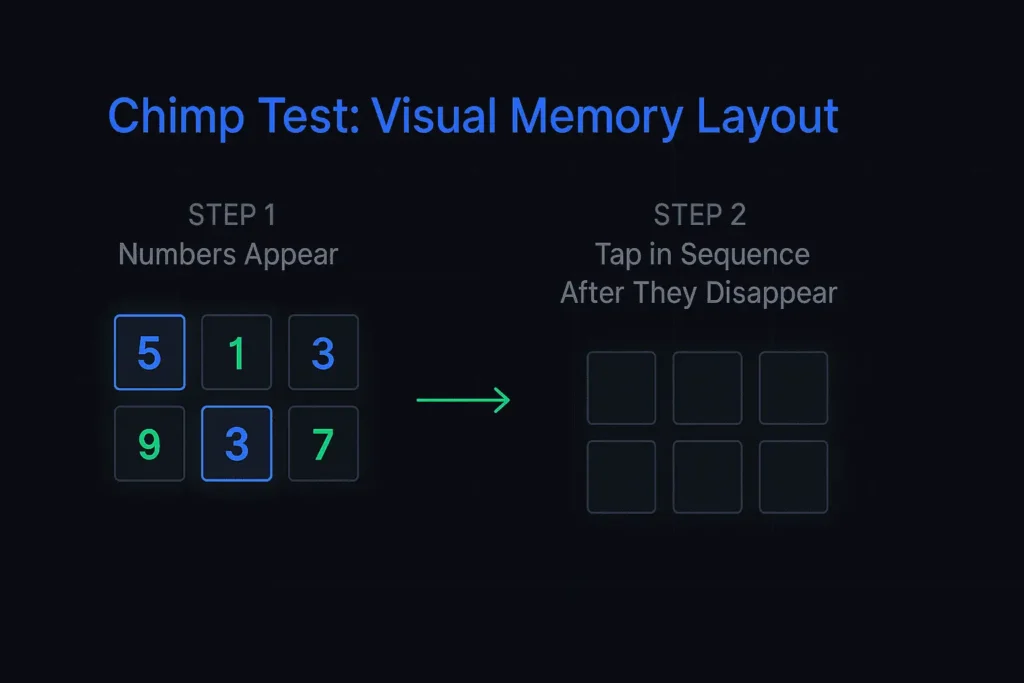
The Chimp Test is a short-term visual working memory task where numbered tiles briefly appear on screen and then disappear. Your goal is to tap the hidden tiles in ascending numerical order. It primarily measures how quickly and accurately you can encode and recall spatial locations under time pressure.

This Page Covers:

  • Exactly what cognitive ability the Chimp Test measures

  • The step-by-step mechanics of how the test works

  • Scientific origins and common misconceptions clarified

  • How to interpret results without training advice

This Page Does NOT Cover:

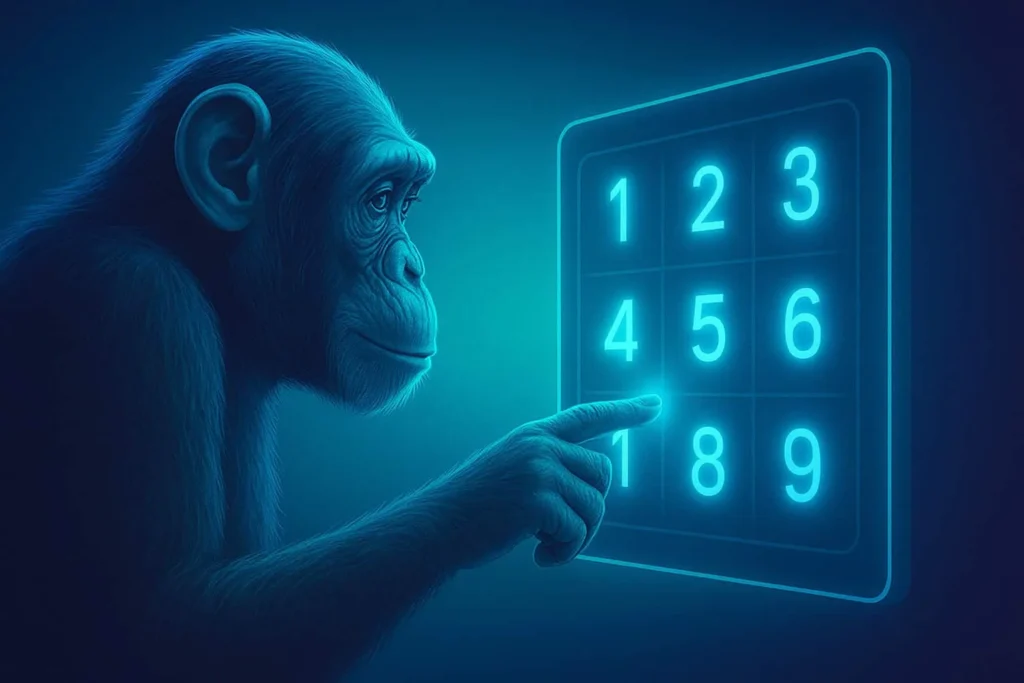
Visual representation of spatial memory and number positioning in cognitive tests Caption: Spatial memory visualization showing number positioning and recall

What the Chimp Test Actually Measures

The Chimp Test specifically evaluates visual-spatial working memory—your brain’s ability to temporarily hold and manipulate visual information about object positions. Unlike long-term memory or verbal recall, it targets the brief retention window (1-3 seconds) where spatial data must be encoded, stored, and retrieved under time constraints.

Three Core Cognitive Components Measured

  • Spatial Encoding Speed—How quickly you capture number positions

  • Visual Buffer Capacity—How many positions you can temporarily hold

  • Sequential Recall Accuracy—How precisely you reconstruct the order

What It Does NOT Measure

  • Overall intelligence or IQ

  • Long-term memory capacity

  • Verbal or semantic memory

  • Problem-solving ability

  • Learning aptitude

The Chimp Test Processing Chain


Stage Cognitive Process Common Failure Mode
Detect Visual perception of numbers & layout Late start, scattered gaze
Encode Forming mental “snapshot” of positions Serial processing (one-by-one)
Hold Brief retention in working memory Interference, cognitive overload
Recall Reconstructing numerical sequence Position-order confusion
Execute Motor execution of tapping Precision errors, mistaps

How the Chimp Test Works: Step-by-Step Mechanics

Step 1: Visual Presentation
Numbers 1-9 (or more) appear randomly positioned on screen for 200-600 milliseconds. This brief window prevents verbal rehearsal strategies.

Step 2: Retention Interval
Numbers disappear, leaving blank squares in identical positions. This creates the memory recall challenge.

Step 3: Sequential Recall
You must tap squares in ascending numerical order based on remembered positions, not current visual cues.

Step 4: Progressive Difficulty
Successful rounds add more numbers or reduce display time, systematically testing working memory limits.

Cognitive science diagram showing working memory processes and brain pathways Caption: Cognitive pathways involved in visual-spatial working memory processing

Scientific Origins & Research Context

The test format originates from primate cognition research at Kyoto University’s Primate Research Institute, where studies demonstrated chimpanzees’ exceptional performance on similar spatial memory tasks.

Key Research Findings

  • Young chimpanzees consistently outperformed adult humans in initial studies

  • Performance differences appear specific to this spatial recall format

  • The test isolates a particular cognitive specialization rather than general superiority

From Laboratory to Online Adaptation

Online versions like MemoryRush’s Chimp Test maintain the core experimental parameters while making the task accessible for cognitive self-assessment.

Human vs Chimp Performance—Myth vs Reality

Common Misconception Accurate Explanation
“It proves chimps are smarter.” It tests a narrow memory specialization
“It’s photographic memory.” It’s rapid encoding + short-term retention
“Low score = poor memory” Many factors affect performance
“It measures intelligence.” It’s not a comprehensive cognitive test
“Humans can’t compete.” Humans excel at strategy-based versions

Interpreting Your Results (Without Training Advice)

Understanding your performance requires recognizing what different score patterns indicate:

Higher Scores Typically Reflect:

  • Efficient spatial encoding strategies

  • Stable visual buffer maintenance

  • Effective interference management

  • Consistent attention focus

Lower Scores May Indicate:

  • Attention fluctuation during encoding

  • Serial processing instead of chunking

  • Working memory capacity limits

  • Unfamiliarity with spatial recall tasks

For detailed improvement strategies, see our dedicated training guide.

Quick Diagnostic—Why You Might Have Missed:

Did you lose where the numbers were located?
→ Encoding issue (snapshot not formed properly)

Did you remember the locations but forget the order?
→ Sequencing/retrieval issue

Did you know both but tap incorrectly?
→ Motor execution/attention issue

Different display formats and timing variations in memory tests and cognitive assessments

Cognitive Science Perspective

The Chimp Test illuminates fundamental aspects of human cognition:

Working Memory Architecture
It demonstrates the separation between visual-spatial and verbal working memory systems, as explained in our overview of working memory vs. short-term memory.

Attention-Resource Tradeoffs
Performance reveals how attentional resources are allocated during rapid visual processing, related to concepts in attention blink research.

Evolutionary Cognitive Specialization
The human-chimp performance difference reflects divergent evolutionary paths in cognitive specialization rather than hierarchical superiority.

Test Variations & Formats

While the core mechanics remain consistent, different implementations vary:

Display Time Variations

  • Standard: 300-500 ms

  • Challenge: 200-300 ms

  • Extended: 600-800 ms

Number Range Options

  • Basic: 4-9 numbers

  • Advanced: 10-15+ numbers

  • Adaptive: Progressive difficulty based on performance

Key Limitations & Considerations

  • Not diagnostic of cognitive disorders or intelligence

  • Device-dependent (screen size and refresh rate affect timing)

  • Practice effects significantly influence scores

  • State-dependent (fatigue, stress, motivation impact performance)

  • Cultural/educational factors may influence number processing

For broader cognitive assessment context, see our comparison of different memory types.

Experience the Test

To directly experience the cognitive processes described here, try our scientifically designed implementation.

Start Cognitive Assessment

Frequently Asked Questions

What does the Chimp Test measure?
Specifically, it measures visual-spatial working memory—your ability to temporarily hold and manipulate information about object positions under time pressure. It does not assess long-term memory, verbal ability, or general intelligence.

Is the Chimp Test an IQ test?
No. While working memory correlates with some aspects of intelligence, the Chimp Test measures one specific cognitive skill. Comprehensive IQ assessment requires multiple cognitive domain measurements.

Why is it called the Chimp Test?
The name originates from primate research where young chimpanzees demonstrated exceptional performance on similar spatial memory tasks, outperforming adult humans in controlled studies.

Why does the test get harder so quickly?
The progressive difficulty (adding numbers, reducing time) systematically tests your working memory limits. This follows the original research methodology for measuring visual memory capacity.

What’s the difference between the Chimp Test and number memory tests?
The Chimp Test focuses on spatial position recall of numbers, while number memory tests typically involve sequential digit recall without spatial components. See our comparison of number memory techniques for details.

External Sources Section

Source 1: Kyoto University – Primate Research Institute

Source 2: National Library of Medicine (PubMed)

  • Description: Peer-reviewed research on visual working memory, short-term recall, and memory span.

  • Link: 🔗 PubMed Research Database

Source 3: American Psychological Association (APA)

  • Description: Authoritative psychological explanations of working memory and human cognitive processes.

  • Link: 🔗 APA Psychology Resources

Author Bio - MemoryRush
Touheed Ali
🧠

Touheed Ali

Founder and Editor

Touheed Ali is the founder and editor of MemoryRush, an educational cognitive science platform. He builds and maintains interactive tools focused on memory, attention, and reaction time.

His work centers on translating established cognitive science concepts into clear, accessible learning experiences, with an emphasis on transparency and responsible design.

MemoryRush

Educational Cognitive Science Platform • Memory • Attention • Reaction Time

⚠️
Educational Use Only

MemoryRush is created for learning and self-exploration and does not provide medical, psychological, or clinical evaluation.