

Attention Blink vs Chimp Memory Advantage: Why Humans Miss What Chimps Instantly Recall
Exploring the cognitive trade-offs between human reasoning and chimpanzee visual memory superiority
Human memory has remarkable strengths, but when it comes to ultra-fast visual recall, chimpanzees consistently outperform us. The difference becomes most obvious when comparing two powerful cognitive phenomena: the human attentional blink and the chimpanzee's snapshot-style visual memory.
Together, they reveal why humans struggle in rapid-flash memory tasks—while chimps excel effortlessly. This article breaks down the science behind both systems, explains the neural limitations involved, and shows how these mechanisms appear in the famous Chimp Test.
I. The Foundations of Fast Visual Memory
Human Visual Working Memory (VWM)
Capacity: 3–7 items typically stored
Speed: Relatively slow encoding (200-500ms per item)
Process: Serial processing with interpretation
Duration: Several seconds of retention
Chimpanzee Iconic Memory
Capacity: 5-9 items instantly captured
Speed: Ultra-fast snapshot encoding (under 200ms)
Process: Parallel processing as single image
Duration: Brief but extremely accurate sensory buffer
Cognitive Tradeoff Hypothesis: Humans evolved advanced language, abstraction, and planning capabilities at the cost of raw visual processing speed. Chimps retained exceptional early-visual abilities needed for survival in arboreal environments—rapid pattern recognition, predator detection, and movement tracking.
II. The Human Limitation: What Is Attentional Blink?
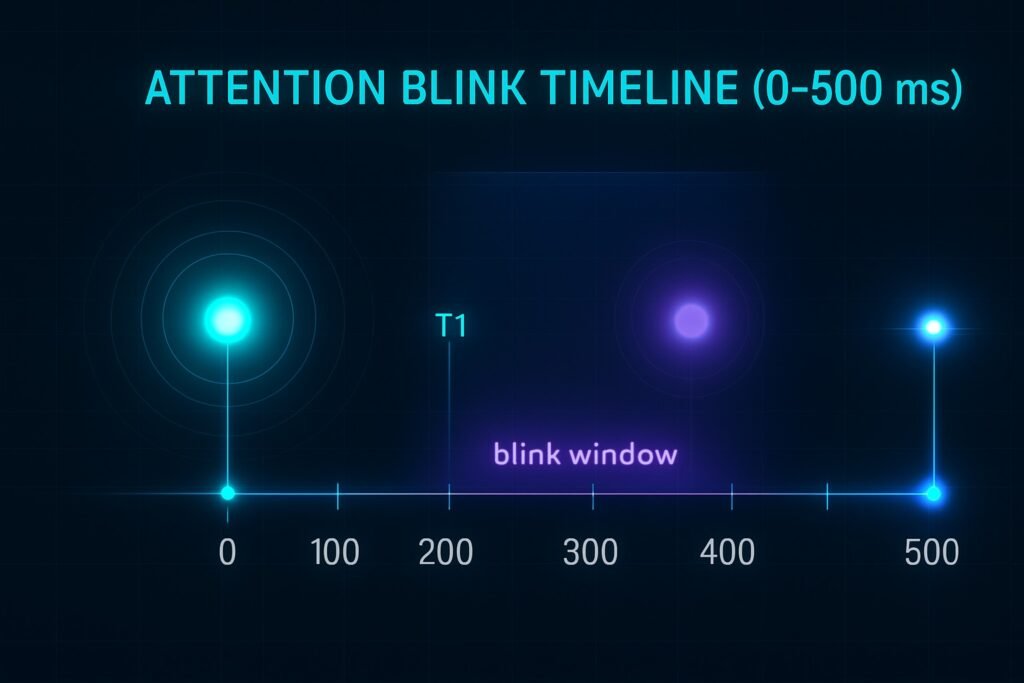
The Attentional Blink Timeline
Neural Explanation: The brain operates on approximately 10 Hz attention cycles (alpha waves). Each cycle determines what gets conscious access. When T2 falls between these cycles—during the "blink" period—it gets suppressed even though the eyes physically saw it.
| Stage | Duration | What Happens | Conscious Access |
|---|---|---|---|
| T1 Detection | 50-100 ms | First target processed | Fully conscious |
| Consolidation | 200-300 ms | T1 enters working memory | Attention locked |
| Blind Window | 200-500 ms | Attention unavailable for new stimuli | T2 suppressed |
| Reset | 50-100 ms | System prepares for next input | Consciousness restored |
III. The Chimpanzee Advantage: Snapshot Encoding
Why Chimps Excel at Rapid Visual Memory:
1. Parallel Encoding
Unlike humans who process items serially, chimps encode all items simultaneously as a single visual snapshot.
2. Stronger Iconic Memory
Their sensory buffer retains more detailed visual information for brief periods before consolidation.
3. Reduced Interference
Fewer competing cognitive processes (language, abstraction) interrupt their visual encoding stream.
4. Faster Attentional Reset
Chimps show minimal attentional blink, allowing rapid sequential processing of visual stimuli.
IV. Serial vs Parallel Encoding: The Core Difference
| Aspect | Human Serial Processing | Chimp Parallel Processing |
|---|---|---|
| Encoding Strategy | Items processed one after another: 1 → 2 → 3 → 4 | Entire array captured as single image |
| Processing Time | Increases linearly with item count | Constant regardless of item count |
| Vulnerability | High susceptibility to interference between items | Low interference due to simultaneous capture |
| Memory Decay | Earlier items decay while later ones process | All items encoded simultaneously, equal decay rate |
| Evolutionary Basis | Optimized for language and sequential reasoning | Optimized for rapid environmental scanning |
Critical Insight: This processing difference explains why chimpanzees like Ayumu can recall exact number positions after a 210ms flash, while even trained humans struggle. The chimp isn't "remembering numbers" in the human sense—they're recalling a visual snapshot that happens to contain number information.
V. Four-Level Performance Comparison
| Comparison | Visual Encoding Speed | Attentional Blink Strength | Span Capacity | Strategy Usage |
|---|---|---|---|---|
| Chimps vs Humans | Chimps: 200-300% faster | Chimps: Minimal blink | Chimps: 5-9 items | Humans: High strategy use |
| Adults vs Children | Similar speeds | Children: 30% less blink | Similar capacity | Adults: More strategies |
| Gamers vs Non-Gamers | Gamers: 15-25% faster | Gamers: 20-35% less blink | Similar capacity | Gamers: Automatic patterns |
| Trained vs Untrained | Trained: 20-40% faster | Trained: 25-50% less blink | Trained: +1-2 items | Trained: Optimized strategies |
VI. Why Humans Fail the Chimp Test
Attentional Blink
During the 200-500ms processing of first items, subsequent items are effectively invisible.
Slow Serial Encoding
Processing items one-by-one creates bottlenecks that chimps avoid with parallel processing.
Interference Sensitivity
Language processing, abstract thought, and other cognitive functions disrupt visual encoding.
Working Memory Overload
Maintaining items in working memory while processing new ones exceeds human capacity.
VII. Human Improvement Strategies (What Chimps Don't Use)
Chunking Strategy
Method: Group 1-3-5-7-9 into visual shapes or patterns
Effect: Reduces cognitive load by 40-60%
Example: See "1 3 5" as a diagonal line rather than three separate numbers
Ghost Visualization
Method: Visualize where numbers "ghosted" before masking
Effect: Extends iconic memory retention
Example: Maintain faint mental image of number positions
Gaming-Based Enhancement
Method: Regular FPS or reaction-time gaming
Effect: 20-35% reduction in attentional blink
Example: Action gamers show faster T1-T2 switching
Frequently Asked Questions
Research suggests chimpanzees experience a much weaker form of attentional blink compared to humans. Studies at Kyoto University's Primate Research Institute show that while chimps do have some attentional limitations, their "blink window" is significantly shorter—estimated at 50-150ms compared to the human 200-500ms window. This reduced blink allows them to process rapid sequential stimuli more effectively, contributing to their superior performance in flash memory tasks.
The difference likely stems from evolutionary adaptations: human brains developed extended processing for language and complex thought, which introduced attentional bottlenecks. Chimpanzee cognition remained optimized for rapid environmental scanning where missing sequential visual information could mean the difference between spotting a predator or becoming prey.
With extensive training and strategy use, some humans can approach chimpanzee-level performance, but surpassing them in raw speed is exceptionally rare. The current research shows:
- Untrained humans: 60-70% accuracy on 5-item, 210ms flash tasks
- Trained humans (6+ months): 85-90% accuracy on same tasks
- Young chimpanzees: 95-100% accuracy without training
- Trained chimpanzees: Near-perfect accuracy with 8-9 items
Where humans can potentially exceed chimps is in transfer learning—applying memory strategies to novel situations. Chimps excel at the specific trained task but show less flexibility than humans in adapting their memory skills to different formats or rule changes.
Yes, multiple peer-reviewed studies confirm that regular action video gaming (particularly first-person shooters and fast-paced strategy games) reduces attentional blink by 20-35%. The mechanisms include:
- Improved attentional resource allocation: Gamers learn to distribute attention more efficiently across multiple stimuli
- Faster processing speed: Reduced latency in visual information processing
- Enhanced perceptual learning: Better discrimination of relevant vs. irrelevant visual information
- Increased cognitive flexibility: Quicker switching between different attentional sets
These improvements are task-specific but show some transfer to real-world situations like driving, sports, and rapid decision-making scenarios. The cognitive benefits typically require 10+ hours per week of gaming over several months to become significant.
No, the exceptional visual memory performance peaks in young chimpanzees and declines with age, similar to human cognitive aging patterns. Research shows:
- Juvenile chimps (3-6 years): Peak performance, near-perfect recall
- Adolescent chimps (7-12 years): 90-95% accuracy, slightly reduced speed
- Adult chimps (13-25 years): 80-90% accuracy, noticeable slowing
- Senior chimps (25+ years): 60-75% accuracy, significant decline
This age-related decline follows a similar trajectory to human working memory aging but starts from a much higher baseline in youth. The decline is less dramatic than in humans, possibly because chimpanzees don't experience the same age-related neurodegenerative diseases at similar rates.
Interestingly, trained older chimps maintain better performance than untrained peers, suggesting cognitive reserve effects similar to those observed in humans with lifelong mental stimulation.
Scientific References & Further Reading
Explore these non-competitive, authoritative resources for deeper understanding:
- NIH: Attentional Blink Neural Mechanisms - Comprehensive review of the neuroscience behind attentional blink
- PLOS Biology: Chimpanzee Visual Memory Studies - Original research on chimp memory superiority
- Current Biology: Cognitive Tradeoffs in Evolution - Analysis of human-chimp cognitive differences
Conclusion: Cognitive Evolution's Trade-Off
Attention Blink and Chimp Memory Advantage represent two sides of cognitive evolution. Humans developed sophisticated reasoning, language, and planning capabilities—advancements that came with the cost of slower visual encoding and vulnerability to rapid stimulus suppression.
Chimpanzees retained exceptional early-visual abilities honed by evolutionary pressures of arboreal navigation and predator detection. Understanding these complementary cognitive systems reveals not just why chimps excel at rapid memory tasks, but how targeted training can help humans reclaim some of this ancestral visual prowess.

Explore Memory Research
MemoryRush offers research-inspired educational content designed for learning and self-exploration. Not a medical assessment.
Chimp Test Research
Explore the cognitive science behind chimpanzee memory studies and what they reveal about primate cognition.
Scientific Insights
Understand what memory research reveals about attention, perception, and cognitive processing in primates.
Learning & Practice
Educational guides for understanding and practicing memory techniques inspired by cognitive research.
Note: This content is for educational self-exploration and learning purposes only. It is not a medical or psychological assessment. Results are based on practice and vary naturally between individuals.
Browse All Chimp Test Content →
Touheed Ali
Touheed Ali is the founder and editor of MemoryRush, an educational cognitive science platform. He builds and maintains interactive tools focused on memory, attention, and reaction time.
His work centers on translating established cognitive science concepts into clear, accessible learning experiences, with an emphasis on transparency and responsible design.
MemoryRush
Educational Cognitive Science Platform • Memory • Attention • Reaction Time
Educational Use Only
MemoryRush is created for learning and self-exploration and does not provide medical, psychological, or clinical evaluation.
1 thought on “Attention Blink vs Chimp Memory Advantage”
Comments are closed.