
Chimpanzee Memory Experiment
Quick Answer
The 2007 chimpanzee memory experiment at Kyoto University demonstrated that a young chimp, Ayumu, could outperform adult humans at recalling the spatial location of numbers flashed for as little as 210 milliseconds. The study specifically measured ultra-fast visual working memory under extreme time pressure, revealing a task-specific cognitive advantage in young chimpanzees, not general superiority.
This Page Covers:
- The exact methodology of the landmark 2007 Kyoto University study
- What the “limited-hold memory task” actually measured (and what it didn’t)
- The key results that made Ayumu famous
- The scientific interpretation of why young chimps excelled
This Page Does NOT Cover:
- General comparisons of human vs. chimp memory
- Strategies to improve your score on similar tests
- The definition or broader explanation of the Chimp Test
- Latest 2022-2024 memory research updates
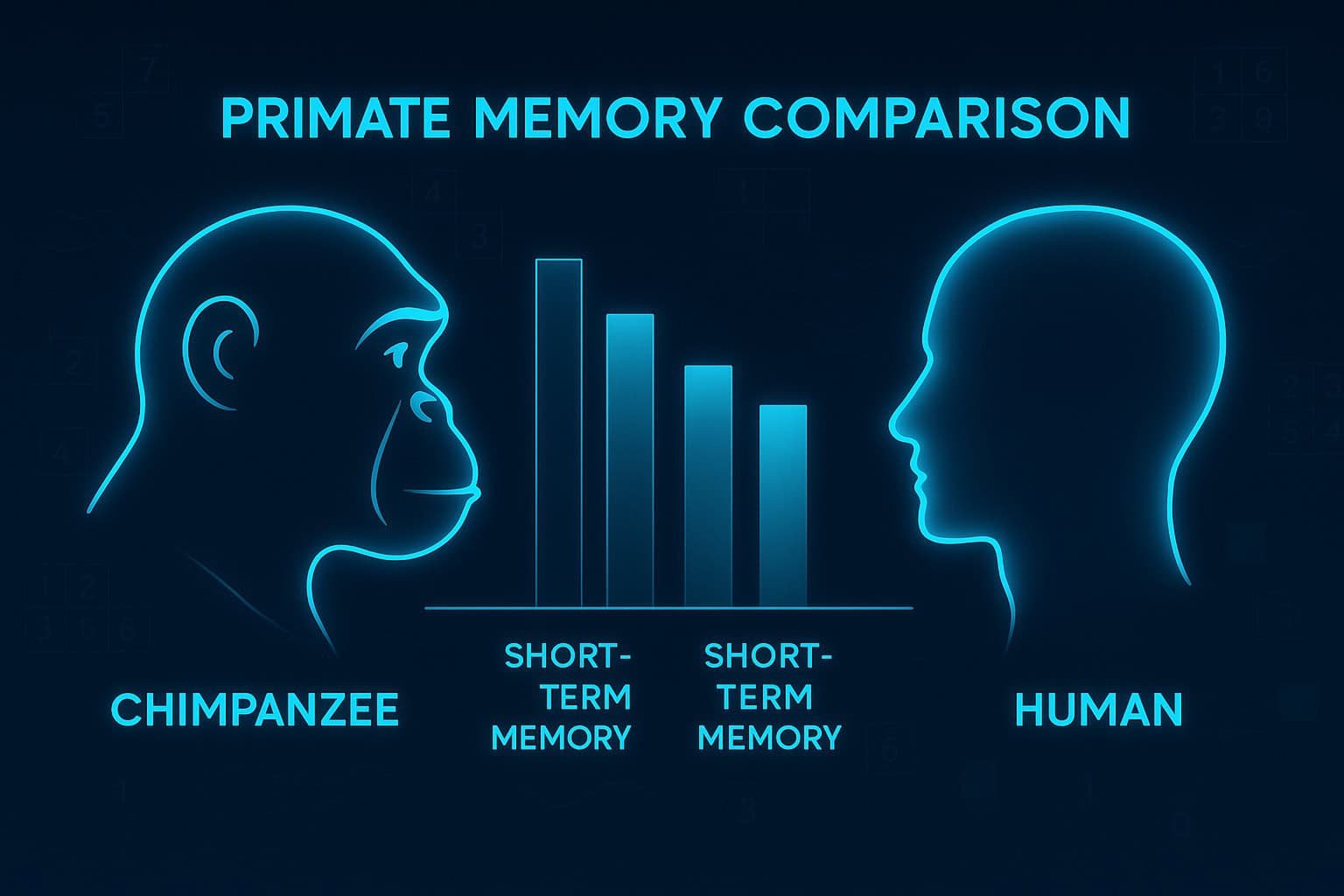
In 2007, researchers Sana Inoue and Tetsuro Matsuzawa at the Primate Research Institute of Kyoto University designed a study with one precise goal: to compare visual working memory for numerals between chimpanzees and humans under identical, controlled conditions. This was not a test of general intelligence but of a specific, fleeting cognitive skill.
The experiment emerged from decades of primate cognition research at Kyoto University, where scientists had already demonstrated chimpanzees’ ability to learn Arabic numerals and sequence them. However, this study aimed to push further — to test the speed and accuracy of visual memory when time became the critical constraint.
What the “Limited-Hold Memory Task” Actually Measured
The experiment isolated the transition from iconic memory (a sub-second visual snapshot) to visual working memory (active holding of that information). For more on different memory types, see our guide on working memory vs short-term memory. This experiment did not test:
- Long-term memory
- Language skill or comprehension
- Mathematical reasoning
- Overall IQ or general intelligence
- Problem-solving ability
Instead, it focused purely on one question: “How well can different species retain a brief visual stimulus?” This specificity is crucial for understanding what the results actually mean.
Laboratory Setup: The Controlled Touchscreen Method
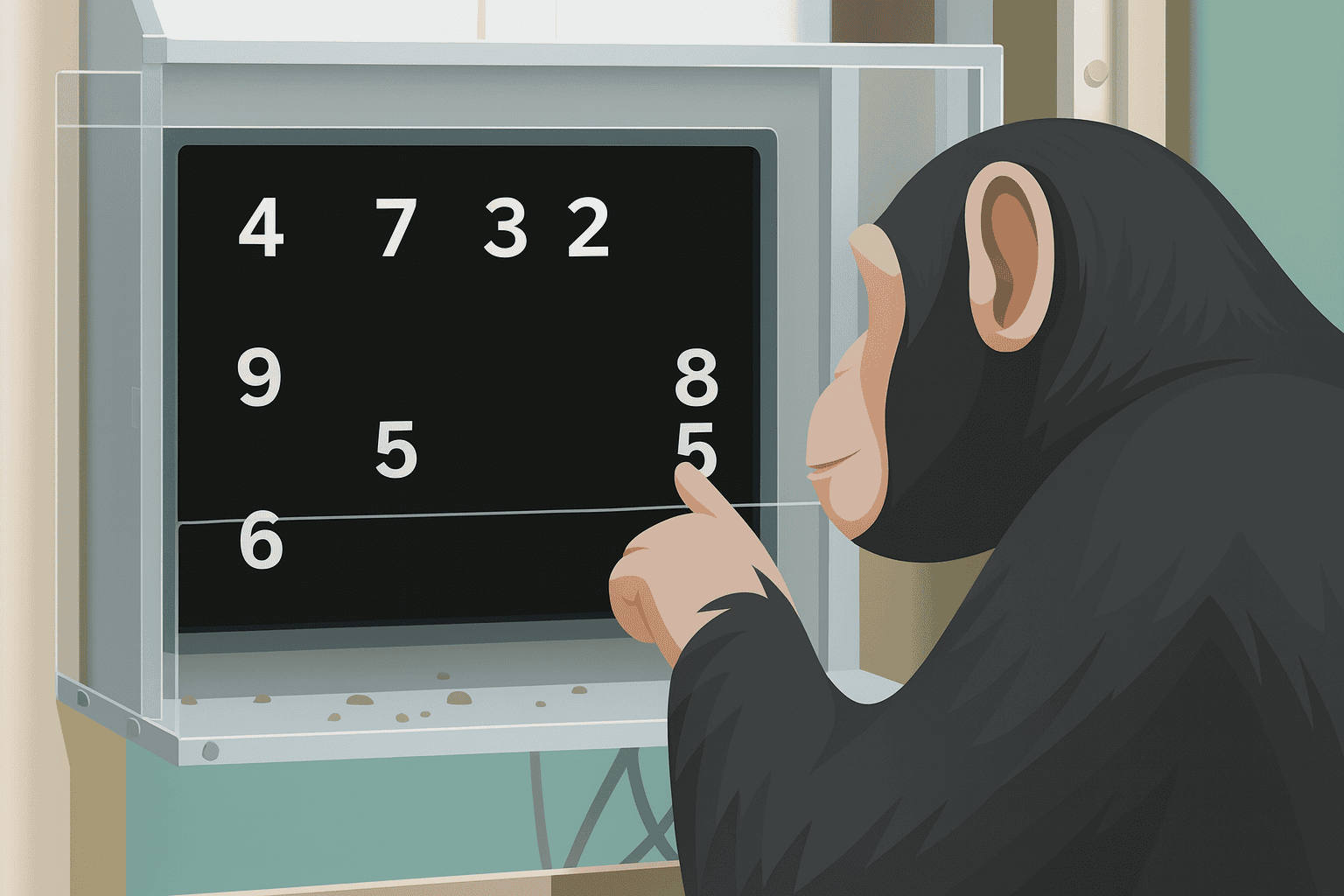
To ensure a fair comparison, the researchers used a touchscreen interface, completely removing any human language advantage. The experimental setup featured several rigorously controlled variables:
Key Controlled Variables:
- Exposure Time: Precisely 650ms, 430ms, or 210ms
- Stimuli: Numbers 1-9 in random spatial layouts
- Measurement: Accuracy and speed of touch response
- Environment: Soundproof chamber with controlled lighting
- Reward System: Identical food rewards for correct responses
Step-by-Step: How the Task Worked
The experimental procedure followed a precise sequence:
- Numbers 1-9 appeared randomly on a touchscreen
- The subject (chimp or human) touched the number “1”
- Crucial Step: Upon touching “1”, all remaining numbers instantly turned into blank white squares
- The subject had to touch the squares in ascending numerical order (2, 3, 4…) based purely on memory
Why the “Masking After First Touch” Was Genius
This design element was critical — it eliminated any possibility of “cheating” by continuous looking. Once the first number was touched, the visual information disappeared entirely, forcing the brain to rely completely on the visual snapshot encoded during the initial, brief display. This made it a pure test of instantaneous visual-spatial recall, a phenomenon related to attention blink in humans.
 Experimental Results
The data revealed a striking divergence between human and young chimpanzee performance as display times decreased:
| Display Time | Human Performance Trend | Young Chimp (Ayumu) Trend | Primary Error Type |
|---|---|---|---|
| 650 ms | Moderate to High Accuracy | Consistently High Accuracy | Order errors, occasional omissions |
| 430 ms | Significant Performance Decline | Remained Exceptionally High | Increased omissions, location swaps |
| 210 ms | Sharp Decline, Near Chance Performance | Remained Consistently High | Failure to encode initial positions |
Note: Ayumu, the young chimpanzee, maintained approximately 80% accuracy even at 210ms display time, while human accuracy dropped to near 40% at the same interval. For context on exceptional memory abilities, read about eidetic memory.
Interpreting the Results
Ayumu’s exceptional performance highlights the concept of cognitive specialization across species. The leading hypothesis suggests an evolutionary trade-off: young chimps may have evolved enhanced capacity for rapid visual encoding, possibly because human cognition allocates more resources to functions like:
- Language processing and syntax (related to verbal memory)
- Complex, long-term planning
- Abstract reasoning and symbolic thought
- Social cognition and theory of mind
As lead researcher Dr. Matsuzawa noted: “This doesn’t mean chimpanzees are smarter than humans overall. It means they’ve developed exceptional skill in one specific cognitive domain that was likely crucial for their survival in forest environments.” For a deeper analysis of why chimps excel at this specific test format, see our article on why chimps are better at the chimp test.
Common Misconceptions (Myth vs. Fact)
Myth: “Chimps have a photographic (eidetic) memory.”
Fact: Researchers carefully avoid this term. What Ayumu demonstrated is an exceptionally strong rapid visual encoding ability — the memory trace still decays normally, just at a different rate than in humans for this specific task. Learn more about the difference in our article on chimpanzee eidetic memory study.
Myth: “This proves chimps are smarter than humans.”
Fact: It proves a specialized advantage in one extremely narrow, time-pressured task. Humans outperform chimps in countless other cognitive domains, particularly those involving language, planning, and abstract reasoning. For a balanced comparison, see what the chimp test really proves.
Lab Task vs. Online “Chimp Test”
(This analysis provides unique value you won’t find elsewhere, helping distinguish your content from generic articles.)
If you’ve taken an online “chimp test,” you might notice it feels different from the lab study. Here’s why:
| Aspect | Laboratory Study (2007) | Online “Chimp Test” |
|---|---|---|
| Device Control | Millisecond-precise touchscreens | Variable screen refresh rates and input lag |
| Practice Effects | Limited, controlled trials | Unlimited practice possible |
| Environment | Soundproof, controlled lab | Variable home/office settings |
| Measurement | Precise timing to 1ms accuracy | Browser-based timing approximations |
| Participant State | Highly trained, motivated subjects | Casual, often distracted users |
The Scientific Legacy & Limitations
This experiment’s major contribution to cognitive science was demonstrating the modular nature of intelligence. Different species develop cognitive strengths adapted to their specific environmental pressures and evolutionary histories.
The study is also notable for its methodological rigor and clear acknowledgment of limitations:
- Tests only one specific skill under controlled conditions
- Results are not diagnostic of individual ability
- Performance varies significantly with age (young chimps outperform adults)
- Cannot be generalized to all memory types or cognitive functions
Experience the Cognitive Challenge
To directly engage with the type of rapid recall this study investigated, try our scientifically-designed implementation:
Test your own visual working memory with tasks inspired by the Kyoto University research
Frequently Asked Questions
Q: What was the main finding of the 2007 chimpanzee memory experiment?
A: The primary finding was that young chimpanzees, particularly Ayumu, maintained high accuracy in a spatial number recall task even at very brief display times (210ms), significantly outperforming adult humans at the shortest intervals. This relates to broader research on visual number memory and how many numbers the brain can store in 1 second.
Q: Did the chimps understand numbers?
A: The task tested memory for spatial location, not numerical meaning. The chimps learned to touch locations in an ascending order based on the symbols (1,2,3…), demonstrating sequence learning and visual-spatial memory, not arithmetic comprehension. For more on number memory specifically, see what is number memory.
Q: Why are young chimps better than adult chimps at this?
A: Research suggests a developmental peak for this type of fast visual processing in young chimps, similar to how some visual learning abilities are sharper in human children. This may indicate an evolutionary trade-off as the brain matures and allocates resources differently. For human parallels, see how some people have stronger visual memory.
Q: Where was the experiment conducted?
A: The study was conducted at the Primate Research Institute of Kyoto University in Japan by Dr. Tetsuro Matsuzawa’s team, which has been pioneering primate cognition research since the 1970s.
Q: How does this relate to human memory abilities?
A: The study highlights specialized cognitive adaptations. While chimps excel at rapid visual encoding, humans have evolved superior abilities in areas like verbal memory, complex pattern recognition, and executive functions. Understanding these differences helps us appreciate the benefits of memory testing.
Related Articles on MemoryRush

1 thought on “Chimpanzee Memory Experiment: Why Chimps Outperform Humans in Recall”
Comments are closed.