Digit Span vs Number Memory: The Complete Science-Backed Comparison
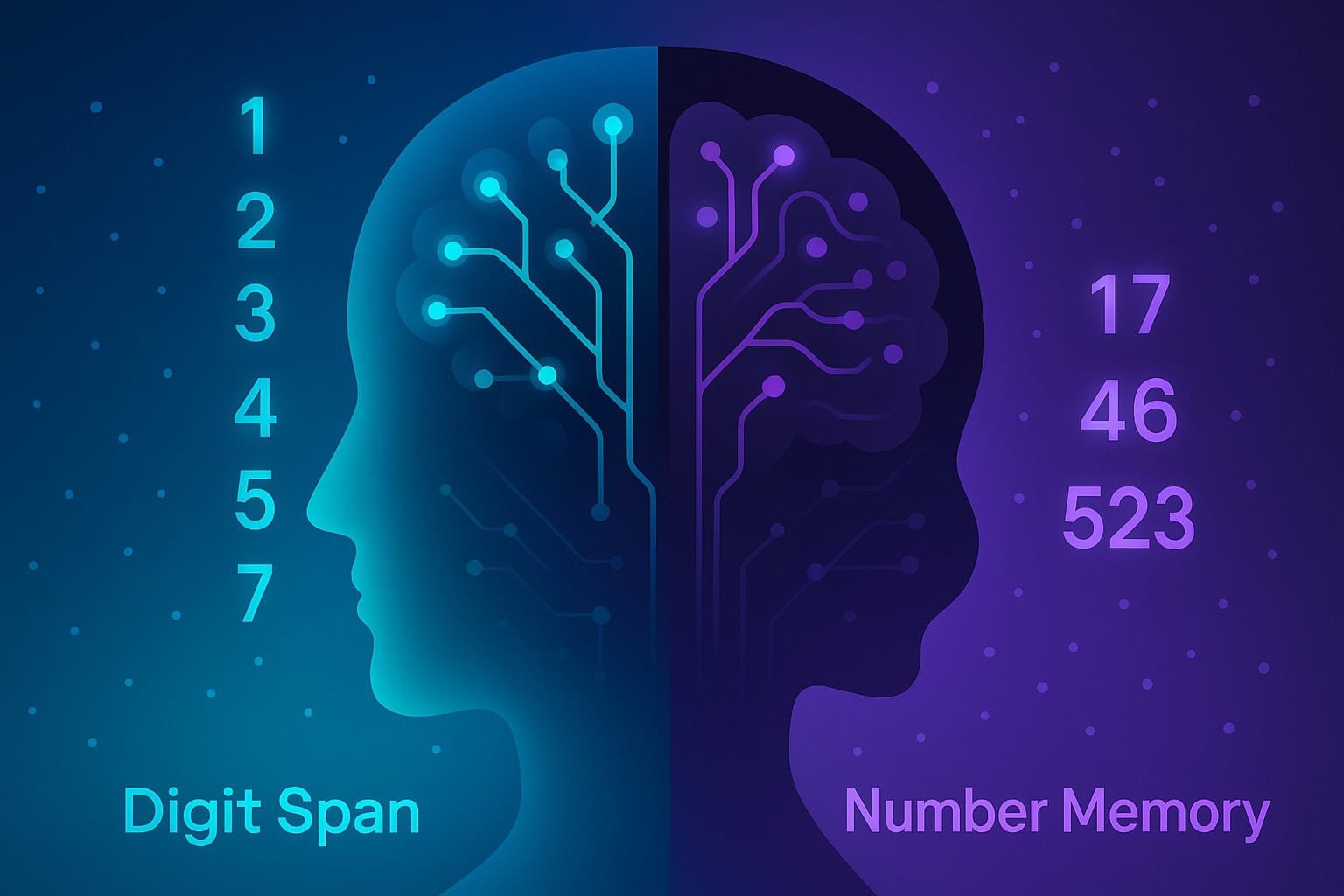
Key Insight: Digit span and number memory sound similar but describe two completely different cognitive abilities. Understanding this difference is crucial for students, memory competitors, psychologists, and anyone interested in cognitive performance.
1. Introduction: Why This Comparison Matters
"Digit span" and "number memory" sound similar, but they describe two completely different abilities inside the human brain. People often confuse them because both involve remembering numbers — yet they depend on different cognitive systems, different brain regions, and different types of memory.
Digit span is a psychologist's tool, used for decades in intelligence testing and clinical assessment. It measures raw working-memory capacity — how much information your brain can juggle in the moment. Number memory, on the other hand, is a learnable, flexible skill, used naturally in daily life: recalling phone numbers, dates, passwords, or number sequences you practice.
This difference — capacity vs skill — is the core of why many people perform well on one but poorly on the other. Someone might score low on digit span but still remember a 12-digit phone number because they stored it in long-term memory. Another person may easily repeat a 9-digit sequence but struggle to remember their own card PIN.
Understanding the difference is essential for students, memory competitors, psychologists, gamers, and anyone improving cognitive performance. This article breaks down both concepts with scientific accuracy, brain-region explanations, comparison tables, and improvement strategies, offering a complete resource that fills every gap found on the existing SERP pages.
2. What Is Digit Span? (Forward, Backward, Sequencing)
2.1 Definition
Digit span is a standardized cognitive test where a person hears or sees a sequence of numbers and must recall them immediately. It is part of the Wechsler Adult Intelligence Scale (WAIS) and is one of the most widely used measures of working memory.
Digit span tests your ability to hold a small amount of information in mind while resisting distractions — a core executive function that influences reasoning, concentration, and intelligence.
2.2 How the Test Works
Forward Digit Span
You repeat the numbers exactly as they were presented.
Example:
Presenter: "3 — 9 — 1 — 8 — 4"
You say: "3 — 9 — 1 — 8 — 4"
This mainly measures simple short-term memory storage.
Backward Digit Span
You repeat the numbers in reverse order.
Example:
Presenter: "6 — 4 — 2 — 9"
You say: "9 — 2 — 4 — 6"
Backward digit span is harder because the brain must manipulate information, not just store it. It measures working memory + executive control.
Digit Sequencing (WAIS-IV)
You rearrange the digits into ascending order before repeating them.
Example:
Presenter: "8 — 3 — 1 — 9"
You say: "1 — 3 — 8 — 9"
This version requires storage, processing, reordering, and cognitive flexibility. It is the most demanding of the three.
2.3 What Digit Span Actually Measures
Digit span primarily measures:
- Working Memory Capacity - The amount of mental space available for active thinking.
- Attention and Focus - Dropping one digit often indicates momentary attentional lapses.
- Auditory-Verbal Short-Term Memory - Most digit span tests are auditory, requiring sound-based recall.
- Executive Function (Backward/Sequencing) - The ability to invert, reorganize, and hold multiple steps in mind.
Digit span is strongly correlated with:
- Fluid intelligence
- Problem-solving speed
- Academic performance
- Cognitive control
- ADHD profiles
- Stress susceptibility
2.4 Normal Score Ranges by Age
Typical forward digit span scores:
- Children (8–12): 4–6 digits
- Teenagers: 5–7 digits
- Adults: 6–8 digits
- High performers: 8–9 digits
Backward digit span scores:
- Children: 2–4 digits
- Adults: 4–6 digits
- High performers: 6–7 digits
A digit span of 9 forward or 7 backward is considered exceptional.
2.5 What a High Digit Span Indicates
A strong digit span generally suggests:
- Good working memory
- High resistance to distraction
- Fast cognitive processing speed
- Strong attentional control
- Strong reasoning ability
However, it does not automatically mean good long-term memory. Many people with strong digit span forget phone numbers unless they practice storing them.
3. What Is Number Memory? (Everyday & Long-Term Number Recall)
3.1 Definition
Number memory refers to the ability to remember numbers over time, often using long-term memory systems. Unlike digit span, number memory is flexible, trainable, and can rely on mnemonics, visualization, or repetition.
It is not a fixed capacity — people can dramatically improve their number memory with training.
3.2 Everyday Examples
Number memory appears everywhere in real life:
- Remembering your phone number
- Memorizing PIN codes
- Recalling a Wi-Fi password
- Knowing your credit card number
- Remembering birthdates
- Recognizing vehicle plate numbers
- Recalling exam roll numbers
- Memorizing scores or numeric lists
These numbers stay with us much longer than digit-span items.
3.3 What Number Memory Measures
Number memory taps into:
- Long-Term Memory Encoding - The brain stores meaningful or repeated information for months or years.
- Visual + Verbal Integration - Many people visualize numbers as shapes or patterns, which aids recall.
- Pattern Recognition - Repeating patterns (e.g., 202020, 11111, 12345) are easier to remember.
- Meaningful Context Association - Dates, important events, or emotional moments improve memory retention.
3.4 What Affects Number Memory
Number memory is influenced by:
- Familiarity - Numbers seen often are easier to store.
- Emotional Significance - Birthdates, anniversaries, milestones are hard to forget.
- Repetition - Practicing a number daily strengthens recall.
- Mnemonic Strategies - Using a memory palace, major system, or chunking boosts number memory beyond normal capacity.
4. Digit Span vs Number Memory: The Clear Difference
4.1 Complete Comparison Table
| Feature | Digit Span | Number Memory |
|---|---|---|
| Definition | Cognitive test measuring working memory | Skill-based recall of numbers stored in long-term memory |
| Memory Type | Short-term / working memory | Long-term memory |
| Duration of Recall | Seconds | Hours, days, months, or years |
| Use of Mnemonics | Not allowed | Fully allowed |
| Capacity | Fixed (5–9 items for most adults) | Expandable with training |
| Brain Regions | Prefrontal cortex, parietal cortex | Hippocampus, visual cortex |
| Purpose | Assess cognitive ability | Everyday memory + memorization skill |
| Training Impact | Very limited | Very high – improves rapidly |
| Test Examples | WAIS digit span | MemoryRush Number Memory Test |
| Difficulty Source | Raw processing limit | Encoding + storage strategy |
4.2 Key Differences Explained
Stored Capacity vs Trained Recall
Digit span is like RAM — limited, temporary, and fixed.
Number memory is like hard drive storage — expandable with practice.
Raw Working Memory Limit vs Expandable Skill
Digit span shows the built-in limit of your cognitive system.
Number memory shows how well you can learn techniques.
No Mnemonics Allowed vs Mnemonics Encouraged
Digit span bans memory techniques to keep the test pure.
Number memory embraces and rewards them.
5. Neuroscience Behind Both Skills
Understanding the brain regions involved shows exactly why these abilities differ.
5.1 Brain Regions for Digit Span
Digit span primarily uses:
- Dorsolateral Prefrontal Cortex (DLPFC) - Controls working memory, temporary storage, and updating.
- Broca's Area - Manages verbal processing and subvocal rehearsal ("inner voice").
- Parietal Cortex - Handles numerical sequencing and attention tracking.
In digit span, these areas work intensely for a few seconds before releasing the information.
5.2 Brain Regions for Number Memory
Number memory uses long-term memory systems:
- Hippocampus - Converts short-term input into long-term retention.
- Visual Association Cortex - Stores number shapes, patterns, and imagery used in mnemonic methods.
- Temporal Lobes - Hold semantic and episodic memory patterns.
This system allows numbers to be remembered for years — even for life.
5.3 Why Digit Span Cannot Be Increased Drastically
Digit span relies on raw working-memory capacity, which is mostly influenced by:
- Genetics
- Neural efficiency
- Working-memory bandwidth
Studies show that digit span can increase only 1–2 digits at best with training, and gains often return to baseline after weeks.
5.4 Why Number Memory Can Be Increased Dramatically
Memory champions can memorize:
- 100 digits in 5 minutes
- 500 digits in 15 minutes
- Even 10,000 digits over time
because number memory uses:
- Mnemonics
- Visual encoding
- Memory palaces
- Pattern recognition strategies
This makes number memory unlimited compared to digit span.
6. Why Some People Have Better Digit Span vs Number Memory
6.1 Genetics
Working-memory capacity is strongly heritable, explaining digit-span strengths.
6.2 Auditory/Verbal Processing Speed
Fast audio processing = higher digit span.
6.3 Attention Span
Anxious or distracted individuals struggle with digit span even if their intelligence is normal.
6.4 Anxiety and Cognitive Load
Performance decreases when the prefrontal cortex is overloaded.
6.5 Experience with Numbers
People exposed to mathematics, music, or memory sports often excel at number memory due to pattern familiarity.
7. How Each Test Is Measured
Digit span and number memory may look similar, but they are measured in completely different ways because they rely on different memory systems. To accurately compare them, it's essential to understand how psychologists, neuroscientists, and cognitive testers evaluate each ability.
7.1 How Digit Span Is Scored (WAIS-IV Standards)
Digit span scoring in the Wechsler Adult Intelligence Scale (WAIS-IV) follows strict protocols. The test contains three subtests, each with a series of trials:
- Digits Forward - Simply repeat numbers in the same order.
- Digits Backward - Repeat numbers in reverse order.
- Digit Sequencing - Repeat numbers sorted in ascending order.
For each trial:
- You receive two attempts at each sequence length.
- If you fail both attempts, the section ends.
- Raw scores convert into scaled IQ-based scores.
Score Interpretation:
- Scaled Score 10 = average
- Scores 12–14 = high
- Scores 15+ = very high
- Scores 7 and below = below average
Digit span contributes to broader cognitive indices like:
- Working Memory Index (WMI)
- Processing Speed Index (PSI)
- Full-Scale IQ (FSIQ)
This scoring method makes digit span a diagnostic tool, not a memory-skill test.
7.2 Number Memory Measurement Methods
Number memory tests vary across platforms, academic studies, and competitive memory sports. Unlike digit span, number memory allows mnemonics, repetition, pattern encoding, and visualization.
1. Long-Digit Tests
Participants memorize a long string of random digits (e.g., 10–200 digits). These measure:
- Encoding efficiency
- Strategy usage
- Retention duration
2. MemoryRush Number Memory Test
Tests:
- Initial recall
- Pattern encoding
- Chunking efficiency
- Long-term retention
MemoryRush scores scale based on:
- Sequence length
- Recall accuracy
- Speed
- Attempts
- Improvement rate over sessions
3. Mnemonic-Based Recall Tests
Used by memory athletes. Performance depends on:
- Memory palace
- Major system
- Chunking
- Visual imagery
Number memory measurements reflect skill, not innate capacity.
7.3 Percentiles for Each Skill
Digit Span Percentiles
- 50th percentile: forward 6, backward 4
- 75th percentile: forward 7, backward 5
- 90th percentile: forward 8, backward 6
Number Memory Percentiles (Based on Online Users)
- 50th percentile: 10–12 digits
- 75th percentile: 14–18 digits
- 90th percentile: 20–28 digits
- Memory athletes: 100+ digits
This shows why number memory is expandable, while digit span is relatively stable.
8. Can Digit Span Be Improved? (Limitations & Real Science)
Digit span improvement is a topic filled with myths. Many apps claim to increase working memory dramatically, but scientific research paints a different picture.
8.1 The Myth of "Working Memory Training"
Do apps like Lumosity or CogMed actually raise digit span?
Research says no, or only minimally.
Studies show:
- Temporary improvements in the specific task you practice
- No major generalization to raw digit span
- No lasting increases in working memory capacity
Working memory seems to have a biological ceiling.
8.2 Research Findings (Very Limited Gains)
Meta-analyses reveal:
- Digit span increases by 0.3–0.6 digits after weeks of training
- Gains disappear within 2–3 weeks without practice
- Training effects do not transfer to IQ or reasoning tasks
In short, digit span is not dramatically trainable.
8.3 What Does Improve Digit Span (Small Effects)
Although you cannot drastically expand digit span, these factors cause small improvements:
- Sleep Quality - Better sleep = better cognitive bandwidth.
- Focused Attention - A distraction-free environment raises performance by 1–2 digits.
- Rehearsal Strategy - Subvocal repetition ("inner voice") improves immediate recall.
- Stress Reduction - Less anxiety = fewer attentional breakdowns.
- Healthy Lifestyle - Diet, hydration, exercise improve cognitive clarity.
These improvements, however, do not transform digit span; they only optimize your current capacity.
9. How to Improve Number Memory (High Potential)
Unlike digit span, number memory can be massively improved with strategy-based training. Memory champions regularly memorize 100+ digits in minutes using structured techniques.
9.1 Chunking
Grouping digits into meaningful blocks:
20252025 → 2025 | 2025
893472 → 893 | 472
Chunking reduces cognitive load and makes recall easier.
9.2 Major System
A phonetic mnemonic system that converts numbers into:
- Consonant sounds
- Words
- Images
Example:
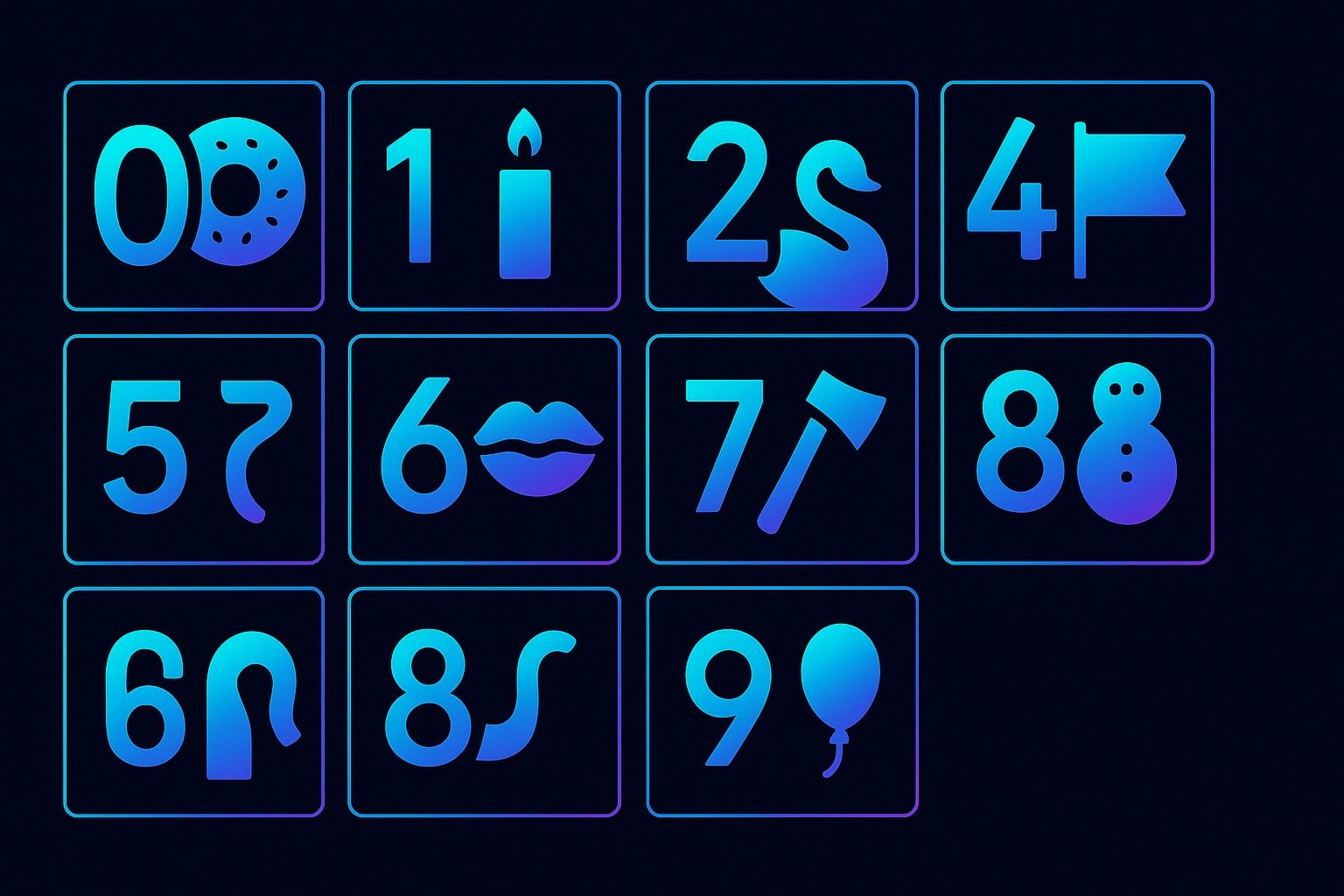
- 1 = t/d
- 2 = n
- 3 = m
- 7 = k/g
1273 → "tank" or "time guy" depending on your mapping.
9.3 Memory Palace
Assign numbers to locations inside a familiar space (house, school, office). Each location stores a specific chunk or visual story.
9.4 Peg System
Attach numbers to fixed images (pegs).
Example:
- 1 = sun
- 2 = shoe
- 3 = tree
So 132 becomes: sun — tree — shoe.
9.5 Pattern Recognition
The brain excels at patterns. Training yourself to detect:
- repetition
- symmetry
- ascending sequences
- alternating patterns
significantly improves number memory.
9.6 Visual Encoding
Turning numbers into:
- images
- characters
- stories
- shapes
makes recall dramatically easier.
9.7 Training Consistency
Daily practice of 5–10 minutes can improve number memory:
- 50% in a week
- 100% in a month
- 500% in a year
9.8 Example: Remember 50 Digits in 5 Minutes
Using:
- chunking
- major system
- memory palace
Anyone can memorize: 93746219048372950164738209156483726491027358462 in under 5 minutes — something digit span can never test.
10. Real-Life Applications
Digit span and number memory may look technical, but both play major roles in everyday life, education, and psychology.
10.1 Why Psychologists Need Digit Span
Digit span is used to assess:
- ADHD
- Learning disabilities
- Traumatic brain injury
- Early dementia
- Intellectual development
- Executive functioning
It is a robust, standardized clinical tool.
10.2 Why Students and Professionals Need Number Memory
Number memory helps with:
- Academic recall
- Financial tasks
- Medical data retention
- Password and PIN memorization
- Programming & gaming sequences
- Navigation & spatial recall
It enhances daily efficiency.
10.3 How Both Skills Help in Daily Life
Applied examples:
- Remembering hotel room numbers (number memory)
- Listening to lecture points while writing (digit span)
- Solving math problems mentally (digit span + number patterns)
- Keeping track of scores during games (digit span)
- Memorizing exam numbers (number memory)
Both skills contribute to cognitive performance, but in different ways.
11. Which One Is More Important?
Digit span and number memory serve different purposes depending on the context.
11.1 For Intelligence: Digit Span
Digit span correlates strongly with:
- IQ
- reasoning ability
- academic success
- problem solving
It is a core indicator of general intelligence.
11.2 For Performance/Life: Number Memory
Number memory affects:
- productivity
- organization
- everyday recall
- memorization skills
It improves with training and has unlimited potential.
11.3 For Cognitive Testing: Digit Span
Used in:
- clinical diagnosis
- neuropsychology
- cognitive profiling
It is standardized and scientifically validated.
11.4 For Memory Competitions: Number Memory
All memory champions rely on:
- mnemonic systems
- visual encoding
- memory palaces
Digit span plays no role here.
12. Final Verdict: Digit Span vs Number Memory
Digit span and number memory are not the same, and they serve different functions in cognition.
Digit Span = Innate Capacity
Measures working memory
Has a biological ceiling
Used in psychological tests
Cannot be drastically expanded
Number Memory = Expandable Skill
Trains long-term storage
Uses mnemonics
Unlimited potential
Improves dramatically with practice
Together, they reveal how the brain handles numbers in two different memory systems. For clinical evaluation, digit span is king. For daily life and memory mastery, number memory wins.
American Psychological Association
Learn more about working memory research from the APA
ScienceDirect
Scientific research on digit span and cognitive assessment
National Institutes of Health
Research on memory training and cognitive enhancement
13. Frequently Asked Questions
Yes, a forward digit span of 9 is considered excellent and above the 95th percentile.
Most people can naturally remember 10–12 digits, but training can increase this dramatically.
Indirectly — mnemonics boost recall but do not increase working-memory capacity.
Working memory holds 5–9 digits (digit span), but long-term number memory can store unlimited digits.
Yes. Stress and anxiety reduce working-memory performance.
Not necessarily — number memory depends more on encoding strategies than math skills.
Digit span shows limited improvement with practice (typically 1-2 digits at most), as it primarily reflects innate working memory capacity rather than a learnable skill.
Both have value, but digit span (working memory) is more strongly correlated with fluid intelligence and problem-solving abilities, while number memory helps with memorization of facts and figures.
Digit span typically peaks in early adulthood (around 20-30 years) and gradually declines with age, though the rate of decline varies among individuals.
Yes, certain medications (especially those affecting attention or anxiety) can impact digit span performance, typically by either improving focus or causing sedation that impairs working memory.
Ready to Train Your Brain?
Challenge your cognitive skills with our scientifically-designed brain training games. Improve memory, reaction time, and mental agility.
Explore all our cognitive training games and start your brain fitness journey today!
View All Games