
ECHOIC MEMORY
Comprehensive Neuroscience & Psychology Guide to Auditory Sensory Memory: Science, Duration, Examples, Tests & Training
Introduction:
Every time you understand a sentence, notice your name being called, or recognize a song within the first few seconds, you’re using a powerful—and often invisible—mechanism known as echoic memory.
This form of auditory sensory memory allows the brain to store the sounds you hear for a very brief period, typically 2 to 4 seconds, long enough to interpret speech, recognize patterns, and make sense of the auditory world around you.
Although most people never think about it, echoic memory is the foundation of spoken communication, learning, music perception, and auditory attention. Without it, everyday life would feel fragmented and confusing—like hearing sounds in pieces that never fully connect.
What Is Echoic Memory? (Definition & Duration)
Definition
Echoic memory is the component of sensory memory responsible for briefly storing auditory information after a sound is heard. It acts as a mental “echo,” allowing the brain to process and interpret incoming sounds even after the physical signal has stopped (Baddeley, 2012).
Duration: How Long Does Echoic Memory Last?
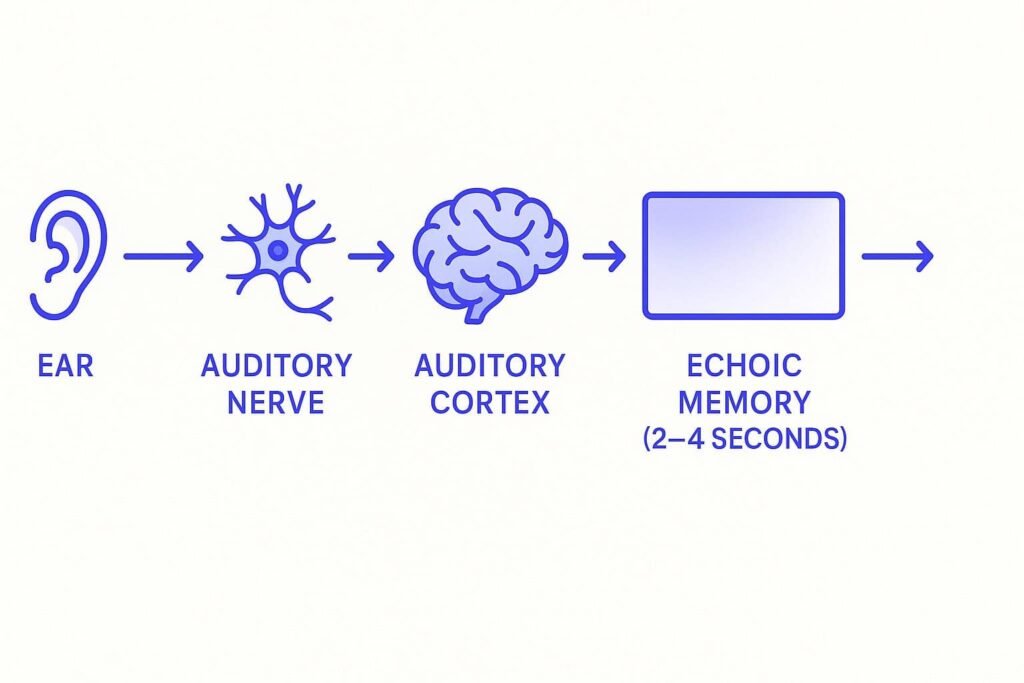
Echoic memory typically lasts 2–4 seconds, although duration varies based on age, attention, and neurological factors. Research by Darwin, Turvey, and Crowder (1972) demonstrated that auditory sensory traces persist significantly longer than visual traces.
- 2-4 Seconds Duration: Darwin et al. (1972)—Sensory Memory Studies
- 8-10 Word Retention: Baddeley (2012) – Working Memory Model
- 200 ms: MMN Response Time Näätänen (1978)—EEG Research
- 75% Speech Comprehension: Kutas & Federmeier (2011) – Language Processing
The Neuroscience of Echoic Memory
Understanding the neural mechanisms behind echoic memory reveals why auditory processing differs fundamentally from visual processing and how our brains construct meaningful experiences from fleeting sound traces.
1. Auditory Cortex Processing
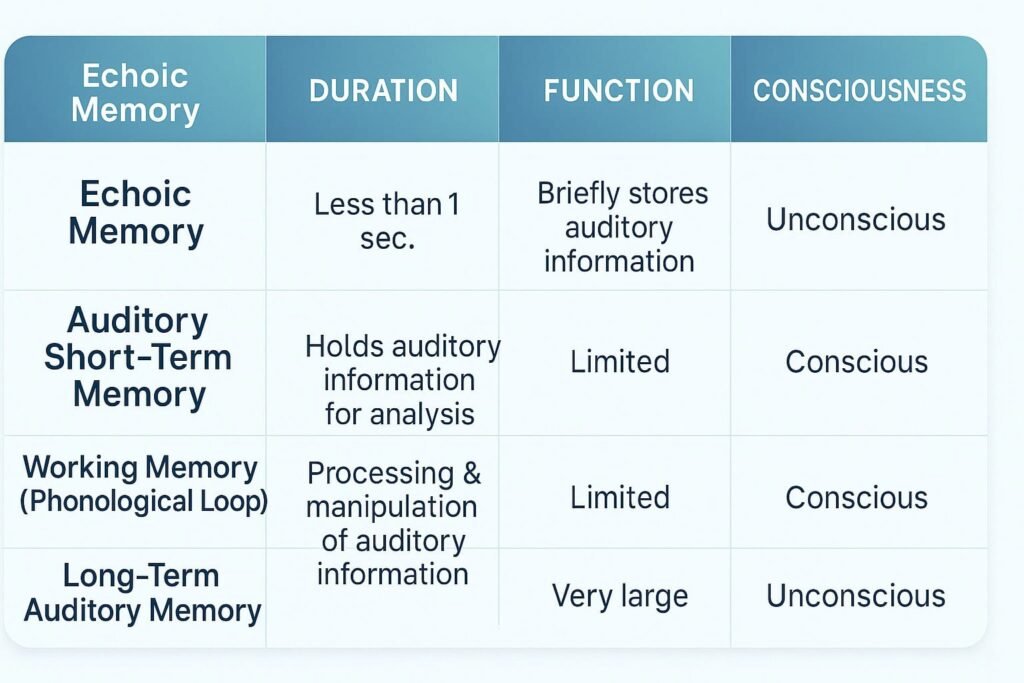
Sound waves activate the primary auditory cortex in the temporal lobe, where neural representations create temporary sensory traces that persist after sound cessation (Zatorre & Belin, 2001).
2. Echoic Trace Formation
The auditory cortex maintains neural patterns—echoic traces—that allow temporal integration of sequential sounds, essential for speech comprehension and music perception.
3. Memory Pipeline Architecture
According to Baddeley’s model, echoic memory feeds into the phonological loop of working memory, enabling conscious processing and manipulation of auditory information.
4. Temporal Integration
Auditory processing requires binding sounds across time, explaining why echoic memory lasts longer than iconic memory—speech and music unfold sequentially.
Echoic Memory vs. Other Types of Memory
Sensory Memory System Comparison
| Feature | Echoic Memory | Iconic Memory | Working Memory | Long-Term Memory |
|---|---|---|---|---|
| Sensory Type | Auditory | Visual | Multi-modal | Consolidated |
| Duration | 2-4 seconds | 0.2-0.5 seconds | 15-30 seconds | Years to lifetime |
| Capacity | High | Medium | Limited (7±2) | Virtually unlimited |
| Conscious Access | Mostly unconscious | Mostly unconscious | Fully conscious | Requires retrieval |
| Primary Function | Speech processing | Pattern recognition | Active manipulation | Knowledge storage |
Auditory Processing Architecture
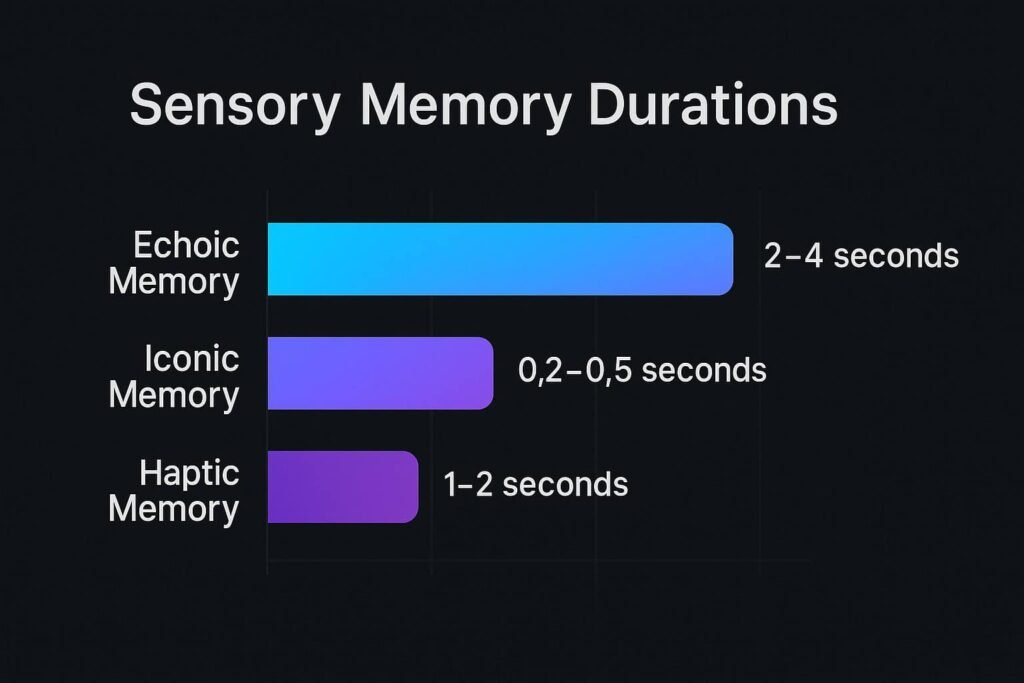
Sound Wave Reception
Physical sound waves enter the ear canal, vibrating the eardrum and activating cochlear hair cells that convert vibrations into neural signals.
Neural Transmission
The auditory nerve transmits signals to the brainstem’s cochlear nuclei, then to the inferior colliculus and medial geniculate nucleus for initial processing.
Cortical Processing
The primary auditory cortex (A1) in the temporal lobe creates echoic traces, with secondary areas (A2) adding semantic and emotional context to sounds.
Temporal Integration
Echoic memory buffers sequential sounds, allowing temporal integration essential for understanding speech patterns and musical melodies.
Working Memory Transfer
Selected auditory information transfers to the phonological loop in working memory for conscious processing, rehearsal, and manipulation.
Historical Development of Echoic Memory Research
Dichotic Listening Experiments (1953)
Cherry’s pioneering work on selective attention demonstrated that unattended auditory information is briefly retained in echoic memory before filtering occurs.
Partial Report Paradigm (1972)
Darwin, Turvey, and Crowder’s landmark study quantified echoic memory duration at 2-4 seconds using simultaneous tone presentation techniques.
Mismatch Negativity Discovery (1978)
Näätänen’s EEG research revealed automatic auditory change detection, proving echoic memory operates pre-attentively and unconsciously.
Cowan’s Model Refinement (1984)
Cowan integrated echoic memory into comprehensive working memory models, explaining its role in speech processing and auditory attention.
Auditory Memory System Components
Echoic Memory
The initial auditory buffer lasts 2-4 seconds, operating automatically and unconsciously to provide raw material for higher processing stages.
Phonological Loop
The working memory component is specialized for verbal information, maintaining speech sounds through subvocal rehearsal for 15-30 seconds.
Auditory LTM
Long-term storage of auditory patterns, including language, music, environmental sounds, and voice recognition templates developed through experience.
Frequently Asked Questions
What exactly is echoic memory, and how long does it last?
How does echoic memory differ from regular auditory memory?
Can echoic memory be improved through training?
What disorders affect echoic memory function?
Why does echoic memory last longer than iconic memory?
How does echoic memory support language learning?
Is echoic memory testing available for self-assessment?
Train Your Auditory Memory Skills
Enhance your echoic memory, auditory processing, and listening comprehension through scientifically designed cognitive training exercises that challenge and strengthen your auditory system.
Scientific References & External Resources
This guide synthesizes peer-reviewed research from leading cognitive neuroscience and psychology publications. Below are key references with direct links to source material.
- Baddeley, A. D. (2012). Working memory: theories, models, and controversies. Annual Review of Psychology, 63, 1-29. https://doi.org/10.1146/annurev-psych-120710-100422
- Darwin, C. J., Turvey, M. T., & Crowder, R. G. (1972). An auditory analogue of the Sperling partial report procedure. Memory & Cognition, 1(1), 41-52. https://doi.org/10.3758/BF03208127
- Näätänen, R., Gaillard, A. W., & Mäntysalo, S. (1978). Early selective-attention effect on evoked potential reinterpreted. Acta Psychologica, 42(4), 313-329. https://doi.org/10.1016/0001-6918(78)90006-9
- Zatorre, R. J., & Belin, P. (2001). Spectral and temporal processing in human auditory cortex. Cerebral Cortex, 11(10), 946-953. https://doi.org/10.1093/cercor/11.10.946
- Kutas, M., & Federmeier, K. D. (2011). Thirty years and counting: finding meaning in the N400 component of the event-related brain potential (ERP). Annual Review of Psychology, 62, 621-647. https://doi.org/10.1146/annurev.psych.093008.131123

Touheed Ali
Touheed Ali is the founder and editor of MemoryRush, an educational cognitive science platform. He builds and maintains interactive tools focused on memory, attention, and reaction time.
His work centers on translating established cognitive science concepts into clear, accessible learning experiences, with an emphasis on transparency and responsible design.
MemoryRush
Educational Cognitive Science Platform • Memory • Attention • Reaction Time
Educational Use Only
MemoryRush is created for learning and self-exploration and does not provide medical, psychological, or clinical evaluation.
1 thought on “Echoic Memory: Definition, Duration, Examples & Neuroscience Guide”
Comments are closed.