

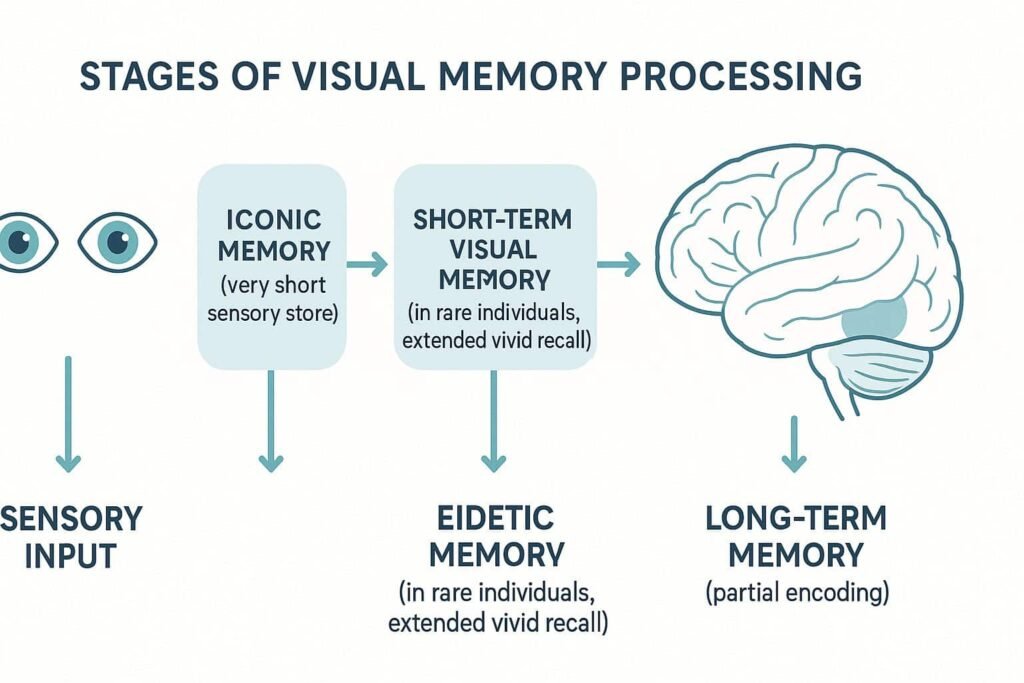
Visual Memory Processing Flow
Complex image seen

500 ms visual buffer
Extended visual persistence
Image fades in 30-90 s.
4. The Reality of Eidetic Memory: Statistics & Data
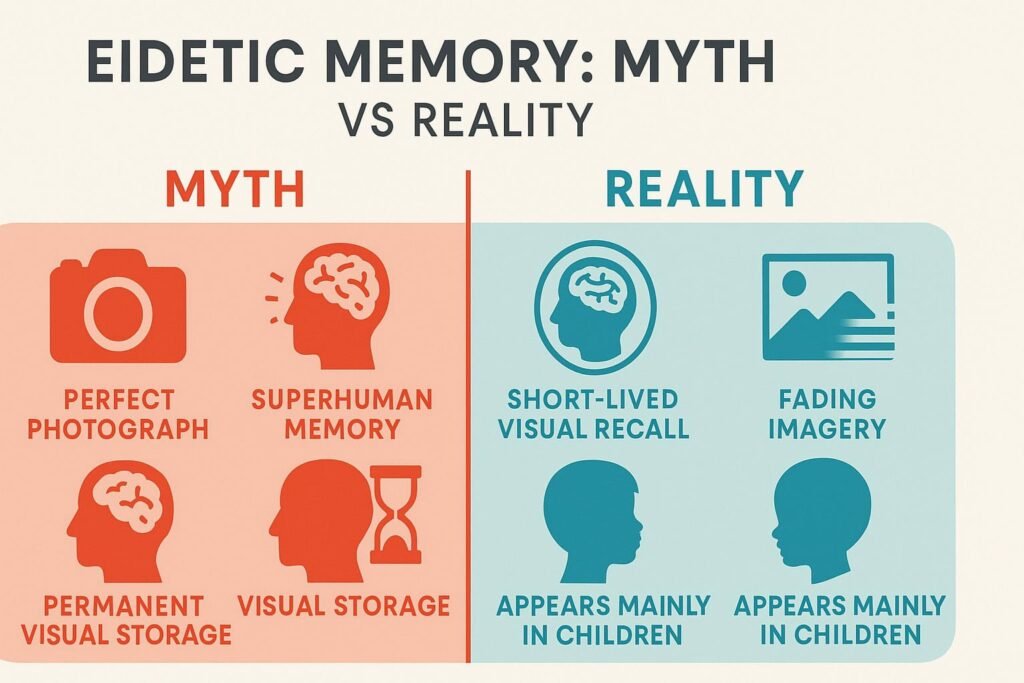
- 2-10%: Children with eidetic ability
- ~0%: Adults with eidetic ability
- 30-90 s: Typical eidetic duration
- 6-12: Peak age for eidetic ability
- 0: Verified adult cases
- 100%: Fictional in movies
5. Eidetic Memory in Children vs Adults (Developmental Psychology)
- Childhood (Ages 6-12): The brain relies more on visual processing than verbal systems. Neural pathways are plastic and visually dominant, allowing extended visual persistence.
- Neural Pruning (Adolescence): Synaptic pruning strengthens frequently used pathways (language, abstraction) and eliminates unused visual persistence mechanisms.
- Adulthood: Verbal encoding replaces visual encoding. Imagery becomes conceptual rather than literal. New stimuli rapidly override mental imagery.
6. Related Memory Phenomena Often Confused with Eidetic Memory
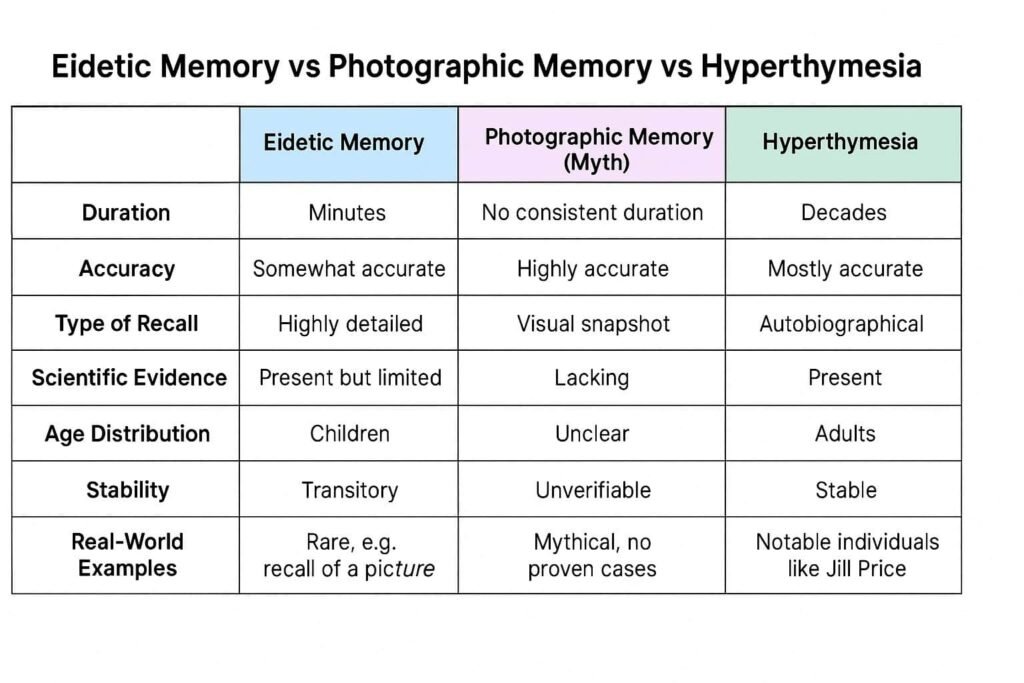
Hyperthymesia
Highly Superior Autobiographical Memory—recalls life events in detail, not visual images, after one exposure.
Savant Syndrome
Extraordinary recall through pattern recognition and computation, not photographic storage of images.
Memory Athletes
Trained mnemonic techniques (method of loci, chunking)—learned strategies, not innate eidetic ability.
Hyperphantasia
Extremely vivid mental imagery, but not stable recall of real external images seen once.
Aphantasia
No visual imagery at all—the complete opposite of eidetic memory.
Working Memory
Manipulates information temporarily—does not store complete visual images with high fidelity.
7. What People Mistake for Eidetic Memory
Strong Attention
Remembering what you really focused on, not a complete visual snapshot.
Pattern Recognition
Recalling structure and relationships, not a literal photographic image.
Chunking Behavior
Grouping information efficiently—a memory strategy, not eidetic ability.
Visual Rehearsal
Mentally redrawing details from memory—active reconstruction, not passive recall.
Important Distinction: None of these abilities equal eidetic memory. They represent different cognitive processes often confused with photographic recall.
8. Frequently Asked Questions
Comprehensive answers to the most searched questions about eidetic memory:
Is eidetic memory real?
How rare is eidetic memory?
Does eidetic memory mean high IQ?
Can adults have eidetic memory?
Can someone train photographic memory?
Is eidetic memory the same as photographic memory?
What is the difference between eidetic memory and hyperthymesia?
9. Scientific References
Key research studies with exact links to authoritative sources:
Eidetic Imagery in Children: Scientific Evidence
Haber, R. N., & Haber, R. B. (1964). Eidetic imagery: I. Frequency. Perceptual and motor skills, 19(1), 131-138.
The Myth of Photographic Memory
Stromeyer, C. F., & Psotka, J. (1970). The detailed texture of eidetic images. Nature, 225(5230), 346-349.
Neural Basis of Visual Memory
Marks, D. F. (1973). Visual imagery differences in the recall of pictures. British Journal of Psychology, 64(1), 17-24.
Memory Development & Cognitive Neuroscience
Kosslyn, S. M., Thompson, W. L., & Ganis, G. (2006). The case for mental imagery. Oxford University Press.

1 thought on “Eidetic Memory: Meaning, Science, Myths, Tests & Real Examples”
Comments are closed.