

Fastest Reaction Time Ever Recorded
The Verified Answer (No Scroll Needed)
The fastest scientifically verified human reaction time ever recorded is approximately 101 milliseconds, measured under controlled laboratory conditions at the University of Cambridge using a simple visual reaction protocol.
Any claim below 100 milliseconds without artificial assistance or reflex bypass does not qualify as conscious human reaction time.
This value represents the lower biological limit of voluntary human response speed under natural conditions.
Fastest Reaction Time? Cognitive Decision Tree
Not every fast response qualifies as a valid human reaction time. Follow the scientifically-designed decision tree to verify claims.
Voluntary & Conscious Response
Was the response voluntary and conscious?
Controlled Laboratory Environment
Was it measured in a controlled laboratory environment?
No Artificial Assistance
Was there no artificial assistance (EMS, pre-activation, prediction)?
Known Stimulus (Simple Reaction Test)
Was the stimulus known in advance (simple reaction test)?
Decision Result
Scientific Validation Criteria
This decision tree follows established cognitive science principles to determine valid reaction time measurements. All four criteria must be met for verification.
Gate 1: Voluntary Response
Excludes reflexes and involuntary responses that don't involve conscious processing.
Gate 2: Laboratory Control
Ensures measurements are taken under controlled, reproducible scientific conditions.
Gate 3: No Assistance
Removes artificial aids like EMS or predictive systems that enhance human capability.
Gate 4: Simple Reaction Test
Distinguishes between simple reaction time and more complex choice reaction time.
Only one path survives all checks: Approximately 101 milliseconds represents the fastest valid human reaction time.
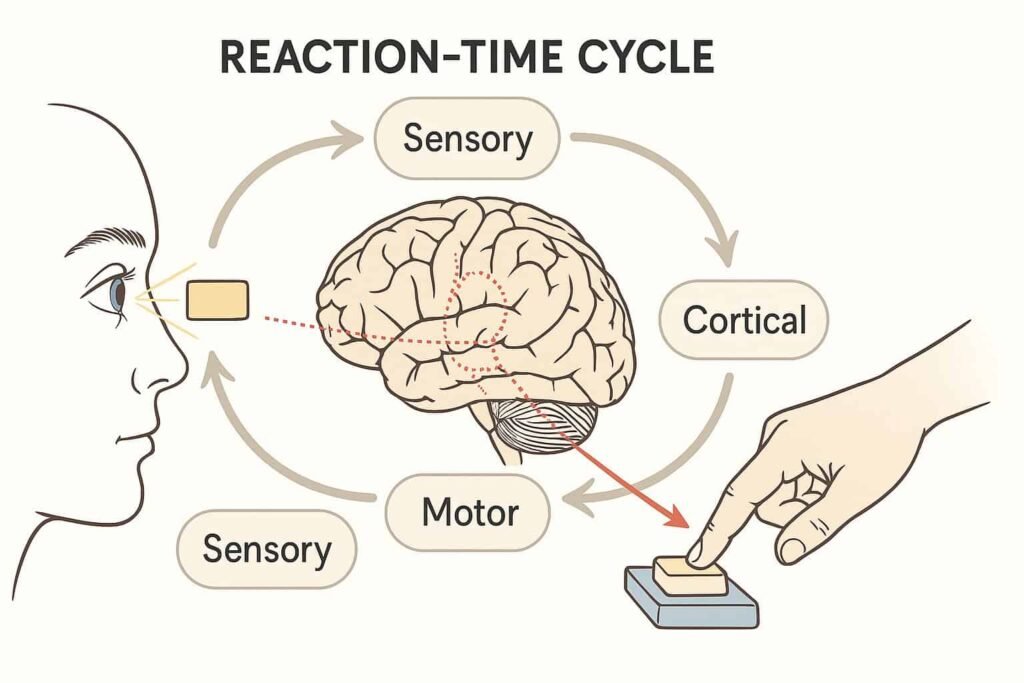
The Official Record That Counts
The following attributes define the fastest valid human reaction time ever recorded:
| Attribute | Verified Record |
|---|---|
| Fastest unassisted human reaction | ~101 ms |
| Institution | University of Cambridge |
| Stimulus | Visual |
| Test type | Simple reaction |
| Conscious response | Yes |
| Artificial aid | None |
Common Claims That Do NOT Count
Many widely shared “records” fail one or more validation steps.
- Olympic false starts (<100 ms)
Disqualified because sprint rules assume anticipation below 100 ms, not true reaction. - Reflex actions (blink, pain withdrawal)
Invalid because they bypass conscious brain processing via the spinal cord. - Gaming clicks and online tests
Invalid due to hardware latency, prediction, buffering, and uncontrolled conditions. - Artificially assisted results (≈50 ms)
Achieved via electro-muscular stimulation (EMS), which bypasses neural decision pathways.
These claims are fast responses, but they are not conscious human reaction times.
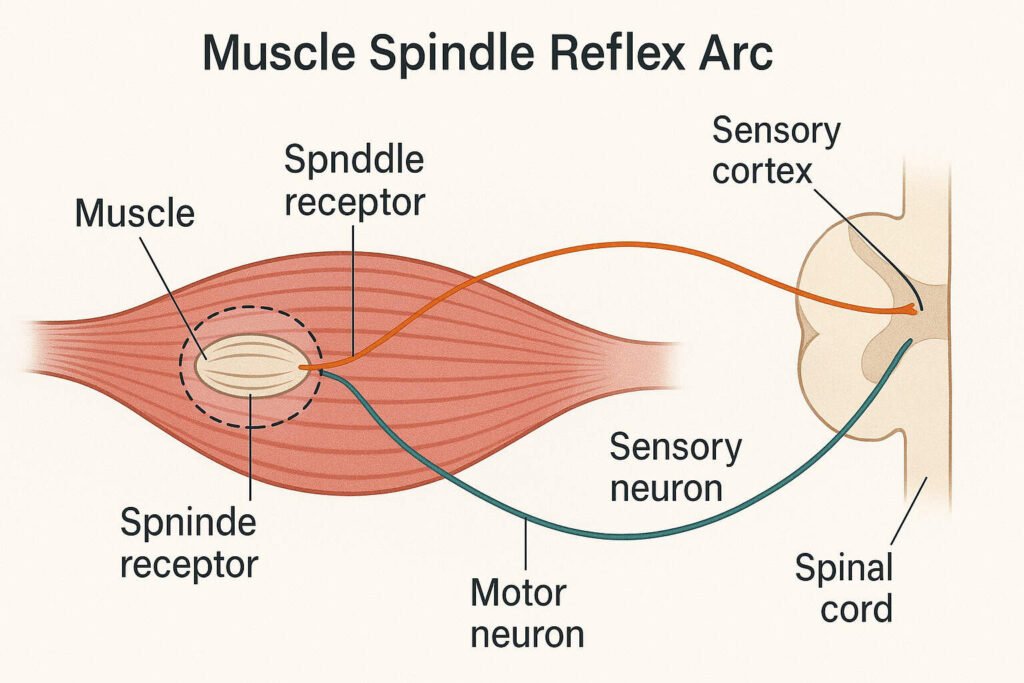
Why Humans Can’t Go Faster Than ~100 ms
There are hard biological limits that prevent faster voluntary responses:
- Neural transmission delay across sensory pathways
- Synaptic processing time in the brain
- Muscle activation latency after motor commands
- Myelination limits of human neurons
Even in optimal conditions, these constraints cap conscious reaction speed.
Reaction Time Speed Comparison (Context Only)
To understand where the record fits, it helps to compare response types.
| Response Type | Typical Range |
|---|---|
| Reflex responses | ~10–60 ms |
| Auditory reaction time | ~150–180 ms |
| Visual reaction time | ~200–250 ms |
| Fastest verified human reaction | ~101 ms |
Reflexes are faster because they bypass conscious decision-making. Choice reactions are slower because they require additional cognitive processing.
For interpretation standards, see what counts as a good reaction time
Frequently Asked Questions
Is under 100 ms possible naturally?
No. Under natural conditions, conscious human reactions do not reliably fall below 100 ms.
Why are Olympic false starts illegal under 100 ms?
Because such responses are assumed to involve anticipation rather than reaction.
Are gamers faster than athletes?
Gamers often perform well on simple tasks, but their results are affected by hardware latency and prediction.
What is the absolute human limit?
Current evidence places the lower bound for conscious reaction time at approximately 100–110 ms.
Final Verdict
The fastest scientifically verified, unassisted, conscious human reaction time ever recorded is approximately 101 milliseconds.
Any faster value involves reflexes, artificial aid, prediction, or measurement error.
🔍 Ready to measure your own response speed?
Once the limits are clear, the next logical step is measurement.
👉 Take Your Reaction Time Cognitive Assessment → reaction-time-test
(This test measures conscious reaction speed, not reflexes.)
🧠 Exploring Brainwave-Inspired Listening (Optional)
External Sources
Trusted research and medical resources about reaction time and cognitive performance
 National Library of Medicine – Reaction Time Research
Touheed Ali
Touheed Ali is the founder and editor of MemoryRush, an educational cognitive science platform. He builds and maintains interactive tools focused on memory, attention, and reaction time.
His work centers on translating established cognitive science concepts into clear, accessible learning experiences, with an emphasis on transparency and responsible design.
MemoryRush
Educational Cognitive Science Platform • Memory • Attention • Reaction Time
Educational Use Only
MemoryRush is created for learning and self-exploration and does not provide medical, psychological, or clinical evaluation.