
Good Number Memory Score
What Counts as Average, Good & Exceptional Performance
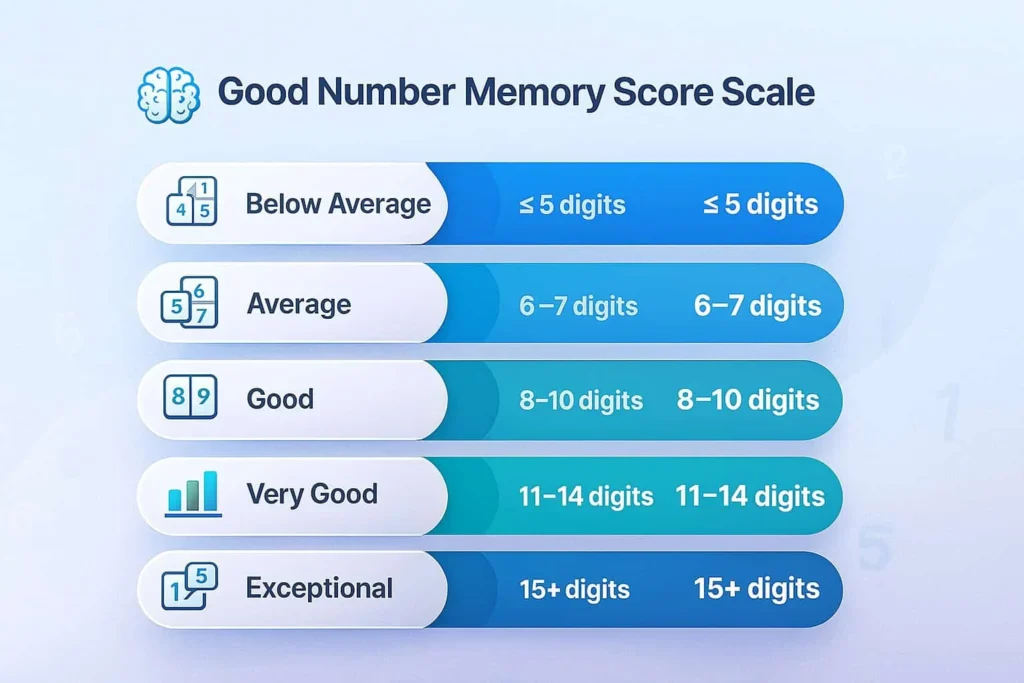
A good number memory score depends on how many digits you can recall in the correct order after seeing them once. Most adults score 6–7 digits, which represents the natural limit of short-term memory. Understanding what makes a "good score" helps you improve your number recall abilities.
Quick Answer: What's a Good Number Memory Score?
A good number memory score generally starts around 10 digits, with 6-7 digits being average for most adults. Scores of 11-14 digits are very good, while 15+ digits fall into the exceptional category often seen in memory athletes.
Number Memory Score Categories
Often influenced by low attention, distraction, or short-term memory limits
Matches the classic memory span range identified in cognitive psychology research
Shows strong attention, better memory encoding, and low susceptibility to interference
Represents high working memory capacity and strong resistance to digit forgetting
Achieved through training techniques, chunking, and deliberate practice
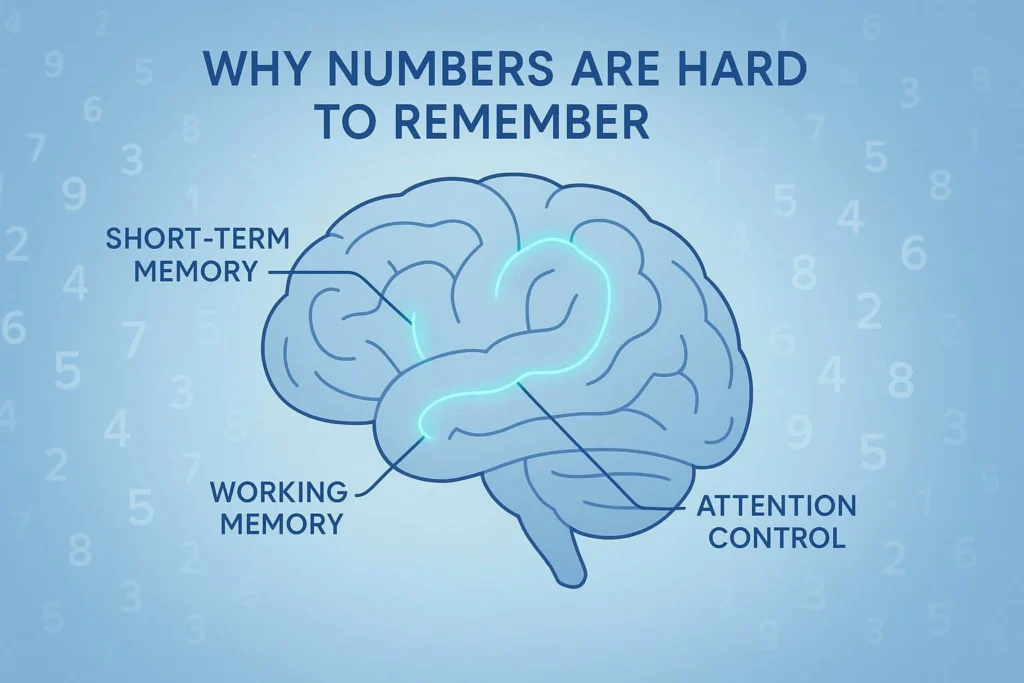
Why Are Numbers So Hard to Remember?
No Emotional Meaning
Digits carry no built-in meaning, so the brain forgets them faster than images or words—you get pure memory decay for numbers.
Short-Term Memory Limits
The brain naturally holds 7 ± 2 items; beyond that, retention collapses. This explains why digits fade quickly and why number sequence forgetting happens fast.
Attentional Overload
If attention slips even slightly, number distraction effects cause an immediate drop in recall accuracy and performance.
Memory Interference
New information replaces old information, leading to number recall difficulty—especially when you're stressed or multitasking.
Common Number Memory Challenges
If you struggle with recalling numbers, these factors might be affecting your performance:
- Cognitive overload or sleep deprivation
- Stress-related number recall difficulty
- Natural short-term memory limits
- Lack of focus during encoding
- Low emotional connection to digits
- Distraction and background noise
- Memory interference from similar digits
- Natural memory decay in seconds
How to Improve Your Number Memory
Use Chunking
Group digits into meaningful blocks. Instead of 748193, remember it as 748 – 193.
Visual Patterns
Turn numbers into shapes or spatial paths to create visual memory anchors.
Repeat Immediately
Active rehearsal prevents memory decay and strengthens encoding.
Reduce Distraction
Background noise sharply increases recall difficulty and error rates.
Sleep Well
Research shows sleep strengthens short-term to long-term memory encoding.
Scores on Memory Games
Here's what different scores mean on platforms like Human Benchmark:
- Average score: 7 digits
- Good score: 10–12 digits
- Great score: 13–15 digits
- Top 1%: 16–20+ digits
Memory champions trained with mnemonics often reach 50–80 digits through specialized techniques and extensive practice.
Frequently Asked Questions
Final Score Assessment
A good number memory score generally starts around 10 digits, but anything above 6–7 is within the normal healthy range. If you're consistently recalling 12+ digits, your performance is statistically superior. Understanding why numbers fade quickly and how memory limits work gives you the power to improve rapidly through targeted practice and effective techniques.
Ready to Train Your Brain?
Challenge your cognitive skills with our scientifically-designed brain training games. Improve memory, reaction time, and mental agility.
Explore all our cognitive training games and start your brain fitness journey today!
View All GamesExternal Sources
Safe, high-authority research on pattern memory and cognitive processes
1National Library of Medicine – Cognitive Pattern Recognition Research
Human memory processing, pattern encoding, and recall pathways ke scientific studies.
👉 National Library of Medicine2Frontiers in Human Neuroscience
Research covering pattern learning, sequence memory, and visual pattern processing.
👉 Frontiers in Human Neuroscience – Sequence Learning Research3APA (American Psychological Association)
General cognitive explanations supporting pattern learning, recall, and recognition mechanisms.
👉 APA – Cognitive Memory Processes