
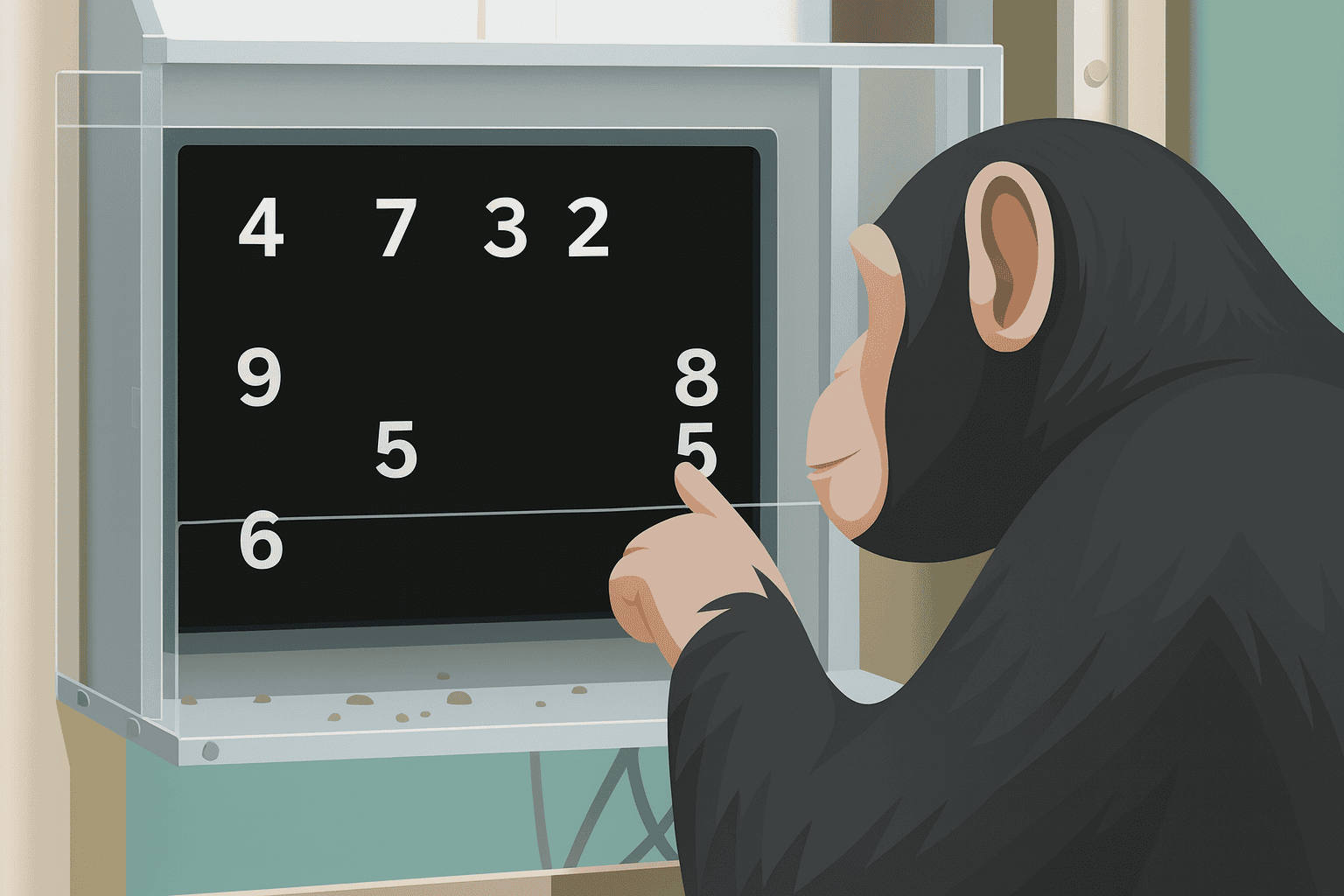
How to Improve Chimp Test Score
Quick Answer
- 5 highest-impact strategies backed by cognitive science
- Step-by-step progression from beginner to advanced levels
- 7-day structured training plan with specific drills
- How to overcome common performance plateaus
The 5 Highest-Impact Strategies
- 1. Zone Chunking (A/B/C Grid Method)
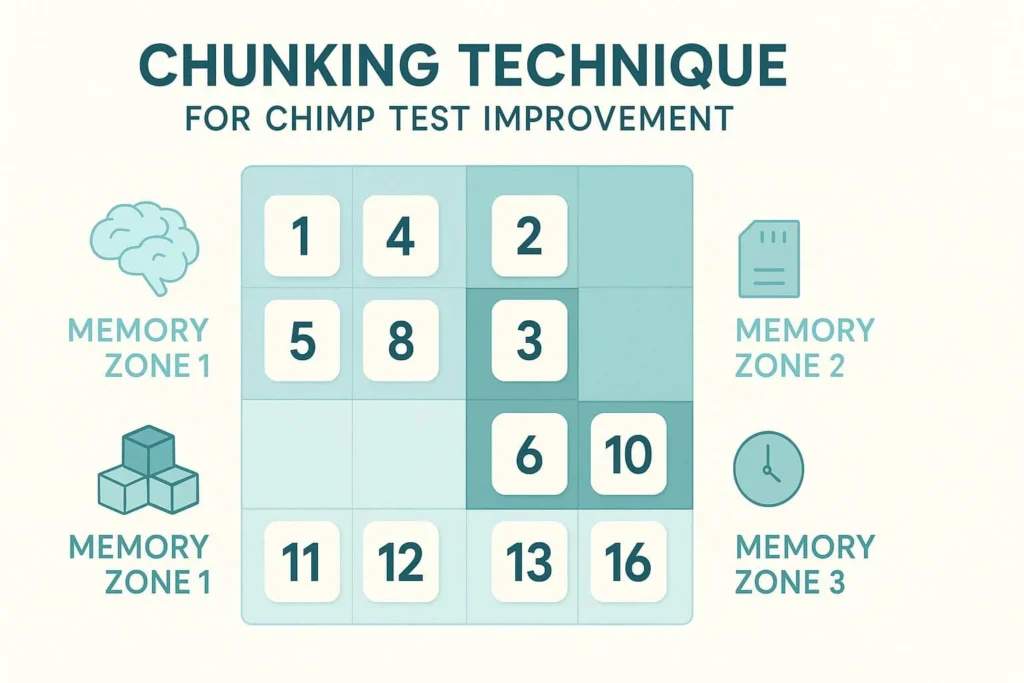
Instead of memorizing 9 individual squares, divide the screen into three zones: Top (A), Middle (B), and Bottom (C). Track which zone each number appears in, reducing 9 items to 3 zone patterns. This leverages the brain’s natural capacity for spatial grouping. - 2 Shape Pattern Recognition
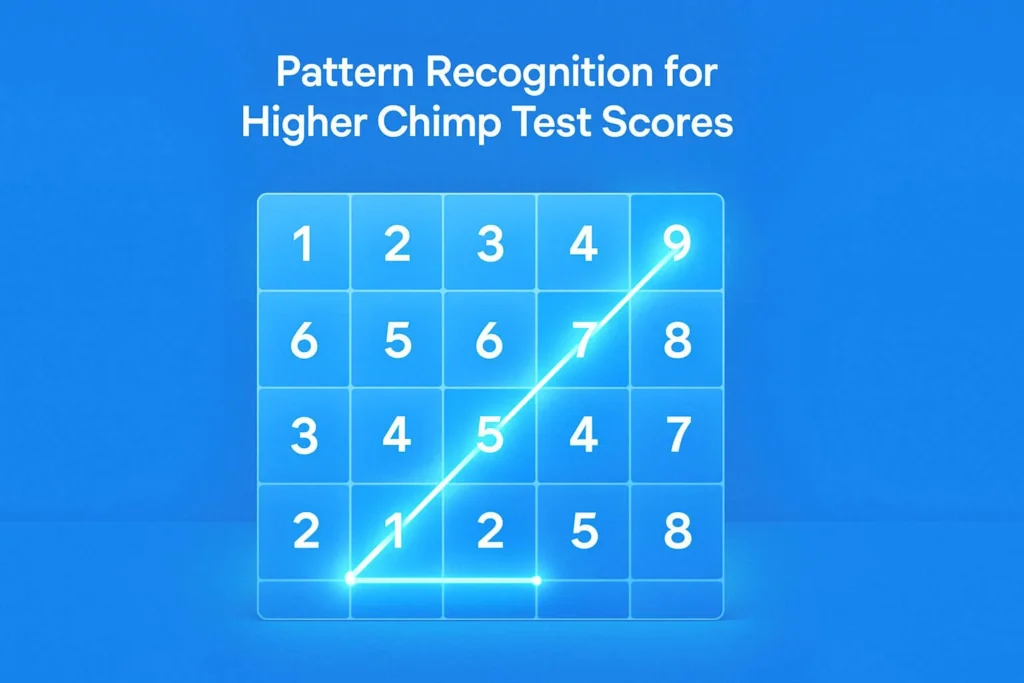
Numbers often form geometric patterns (L-shapes, diagonals, clusters). Train yourself to see these shapes rather than individual digits. A “7-8-9” diagonal is one pattern unit, not three separate numbers. - 3 Fixed Scan Path Development
Create and consistently use the same visual scanning route. Example: Start top-left → move right → next row → etc. This reduces cognitive load by making the search process automatic rather than exploratory. - 4 Ghost Trail Visualization
As numbers disappear, visualize a faint “ghost” image remaining in their positions. This mental overlay technique bridges the gap between visual presentation and spatial recall. - 5. Pre-Attempt Priming Protocol
Spend 30 seconds before each attempt visualizing the task, recalling previous successful patterns, and setting intention. This activates relevant neural pathways before the test begins.
MemoryRush Strategy Analysis
Cognitively designed strategies for optimal memory training and score improvement
| Strategy | Best For | Time to Master | Score Impact |
|---|---|---|---|
|
Zone Chunking
|
Beginners | ⏱️ 2-3 days | +3-5 points |
|
Shape Recognition
|
Intermediate | ⏱️ 5-7 days | +4-7 points |
|
Fixed Scan Path
|
All levels | ⏱️ 3-4 days | +2-4 points |
|
Ghost Trail
|
Advanced | ⏱️ 7-10 days | +5-8 points |
|
Priming Protocol
|
Plateaus | ⏱️ 1-2 days | +1-3 points |
Step-by-Step Progression System
Focus: Basic chunking + distraction elimination
Key Drill: Practice with only 4-6 numbers initially, focusing exclusively on zone recognition
Common Mistake: Trying to remember each number individually instead of positions
Focus: Pattern recognition and speed enhancement
Key Drill: Use our pattern memory training techniques to improve spatial grouping
Progression Tip: Gradually reduce display time as skill improves
Focus: Peripheral vision and overload management
Key Drill: Practice while consciously expanding peripheral awareness of all squares simultaneously
Elite Technique: Develop “whole-grid” perception rather than sequential scanning
Overcoming Common Performance Plateaus
Plateau 1: Stuck at 8-10 Points
Cause: Still using serial processing (one number at a time)
Solution: Force yourself to see at least two numbers as a pair. Use the techniques explained in visual number memory to enhance spatial processing.
Plateau 2: Stuck at 12-14 Points
Cause: Encoding speed bottleneck
Solution: Practice with intentionally shortened display times (even if you fail) to train faster initial capture
Plateau 3: Stuck at 15-18 Points
Cause: Cognitive fatigue and attempt management
Solution: Limit yourself to 3 serious attempts per session with 5-minute breaks between
Elite Level: 20+ Points
Strategy: Fewer attempts (1-2 per day), optimal timing (morning alertness), and mental state management
MemoryRush Training Program
Structured 7-day plan designed for maximum cognitive improvement and memory mastery
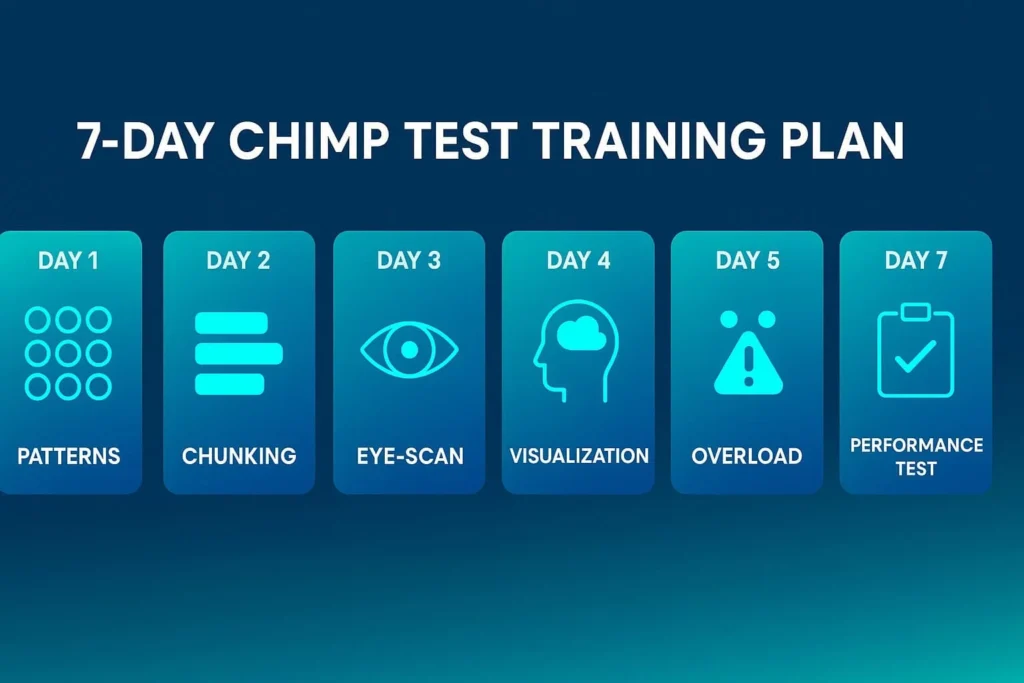
7-Day Structured Training Plan
| Day | Focus | Specific Drills | Attempts | Time |
|---|---|---|---|---|
|
1
Day 1
|
Zone Recognition | Practice with only zones A/B/C identification | 10 | 15min ⏱️ |
|
2
Day 2
|
Pattern Spotting | Identify L-shapes, diagonals, clusters | 8 | 20min ⏱️ |
|
3
Day 3
|
Scan Path | Develop and stick to one scanning route | 6 | 15min ⏱️ |
|
4
Day 4
|
Speed Training | Reduce display time by 20% | 10 | 25min ⏱️ |
|
5
Day 5
|
Integration | Combine zone + pattern + scan | 5 | 20min ⏱️ |
|
6
Day 6
|
Overload | Practice with mental distractions | 6 | 20min ⏱️ |
|
7
Day 7
|
Peak Performance | Optimal conditions, minimal attempts | 3 | 15min ⏱️ |
Cognitive Science Behind Improvement
Improvement in the Chimp Test reflects neuroplasticity in visual-spatial working memory networks. As you practice:
Neural Efficiency Gains
Repeated spatial recall strengthens connections between the visual cortex and prefrontal working memory areas, similar to findings in working memory vs. short-term memory research.
Automaticity Development
Consistent strategies shift processing from conscious effort to automatic pattern recognition, freeing cognitive resources for higher-level processing.
Fatigue Management
Learning to recognize and work within your cognitive limits is as important as raw skill development. This mirrors principles from attention blink vs. chimp memory advantage research.
Limitations & Realistic Expectations
- Device variability affects scores
- Daily fluctuation is normal (±2-3 points)
- Not intelligence measure—tests specific skill
- Diminishing returns—improvement slows at higher levels
- Transfer effects limited—Chimp Test skill doesn’t generalize broadly
For a foundational understanding of what you’re improving, see our definition guide.
Apply These Strategies
Now that you understand the training methodology, apply these techniques with our scientifically designed test.
Frequently Asked Questions
What is a good Chimp Test score for humans?
How well do chimps actually perform on the Chimp Test?
How do I improve my Human Benchmark score quickly?
How long does significant improvement take?
Can anyone reach 20+ points?
External Sources
These reputable academic and scientific sources support the cognitive principles behind the Chimp Test and visual short-term memory
- Home of the original chimpanzee visual memory experiment that inspired modern “chimp tests.”
 Kyoto University Primate Research Institute Publications
 Kyoto University Primate Research Institute Publications
- Peer-reviewed research on visual working memory, short-term recall, and memory span. PubMed Research Database
- Authoritative psychological explanations of working memory and human cognitive processes. APA Psychology Resources

Touheed Ali
Touheed Ali is the founder and editor of MemoryRush, an educational cognitive science platform. He builds and maintains interactive tools focused on memory, attention, and reaction time.
His work centers on translating established cognitive science concepts into clear, accessible learning experiences, with an emphasis on transparency and responsible design.
MemoryRush
Educational Cognitive Science Platform • Memory • Attention • Reaction Time
Educational Use Only
MemoryRush is created for learning and self-exploration and does not provide medical, psychological, or clinical evaluation.
4 thoughts on “How to Improve Chimp Test Score: Best Tips & Memory Tricks”
Comments are closed.