

How to Improve Number Memory
The Fastest Path to a Better Score
Forget random tips. To improve quickly: Start with chunking (break numbers into groups), add rhythm for encoding, and do short, daily recall drills. Protect your focus and get good sleep—it’s a performance multiplier. Follow the 7-day plan below for structured progress.
You’ve probably seen lists of memory tricks. “Use the Major System!” “Build a Memory Palace!” It’s overwhelming. The real question isn’t “What techniques exist?”—it’s “What should I do first, and in what order, to actually see improvement?”
This guide is different. It’s a structured training program based on cognitive science. We’ll give you a clear starting point, a decision tree to choose your path, and a simple 7-day plan. No confusion, just progress.
This page is your training manual. It covers the step-by-step techniques, practice drills, and plan to improve.
Looking for something else? To understand what your current score means, or to take the assessment and measure your progress, visit our dedicated pages.
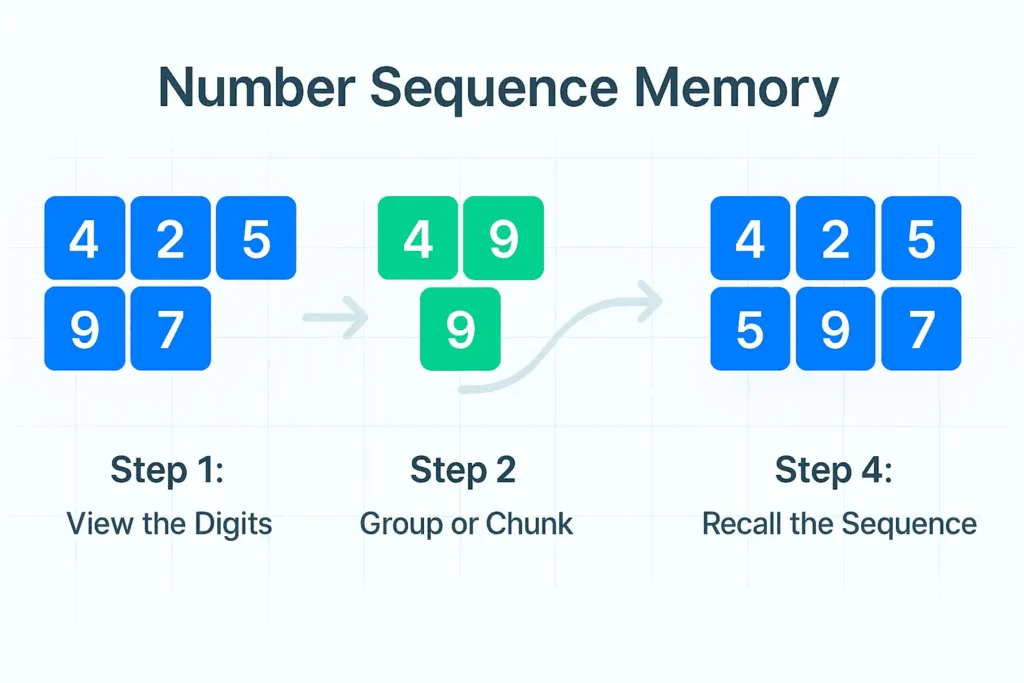
Why Numbers Slip Away (The Science)
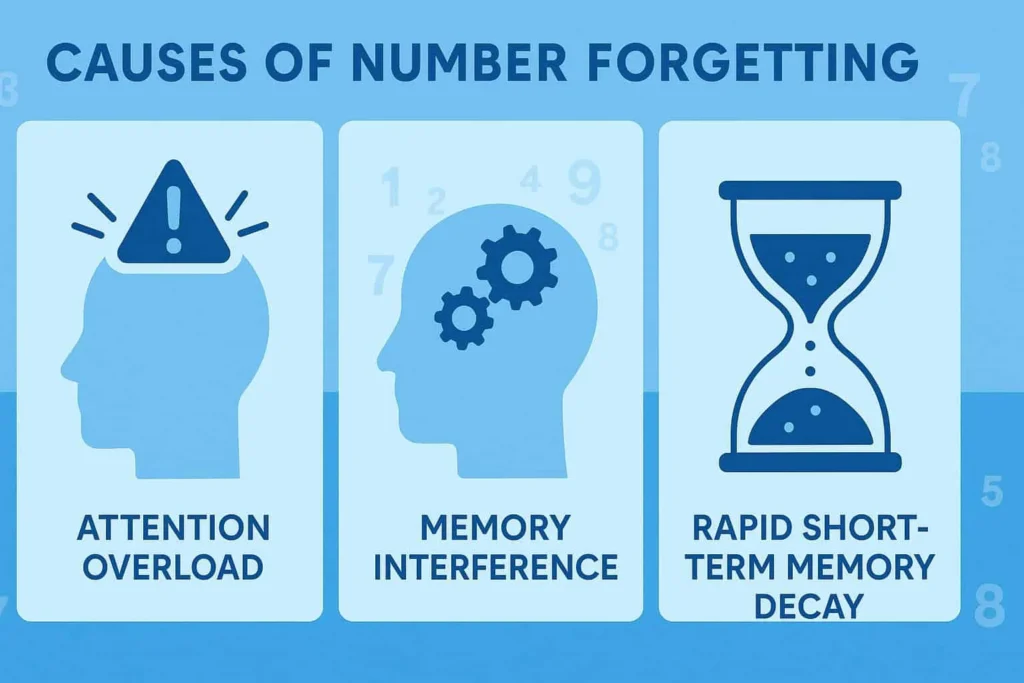
Knowing why it’s hard makes the solutions click. Numbers are tough because:
- Low Meaning: Unlike a word like “apple,” the digit “7” has no inherent image or story. Our brains struggle to hold onto abstract things.
- Working Memory Limits: Your brain’s “mental scratchpad” can only hold a few items at once. For most people, that’s about 4-7 unrelated pieces of information.
- Interference: New digits actively push out old ones if they’re not properly stored. This is a key reason numbers are harder than words.
Find Your Starting Point: The Decision Tree
Don’t guess. Use this flowchart to pick the right method for your goal and time.
Step 1: What’s your main goal?
→ Goal: 7-10 digits (Quick Win / Beginner): Use Chunking + 30-second drills. If you still forget, add rhythm and cut distractions.
→ Goal: 10-15 digits (Serious Improvement): Use Chunking + Visualization + Spaced Repetition. Stuck at 12? Add pattern spotting.
→ Goal: 15+ digits (Elite/Competitive): Use Memory Palace (Loci). For speed, later add the Major System.
Step 2: What’s your biggest weakness?
→ Forget instantly? That’s an encoding issue. Focus on chunking and creating visual anchors for the first 3 digits.
→ Mix up the order? That’s a sequencing issue. Use a strong rhythm and stick to fixed chunk sizes (always groups of 3 or 4).
→ Score drops under pressure? That’s an attention issue. Practice shorter sessions, take more breaks, and prioritize sleep.
Step 3: How much time do you have daily?
→ 2-5 minutes: Do three 30-second drills focusing purely on chunking.
→ 5-10 minutes: Add a spaced repetition ladder (recall after 10 sec, 1 min, 5 min) and simple visualization.
→ 15+ minutes: Build a Memory Palace route and dedicate time to reviewing mistakes.

The Techniques, Ranked from Simple to Advanced
Start at the top. Master one before layering in the next.
1. Chunking (Your Foundation)
What it is: Breaking a long string into smaller, manageable groups, like a phone number (555-867-5309).
How to do it: Look at the number and immediately split it. Use 3-4 digits per chunk. Example: 827491 becomes 827 / 491.
Best for: Everyone. Always start here.
Common mistake: Making uneven chunks (like 82-74-91). Keep them consistent.
2. Rhythm & One-Cycle Rehearsal
What it is: Saying the numbers with a beat to engage your auditory memory.
How to do it: Whisper or tap as you read: “58 [pause] 39 [pause] 10.” Only rehearse the sequence one time immediately after seeing it.
Best for: Boosting initial “stickiness” of the numbers.
Common mistake: Repeating it over and over silently. This tires out your focus without strengthening memory.
3. Simple Visualization (Image Mapping)
What it is: Turning digits into simple pictures. 0=ball, 1=pencil, 2=swan, 3=heart, 4=sailboat, 5=hook, 6=elephant trunk, 7=cliff, 8=snowman, 9=balloon on a string.
How to do it: For 527, picture a hook (5) pulling a swan (2) off a cliff (7).
Best for: Moving past the 9-12 digit plateau.
Common mistake: Making images too complex. Simple and vivid works best.
4. Spaced Repetition (For Long-Term Hold)
This is the secret weapon for moving numbers from short-term to long-term memory. It’s based on the well-researched spacing effect. After you recall a sequence correctly, test yourself again after 10 seconds, then 1 minute, then 10 minutes, then the next day.
5. Memory Palace / Method of Loci (Advanced)
What it is: Placing your number-images along a familiar mental journey, like the rooms in your house.
How to do it: Choose a route (e.g., Bedroom → Hallway → Kitchen). Put one image from your sequence in each location. To recall, walk the route in your mind.
Best for: Ambitious goals of 15+ digits.
Note: We mention the Major System (converting digits to sounds) as the elite tool for this, but it’s a multi-week project. Don’t start with it.
Your 7-Day Number Memory Training Plan
Commit to 5–10 minutes a day. Consistency beats marathon sessions.
| Day | Focus & Technique | Daily Drill (5–10 min) |
|---|---|---|
| Day 1 | Baseline & Chunking | Test your current max digits. Practice chunking 5 different 8-digit sequences. |
| Day 2 | Add Rhythm | Do 3 recall drills with 8-digit numbers, using a clear rhythm as you encode. |
| Day 3 | Simple Visualization | Learn images for 0–9. Recall 3 sequences using pictures for the first 3 digits. |
| Day 4 | Mixed Drill Day | Alternate between 8-digit (speed) and 10-digit (accuracy) sequences. |
| Day 5 | Spaced Repetition Ladder | Recall one 9-digit sequence immediately, after 1 min, and after 5 min. |
| Day 6 | Push Length & Manage Fatigue | Attempt two 12-digit sequences. If you fail, note where the break occurred. |
| Day 7 | Performance & Review | Retest your max digits. Review what worked and what felt difficult. |
Stuck? How to Break Through Common Plateaus
- Plateau at 7-9 digits? digits? You likely need consistent chunking. Are you grouping the same way every time? Also, eliminate distractions—close extra tabs, andtabs, and silence your phone.
- Plateau at 10-12 digits? digits? Add visualization for the first chunk. Also, implement the spaced repetition ladder to fight decay.
- Plateau at 13-15 digits? digits? It’s time to learn a Memory Palace. Dedicate time to building one 5-location route.
- Random score drops? drops? Check sleep, stress, and multitasking. Cognitive performance is state-dependent. state-dependent. Poor sleep drastically impairs memory encoding.
Quick Answers to Common Questions
What is a good number memory score?
A good score depends on your technique! A raw score of 9-10 digits is strong. A score of 15+ usually means you’re using strategies. See our detailed score interpretation guide.
How long until I see improvement?
With the 7-day plan, most people notice better focus and accuracy within the first 3-4 days. Adding 2-3 stable digits to your max span typically takes 2-3 weeks of consistent practice.
Do I really need a memory palace?
Only if your goal is to remember 15+ digits routinely. For everyday improvement (up to 12-13 digits), chunking, rhythm, and visualization are perfectly sufficient.
Ready to Train, Not Just Read?
Knowledge is useless without practice. Apply this plan with structured sequences and track your progress scientifically. Use the MemoryRush Number Memory Test for consistent drills and to measure your improvement week over week.
External Sources
Safe, high-authority research on pattern memory and cognitive processes
- Human memory processing, pattern encoding, and recall pathways are key scientific studies. National Library of Medicine
- Research covering pattern learning, sequence memory, and visual pattern processing. Frontiers in Human Neuroscience—Sequence Learning Research
- General cognitive explanations supporting pattern learning, recall, and recognition mechanisms. APA – Cognitive Memory Processes
Note: This guide provides cognitive training strategies. Individual results depend on consistency, baseline ability, and overall cognitive health. It is not a substitute for professional medical advic

Touheed Ali
Touheed Ali is the founder and editor of MemoryRush, an educational cognitive science platform. He builds and maintains interactive tools focused on memory, attention, and reaction time.
His work centers on translating established cognitive science concepts into clear, accessible learning experiences, with an emphasis on transparency and responsible design.
MemoryRush
Educational Cognitive Science Platform • Memory • Attention • Reaction Time
Educational Use Only
MemoryRush is created for learning and self-exploration and does not provide medical, psychological, or clinical evaluation.
9 thoughts on “How to Improve Number Memory”
Comments are closed.