
Human vs Chimp Memory
Quick Answer:
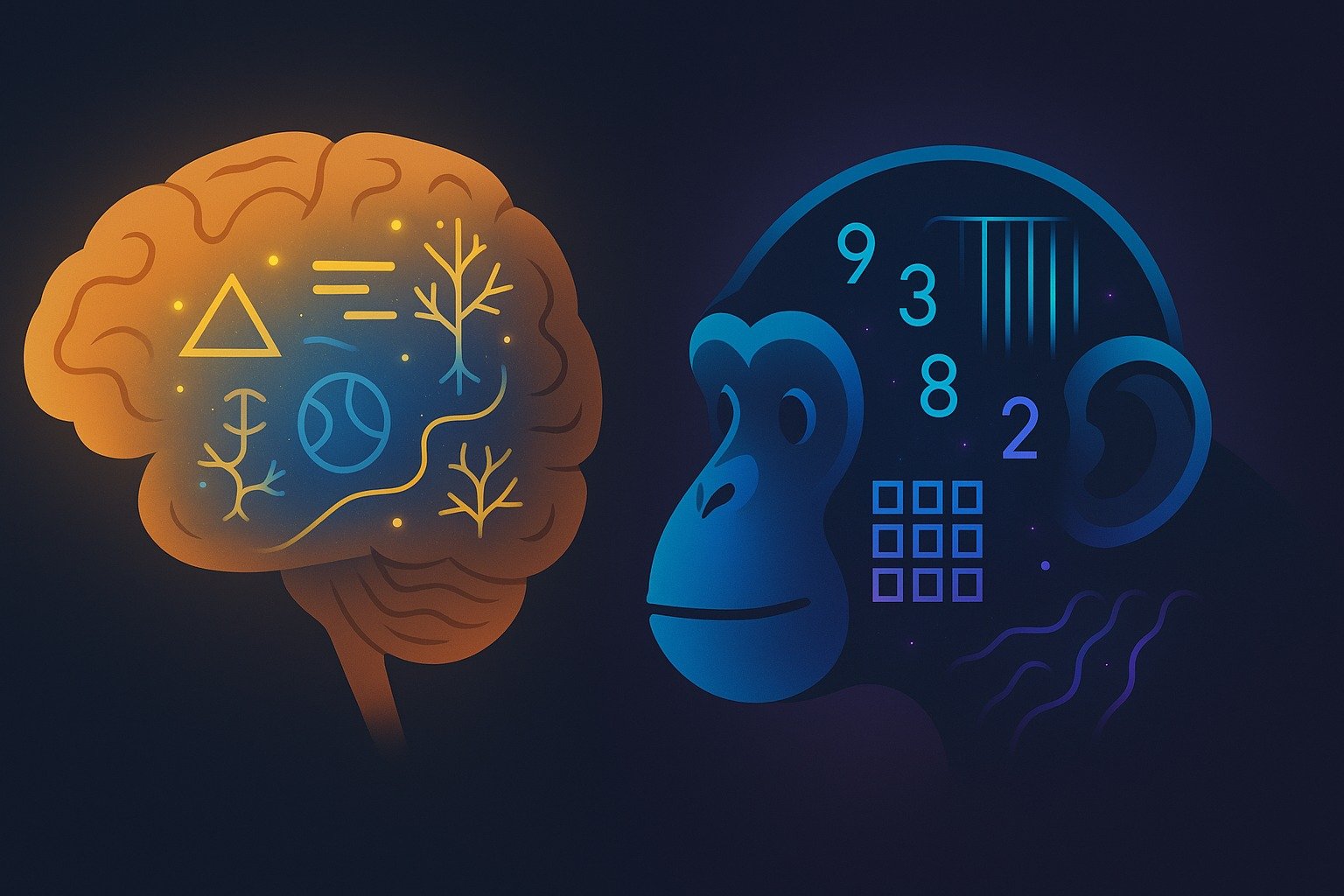
Human and chimpanzee memory systems share deep evolutionary roots, yet they diverge sharply in structure, speed, and purpose. While humans excel in symbolic reasoning, long-term knowledge, and autobiographical detail, chimpanzees display astonishing strengths in ultra-fast visual memory and rapid spatial processing.
The Core Memory Systems: A Species-Level Comparison
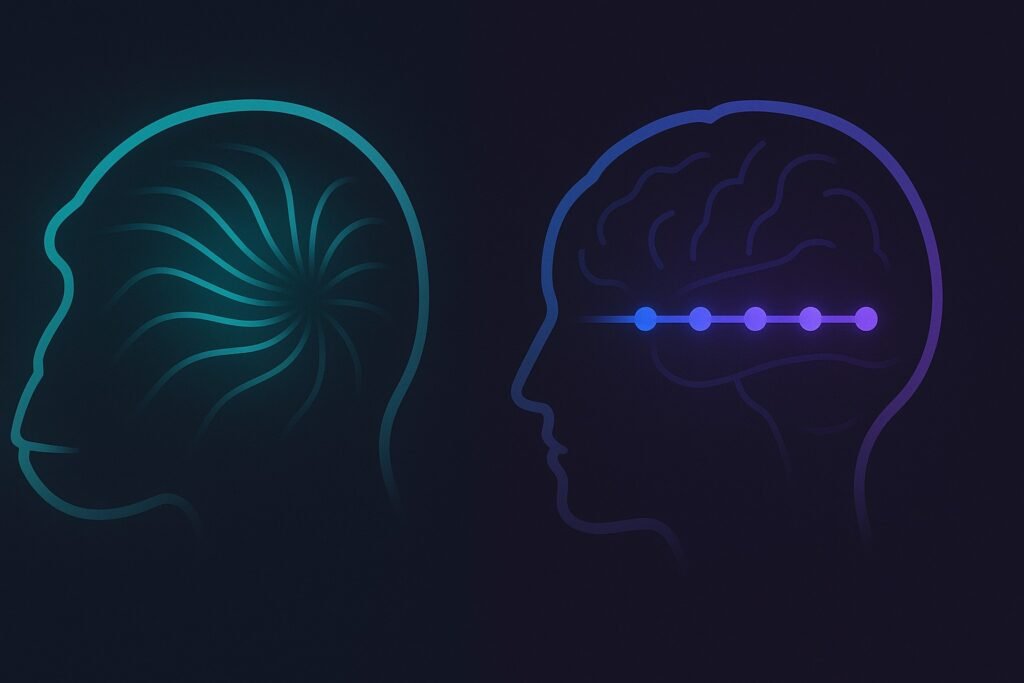
Memory is not a single structure but a constellation of independent systems shaped by evolution. Humans and chimpanzees each possess strengths optimized for their respective environments and lifestyles.
Sensory/Iconic Memory
Chimps encode visual arrays in under 200 ms, while humans require 200–500 ms. This allows young chimps to recall the position of nine numbers flashed for only 210 milliseconds — an ability most humans cannot approach.
Visual Working Memory
Parallel vs. serial encoding: Chimps use parallel encoding, capturing entire arrays as unified snapshots. Humans use serial encoding, processing items one after another. Chimps show lower interference and maintain stable performance even under increasing difficulty.
Spatial Memory
Chimps evolved in dense, visually complex forests. Their survival depended on rapid pattern detection, movement tracking, and instant spatial mapping. They outperform humans in object–location binding and rapid scene reconstruction.
Auditory Working Memory
Phonological loop superiority: Humans possess a robust auditory rehearsal system enabling repeating, rehearsing, and refreshing sequences. Chimps lack linguistic rehearsal, resulting in weaker auditory short-term memory for sequences.
Episodic Memory
Autobiographical richness: Humans excel at storing personal events with time, emotion, and narrative context. Chimps show basic episodic-like memory but lack the complexity, temporal detail, and self-narrative formation humans demonstrate.
Semantic Memory
Conceptual networks: Humans build large conceptual networks enabling reasoning, teaching, and abstract thinking. Chimps possess basic category knowledge but do not organize it symbolically or linguistically as humans do.
Procedural Memory
Skill-based learning: Both species show strong procedural learning — skills acquired through repetition. Chimps use tools, crack nuts, and solve mechanical puzzles. Humans show greater refinement and long-term stabilization of complex procedures
Neural Architecture Differences
Human and chimp memory differences begin with the structure and wiring of their brains.
Stronger Early Visual Cortex in Chimps
Chimpanzees display unusually strong activation in early visual processing areas (V1/V2/V3), enabling faster feature detection and higher fidelity early-stage encoding.
Expanded Prefrontal Cortex in Humans
The human prefrontal cortex is far larger and more interconnected, enabling planning, abstraction, rule formation, symbolic computation, and strategic memory management.
Dorsal vs Ventral Stream Dominance
Chimps: Dorsal dominance for fast spatial orientation. Humans: Ventral reliance for recognizing and interpreting meaning. This fits their ecological roles.
Parallel vs Serial Encoding
Chimps capture entire visual arrays in one snapshot. Humans encode sequentially, slowing performance and increasing interference. Parallel encoding is extremely rare in adult humans.
The Cognitive Trade-Off Hypothesis
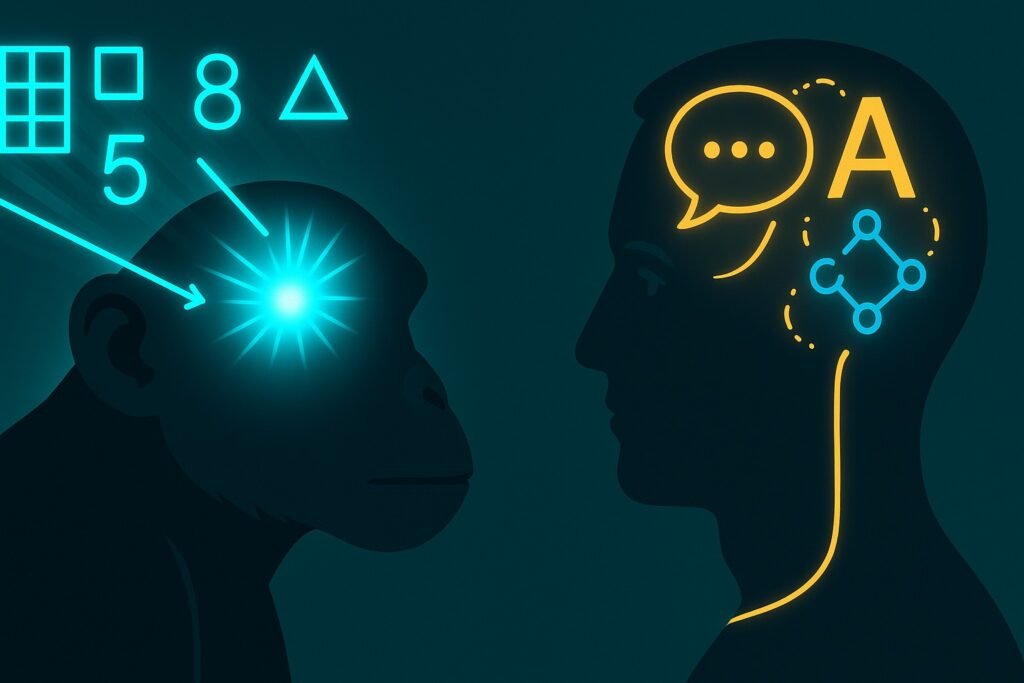
This evolutionary theory explains why humans lost some raw memory abilities while gaining others.
What Humans Gained
Language, abstract thought, complex social structures, multi-step planning, conceptual hierarchy, and story-based long-term memory. These abilities depend heavily on the prefrontal cortex.
What Chimps Retained
Ultra-fast visual precision, snapshot encoding, rapid spatial judgment, low-latency motor responses, and high perceptual clarity. Essential in forest environments where threats and opportunities are fleeting.
Why Both Traits Cannot Coexist Fully
High-speed visual processing and slow, abstract symbolic reasoning require opposite neural resource patterns. Evolution chose different optimizations: Chimps → raw perceptual power; Humans → conceptual complexity.
Strengths & Weaknesses: Direct Species Comparison
Chimpanzee Strengths
- Ultra-fast iconic memory
- Parallel encoding
- Fast spatial mapping
- Low interference
- Stable short-term performance
- Rapid attentional reset
Chimpanzee Weaknesses
- Poor symbolic memory
- Weak long-term planning
- No sophisticated strategies
- Poor rule-switching
- Limited episodic richness
- Minimal abstract reasoning
Human Strengths
- Strong long-term memory
- Excellent symbolic memory
- Episodic detail with self-narrative
- Rule-building and abstraction
- Strategic problem-solving
- Flexible task-switching
Human Weaknesses
- Vulnerable to attentional blink
- Slow visual encoding
- High cognitive interference
- Serial processing bottleneck
- Overreliance on language
- Limited parallel processing
Performance Statistics: Human vs Chimp Memory
Quantitative comparisons from cognitive neuroscience research:
210 ms
350 ms
90%
40%
200-500 ms
50-100 ms
Parallel
Serial
Frequently Asked Questions
Common questions about human vs. chimp memory, answered with detailed neuroscience insights:
Do chimps really have better memory than humans?
Do chimps have photographic memory?
Why do humans fail the chimp test?
Can humans develop chimp-like memory?
Are chimps smarter than humans?
Do chimps experience attentional blink?
How does working memory compare?
What is the cognitive trade-off hypothesis?
Why are chimps so fast at number tasks?
Why can humans remember stories better?
Scientific References
Key research studies supporting the neuroscience of human vs. chimp memory comparisons:
Working memory of numerals in chimpanzees
Visual short-term memory in chimpanzees and humans
Cognitive trade-offs in primate evolution
Explore Memory Research
MemoryRush offers research-inspired educational content designed for learning and self-exploration. Not a medical assessment.
Chimp Test Research
Explore the cognitive science behind chimpanzee memory studies and what they reveal about primate cognition.
Scientific Insights
Understand what memory research reveals about attention, perception, and cognitive processing in primates.
Learning & Practice
Educational guides for understanding and practicing memory techniques inspired by cognitive research.
Note: This content is for educational self-exploration and learning purposes only. It is not a medical or psychological assessment. Results are based on practice and vary naturally between individuals.
Browse All Chimp Test Content →
Touheed Ali
Touheed Ali is the founder and editor of MemoryRush, an educational cognitive science platform. He builds and maintains interactive tools focused on memory, attention, and reaction time.
His work centers on translating established cognitive science concepts into clear, accessible learning experiences, with an emphasis on transparency and responsible design.
MemoryRush
Educational Cognitive Science Platform • Memory • Attention • Reaction Time
Educational Use Only
MemoryRush is created for learning and self-exploration and does not provide medical, psychological, or clinical evaluation.
3 thoughts on “Human vs Chimp Memory: Full Cognitive Comparison & Evolution Guide”
Comments are closed.