
Understanding the Number Memory Assessment
What Is the Number Memory Test?
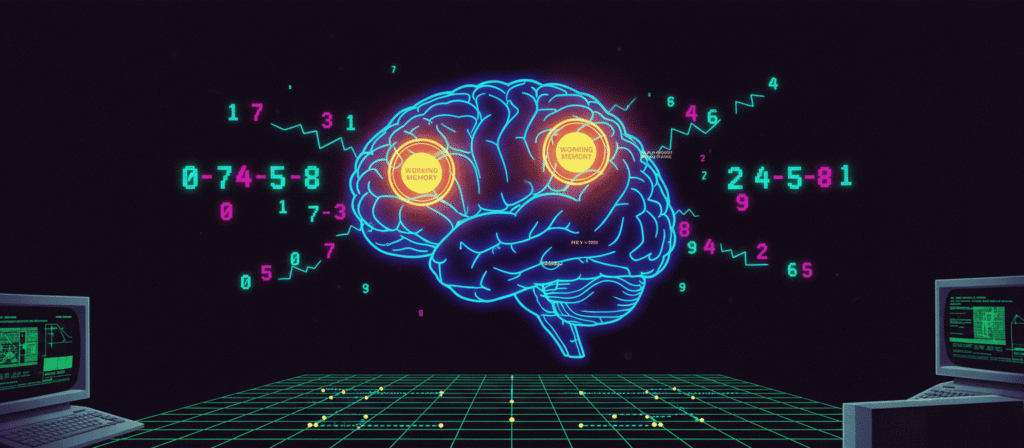
The Number Memory Test is an educational cognitive task designed to explore working memory—your brain’s ability to temporarily hold and manipulate numbers.
On MemoryRush, this test is presented purely for educational purposes. It demonstrates how the brain processes sequential information, a skill used in daily life for remembering phone numbers, codes, or steps in procedures.
You can try the interactive version here: Number Memory Test
What Does the Number Memory Test Measure?
This assessment evaluates specific cognitive skills, including:
- Sequential Working Memory—Ability to recall numbers in the order they appear. Learn more about the difference between digit span and number memory.
- Visual-Spatial Memory – Observing and recalling number positions strengthens spatial awareness. Explore visual chunking and memory strategies.
- Attention and Focus – Short memorization periods train selective attention. Related reading: Does Multitasking Ruin Reaction Time?
These measures reflect task-specific memory performance. They do not indicate intelligence or clinical ability.

How the Number Memory Test Works
- Numbers appear in a sequence on the screen.
- Memorize the sequence in order.
- Recall the sequence by inputting it correctly.
- Difficulty increases as the sequence lengthens.
Observation modes include:
- Standard – Progressive sequence lengths, no time pressure.
- Timed—Complete as many sequences as possible within a fixed interval.
- Practice—Unlimited attempts at your chosen difficulty level.
- Reverse Sequence—Recall sequences in reverse order, testing working memory manipulation.
How Scoring Works
Your score represents the longest sequence you successfully recall:
- Remembering 5 numbers = score of 5
Remembering 8 numbers = score of 8
There is no pass or fail, and results can vary based on fatigue, focus, or device conditions.
Curious about what counts as a good performance? See Good Number Memory Score
Interpreting Your Results
Your score is a snapshot of task-specific memory, not a measure of intelligence.
- Higher scores indicate strong short-term recall for numeric sequences.
- Lower scores reflect faster decay of the sequence in memory under testing conditions.
Performance can fluctuate daily due to stress, distractions, or prior experience.

Common Misconceptions
- Memory is fixed: Reality—working memory can improve with practice.
- Digit span equals intelligence: Reality—it measures a narrow memory skill, not IQ.
- Perfect recall is required: Reality—forgetting is normal; memory has natural limits.
Why This Test Matters
Tasks like this are widely used in cognitive research to:
- Examine working memory limits
- Understand attention and focus patterns
- Study neuroplasticity and learning strategies
For context, explore these guides:
Important Limitations
- This test is not a medical assessment.
- Results are educational only and should not be used for self-evaluation, comparison, or clinical decisions.
- For full context, see our Content Disclaimer and Editorial Policy.
Who Should Use This Test
Suitable for:
- Curious learners
- Students exploring memory concepts
- People interested in cognitive patterns
Not intended for:
- Medical evaluation
- Mental health screening
- Professional decision-making
About This Guide
This guide is written and reviewed by Touheed Ali, founder and editor of MemoryRush.
Learn more about MemoryRush and our team: