
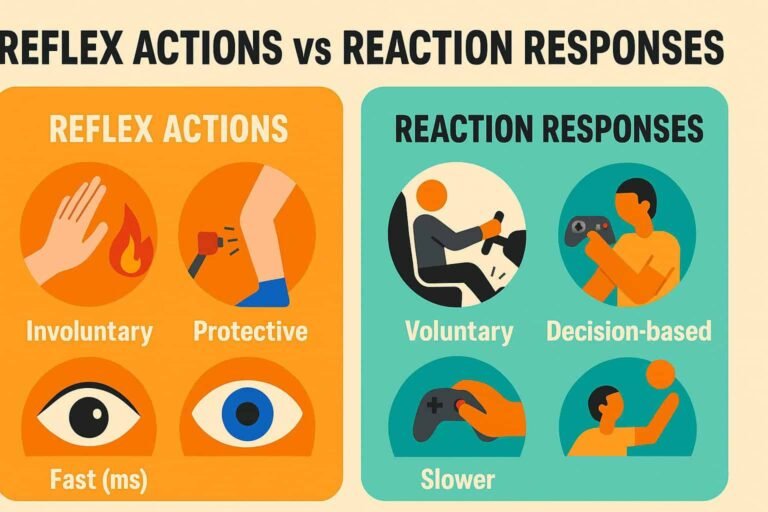
Reaction Time vs Reflex Time
Complete Scientific Breakdown of Voluntary vs Involuntary Responses
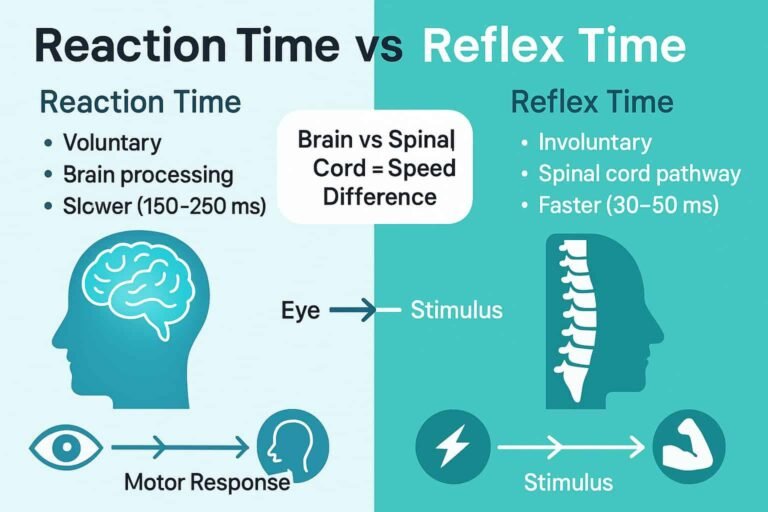
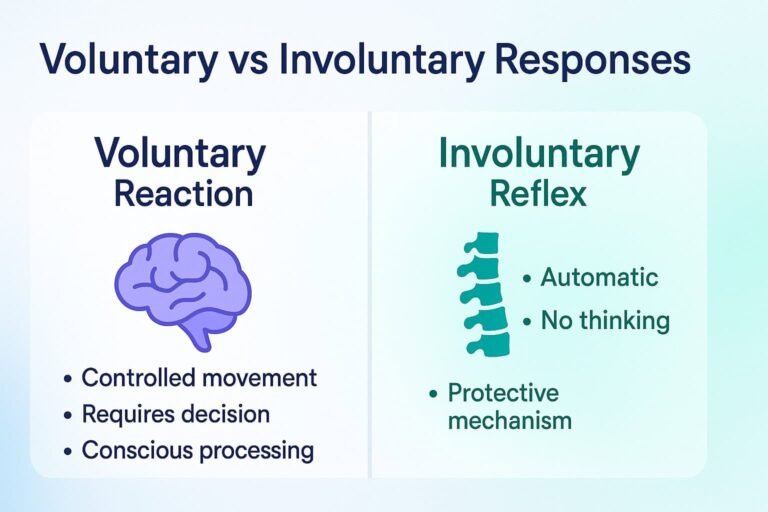
Understanding the difference between reaction time vs reflex time is essential for neuroscience, psychology, sports performance, and human behavior. Although often used interchangeably, the mechanisms are fundamentally different. A reaction is voluntary and conscious, requiring brain processing, while a reflex is involuntary and automatic, controlled by the spinal cord.
Key Differences: Reaction vs Reflex
Reaction Time
Voluntary, Conscious Response
- Requires brain processing
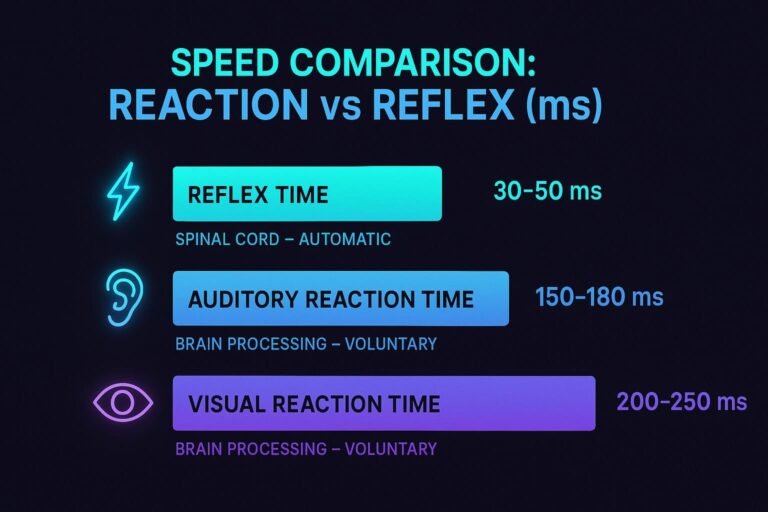
- Slower: 150-250 ms
- Decision-based
- Can be improved with practice
- Examples: Gaming, sports, driving
Reflex Time
Involuntary, Automatic Response
- Bypasses brain (spinal cord)
- Faster: 30-50 ms
- Protective mechanism
- Fixed, built-in response
- Examples: Blinking, pain withdrawal
What Is Reaction Time? (Voluntary Response)
Reaction time refers to how long it takes the brain to perceive a stimulus and make a voluntary decision to respond. It's a fully conscious action that involves sensory detection, brain processing, motor planning, and execution of movement.
Stimulus Appears
Light, sound, movement, or touch is detected by sensory receptors.
Brain Processing
Sensory input travels to the brain for interpretation and analysis.
Decision Made
Cerebral cortex analyzes information and makes a conscious decision.
Movement Execution
Motor cortex sends commands to muscles for voluntary movement.
Typical Reaction Time Ranges
Visual Reaction
Seeing and responding to visual stimuli
Auditory Reaction
Hearing and responding to sounds (faster)
Touch Reaction
Responding to physical contact (fastest)
What Is Reflex Time? (Involuntary Response)
Reflex time is the duration of an automatic action that happens without conscious control. Reflexes are the body's built-in protective mechanisms that occur rapidly because they bypass the brain and are processed through the spinal cord.
Stimulus Detected
Heat, pain, or pressure triggers sensory receptors.
Spinal Cord Processing
Signal travels to spinal cord (bypassing brain).
Immediate Response
Motor neurons activate muscles without conscious thought.
Protective Action
Body performs automatic protective movement.
Reflex Speed Examples
Typical Human Reflex
General reflex response time
Pain Withdrawal
Pulling hand from hot surface
Blink Reflex
One of the fastest human reflexes
Detailed Comparison Table
| Feature | Reaction Time | Reflex Time |
|---|---|---|
| Type of Response | Voluntary, conscious | Involuntary, automatic |
| Control Center | Brain / cerebral cortex | Spinal cord |
| Speed | Slower (150-250 ms) | Faster (30-50 ms) |
| Pathway | Long (brain processing) | Short (reflex arc) |
| Purpose | Decision-based responses | Protection and survival |
| Examples | Catching a ball, pressing buttons | Withdrawal from pain, blinking |
| Flexibility | Can be improved with practice | Fixed, built-in |
| Mechanics | Requires thinking | Requires no thinking |
Why Reflexes Are Faster Than Reactions
Reflexes consistently beat reactions due to neurological distance and processing efficiency:
- Reflexes bypass the brain - No conscious processing required
- Shorter reflex arc - Fewer synapses mean faster transmission
- Evolutionary priority - Protection mechanisms favored speed over accuracy
- No decision-making - Automatic responses eliminate hesitation
For more detailed information on reflex arcs, see this comprehensive guide to reflex arcs from the National Library of Medicine.
Real-World Examples
Reaction Examples
- Gamer pressing shoot button
- Cricket fielder catching a ball
- Driver braking for hazards
- Student answering questions
- Tennis player returning serve
Reflex Examples
- Pulling hand from hot pan
- Blinking when object approaches
- Knee-jerk reflex at doctor's office
- Sneezing from dust irritation
- Coughing reflex
Improving Your Reaction Time
While reflex time cannot be trained (it's automatic), reaction time can be significantly improved through various methods:
Reaction Drills
Gaming and cognitive training exercises
Memory Games
Pattern recognition and speed exercises
Sports Practice
Coordinated movement training
Sleep Optimization
7-8 hours quality sleep for peak performance
For scientific evidence on improving reaction time, see this study on cognitive training and reaction time.
Frequently Asked Questions
Key Takeaway
Understanding reaction time vs reflex time reveals how the brain and spinal cord work together for protection and interaction. Reactions are slow but flexible and improvable, while reflexes are fast, automatic, and fixed. Together, they form the foundation of human behavior, survival mechanisms, athletic performance, and everyday decision-making processes.
Scientific Sources & References
The information in this article is supported by scientific research from reputable sources:
- Neural Pathways and Reflex Arcs - National Library of Medicine
- Physiology, Reflex Arc - StatPearls Publishing
- Cognitive Training and Reaction Time Improvement - NCBI
- Reaction Time and Decision Making - ScienceDirect
- Neural Basis of Voluntary Movement - Journal of Neurophysiology
- Neuron Structure and Function - Khan Academy
- Reflex Physiology - Encyclopedia Britannica
- Understanding Reaction Time - Verywell Mind
Infographic: Reaction Pathway vs Reflex Arc
Ready to Train Your Brain?
Challenge your cognitive skills with our scientifically-designed brain training games. Improve memory, reaction time, and mental agility.
Explore all our cognitive training games and start your brain fitness journey today!
View All Games