
Spatial vs Object Memory Psychology:
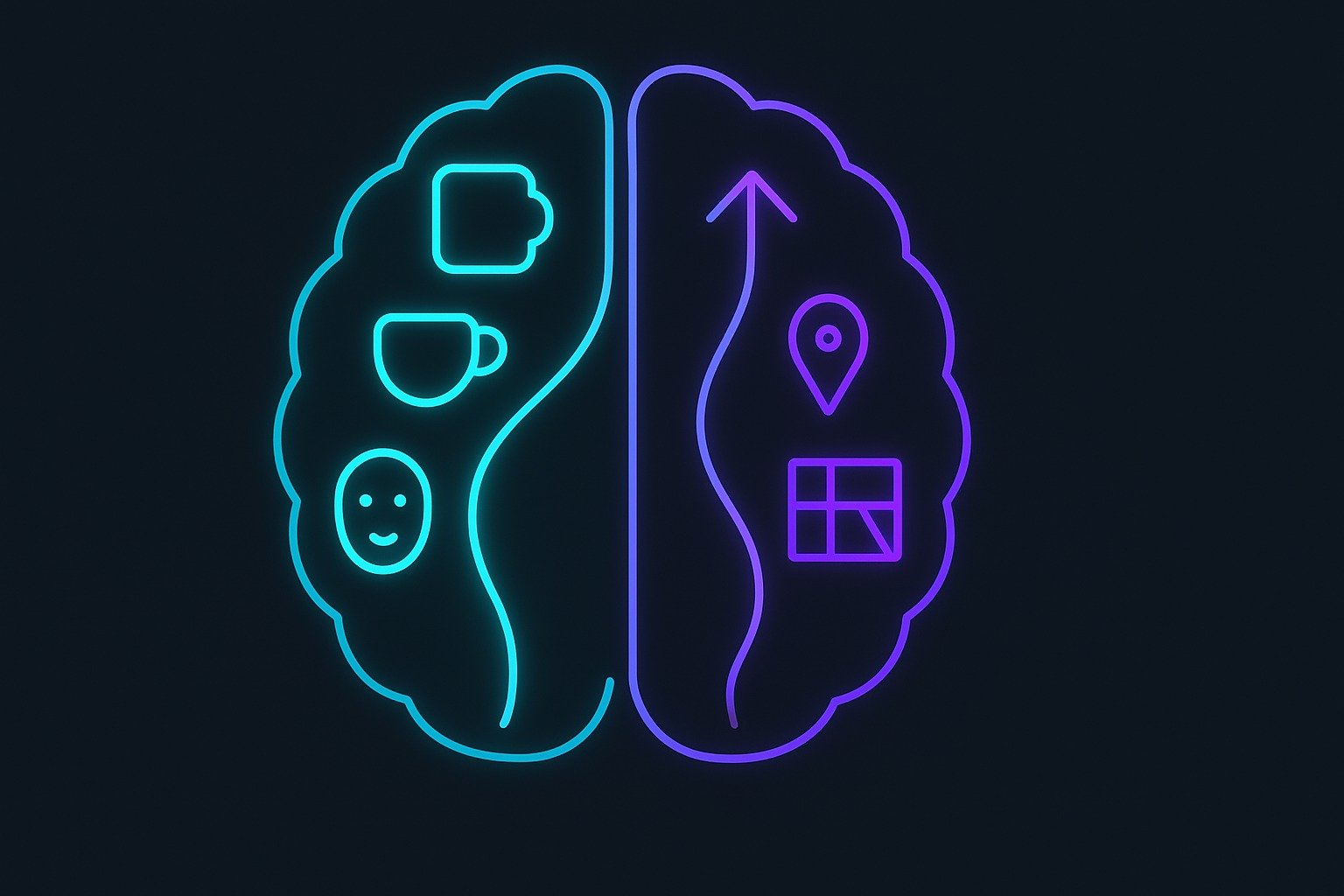
Your brain stores visual information using two powerful yet separate systems: object memory (what something looks like) and spatial memory (where things are located). Together, these systems help you recognize faces, navigate rooms, remember scenes, and solve day-to-day visual tasks.
This guide explains both types of memory, how they work in the brain, how they differ, how fast they decay, and how you can strengthen them using simple daily exercises and cognitive training approaches.
1. What Is Object Memory? (The “What” Pathway)
Object Memory: The “What” System
- Definition: Your ability to remember what an item looks like – its shape, color, texture, and identity.
- Brain Pathway: Ventral stream (occipital lobe → temporal lobe)
- Specializes in: Object recognition, face processing, detail retention
Decay Speed: Fast – details fade within seconds without reinforcement
Examples of Object Memory in Action:
- Recognizing a friend’s face instantly in a crowd
- Remembering the specific logo design of your favorite brand
- Recalling the exact appearance of your smartphone or laptop
- Visualizing detailed features of objects like cups, books, or buildings
Key Neuroscience Insight: Object memory details (color, shape, texture) fade faster than spatial information. Your brain loses these specifics within milliseconds to seconds unless focused attention or repetition reinforces the memory trace.
2. What Is Spatial Memory? (The “Where” Pathway)
Spatial Memory: The “Where” System
- Definition: Your ability to remember locations, distances, directions, and spatial relationships between objects.
- Brain Pathway: Dorsal stream (occipital lobe → parietal lobe)
- Specializes in: Navigation, layout memory, spatial awareness
- Decay Speed: Slow – spatial information remains stable for longer periods
Examples of Spatial Memory in Action:
- Remembering exactly where you parked your car in a large parking lot
- Navigating your home in complete darkness
- Recalling the layout of a new city after one visit
- Knowing where every item sits on your desk without looking
Key Neuroscience Insight: Spatial memory decays more slowly and stays stable for longer than object memory. This evolutionary advantage prioritizes navigation and environmental awareness – crucial survival skills.
3. Object vs Spatial Memory: Complete Comparison
| Feature | Object Memory (“What”) | Spatial Memory (“Where”) |
|---|---|---|
| Brain Pathway | Ventral Stream | Dorsal Stream |
| Primary Function | Stores shape, color, identity | Stores location, direction, layout |
| Neuroscience Name | Object Working Memory | Spatial Working Memory |
| Decay Speed | Fast decay (milliseconds to seconds) | Slower decay (minutes to hours) |
| Best At | Recognizing objects, faces, symbols | Navigation, room layouts, routes |
| Everyday Example | Knowing what your keys look like | Knowing where you placed your keys |
| Brain Region | Temporal lobe (inferotemporal cortex) | Parietal lobe (posterior parietal cortex) |
| Evolutionary Purpose | Object recognition, food identification | Navigation, predator avoidance |
4. How the Brain Processes “What” vs “Where” Information
The Dual Visual Processing Streams
Ventral Stream (“What” Pathway)
- Occipital → Temporal Lobe
- Processes: Color, Shape, Identity
Dorsal Stream (“Where” Pathway)
- Occipital → Parietal Lobe
- Processes: Location, Movement, Spatial Relations
This neural separation explains why you might remember where something was located but forget what it looked like (or vice versa). The two systems can operate somewhat independently, though they work together for complete scene memory.
5. Object-Location Binding: Connecting What & Where
The Critical Link: To fully remember a visual scene, your brain must successfully bind object information (what it is) with spatial information (where it is). This binding process occurs in the hippocampus and surrounding medial temporal lobe structures.
Example of Successful Binding: You see a blue coffee mug on the left side of your desk. Your brain stores: “Blue mug (object) + Left desk position (spatial) = Complete memory.”
When Binding Fails:
- You remember seeing a mug but can’t recall where you placed it
- You remember there was something on the left desk but forget what it was
- The object and location memories become disconnected
Binding Strength Factors:
- Attention: Focused attention improves binding
- Emotional Significance: Emotional objects bind better
- Distinctiveness: Unique objects bind more strongly
- Practice: Repeated exposure strengthens binding
6. Self-Test: Object vs Spatial Visualizer Type
Discover your dominant visual memory type by answering these questions:
1. When meeting someone new, what do you remember best?
- Object: Their facial features and appearance
- Spatial: Where you met them and the surroundings
2. In a new city, how do you navigate?
- Object: By remembering landmarks and buildings
- Spatial: By creating a mental map of streets
3. When recalling a room, what comes to mind first?
- Object: Specific objects and their details
- Spatial: The layout and spatial arrangement
Results Interpretation:
- Strong Object Visualizer (3 object answers): Excel at visual details, faces, and object characteristics
- Strong Spatial Visualizer (3 spatial answers): Excellent spatial awareness and navigation skills
- Object-Dominant Visualizer (2 object, 1 spatial): Lean toward object memory with decent spatial abilities
- Spatial-Dominant Visualizer (2 spatial, 1 object): Lean toward spatial memory with decent object recognition
- Balanced Visualizer (mixed answers): Balanced object and spatial memory abilities
7. How to Improve Object Memory
Photo Detail Training
Study a complex photo for 10-15 seconds, then recall as many details as possible. Gradually increase photo complexity and reduce viewing time.
Frequency: Daily, 5-10 minutes
Object Drawing Practice
Look at 5-7 random objects for 30 seconds, then draw them from memory with as much detail as possible.
Focus: Shape, color, texture, proportions
Logo Recall Drills
Study various logos for brief periods, then attempt to redraw them from memory. Focus on exact proportions, colors, and design elements.
Progression: Increase logo complexity over time
8. How to Improve Spatial Memory
GPS-Free Navigation
Navigate familiar routes without GPS. Start with simple routes, then progress to more complex navigation in unfamiliar areas.
Challenge: Create mental maps as you go
Mental Rotation Exercises
Visualize objects rotating in 3D space. Start with simple shapes, then progress to complex objects and multiple rotations.
Benefit: Strengthens spatial visualization
Position Recall Training
Place 5-10 objects on a table, study for 30 seconds, then recreate the exact arrangement from memory after removing the objects.
Progression: Increase object count and complexity
Frequently Asked Questions
What is the main difference between object and spatial memory?
The fundamental difference lies in what each system stores and processes. Object memory is concerned with “what” something is—its visual characteristics like shape, color, texture, and identity. Spatial memory handles “where” something is—its location, position relative to other objects, distance, and spatial relationships.
These systems use different brain pathways (ventral stream for object, dorsal stream for spatial) and have different evolutionary purposes. Object memory helps with recognition and identification (crucial for finding food, recognizing threats), while spatial memory supports navigation and environmental awareness (essential for survival in complex environments).
Why does object memory fade faster than spatial memory?
Object memory details fade faster due to several neurological and evolutionary factors:
- Neural Resource Allocation: The brain dedicates more stable resources to spatial processing since navigation is continuously essential for survival.
- Information Complexity: Object details (color, texture, fine shape) are more complex and require more precise neural coding than spatial positions.
- Evolutionary Priority: Remembering locations (where food sources are, where predators might be) was more critical for survival than remembering exact visual details.
- Interference Susceptibility: Object memories are more vulnerable to interference from similar objects, while spatial positions are often unique.
- Processing Speed: Spatial information can be processed more quickly and encoded more efficiently in neural networks.
Research shows object details begin decaying within 300-500 milliseconds without reinforcement, while spatial positions can remain stable for seconds to minutes.
Can I be strong in both object and spatial memory, or am I naturally better at one?
Most people have a natural inclination toward one system, but you can develop strength in both through targeted training. Research suggests:
- Natural Inclination: About 60-70% of people show a clear preference for either object or spatial processing.
- Neuroplasticity: Both systems can be strengthened with practice, regardless of natural inclination.
- Transfer Effects: Improving one system often provides some benefit to the other due to shared neural resources.
- Optimal Performance: The most effective visual memory comes from balanced development of both systems.
- Assessment: Simple tests (like the one in this article) can help identify your current strengths and areas for improvement.
Professionals who excel in visually demanding fields (surgeons, architects, pilots, artists) typically develop both systems to high levels through extensive practice.
How does aging affect object vs spatial memory differently?
Aging affects object and spatial memory differently due to distinct neural vulnerabilities:
- Object Memory Decline: Typically shows earlier and more pronounced decline. The temporal lobe regions supporting object recognition are vulnerable to age-related changes.
- Spatial Memory Resilience: Often remains relatively stable until later ages. The parietal lobe and hippocampal spatial systems show more gradual decline.
- Binding Impairment: The ability to connect objects with locations declines significantly with age, often before either system shows major individual decline.
- Compensatory Strategies: Older adults often develop compensatory strategies (verbal labeling, chunking) that can mask object memory decline.
- Training Benefits: Both systems remain trainable in older age, though improvement rates may differ from younger individuals.
Research suggests that regular visual memory training can help mitigate age-related decline in both systems, with particular benefits for maintaining object-location binding abilities.
Are there real-world applications for understanding my object/spatial memory profile?
Absolutely! Understanding your visual memory profile has practical applications in many areas:
- Career Choices: Object-dominant individuals often excel in fields like art, design, facial recognition, and quality control. Spatial-dominant individuals typically thrive in architecture, engineering, surgery, and navigation roles.
- Learning Strategies: Tailor study methods to your strengths. Object learners benefit from visual diagrams, color coding, and detailed illustrations. Spatial learners excel with mind maps, physical models, and spatial organization of information.
- Everyday Organization: Use your strengths for better organization. Object-dominant people remember what things look like, so visible storage works well. Spatial-dominant people remember where things are, so consistent locations are key.
- Skill Development: Focus training on your weaker system to build balanced abilities. This is particularly valuable for professions requiring both object recognition and spatial navigation.
- Problem Solving: Approach problems using your dominant system first, then consciously apply strategies from your non-dominant system for more comprehensive solutions.
Scientific References & Further Reading
- NIH: The What and Where Visual Pathways – https://www.ncbi.nlm.nih.gov/pmc/articles/PMC3887086/ – Comprehensive review of ventral and dorsal stream functions in visual processing
- Sage Journals: Object-Spatial Memory Interactions – https://journals.sagepub.com/doi/10.1177/0956797615575002 – Research on how object and spatial memory systems interact and influence each other
- Frontiers in Neuroscience: Training Visual Memory – https://www.frontiersin.org/articles/10.3389/fnhum.2017.00636/full – Study on cognitive training effects on object and spatial memory systems.


Explore Cognitive Processing
Discover how the brain processes, holds, and manipulates information through research-based educational exploration.
Working Memory Systems
Explore how the brain temporarily holds and manipulates information for cognitive tasks.
Verbal Memory Processing
Understand how the brain processes, stores, and recalls language-based information.
Cognitive Research Insights
Explore scientific findings about memory limitations, forgetting, and cognitive processing.
Specialized Memory Systems
Learn about different memory systems including sensory and exceptional memory phenomena.
Working Memory
Explore active information processing systems
Memory Research Hub
Browse all cognitive science articles
Educational Exploration: This content is designed for learning about cognitive processes through research-based materials. Memory systems vary naturally and are influenced by individual differences, experience, and context.

Touheed Ali
Touheed Ali is the founder and editor of MemoryRush, an educational cognitive science platform. He builds and maintains interactive tools focused on memory, attention, and reaction time.
His work centers on translating established cognitive science concepts into clear, accessible learning experiences, with an emphasis on transparency and responsible design.
MemoryRush
Educational Cognitive Science Platform • Memory • Attention • Reaction Time
Educational Use Only
MemoryRush is created for learning and self-exploration and does not provide medical, psychological, or clinical evaluation.
1 thought on “Spatial vs Object Memory: What vs Where Pathway Explained Simply”
Comments are closed.