

Visual Number Memory
Quick Answer:
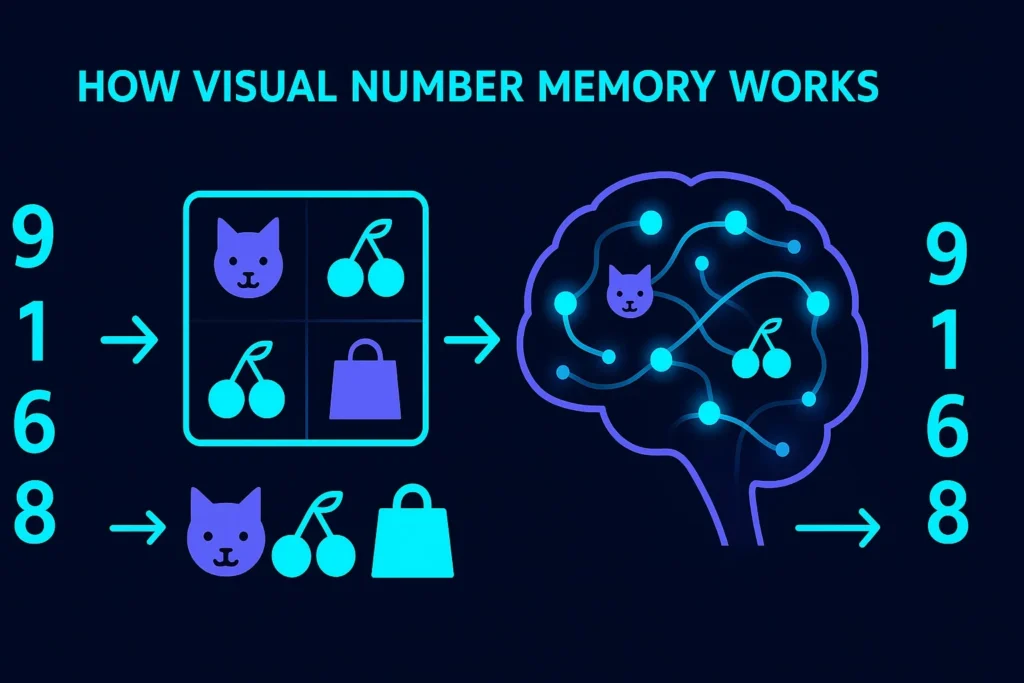
Most people think they are “bad with numbers,” but the real problem is how they try to remember them. We repeat digits in our heads—3-7-9-1-4-2—until they slip away. Visual number memory takes a different route. Instead of chanting digits, you turn them into images, patterns, and scenes and let your brain’s visual system do the heavy lifting.
In this guide, we’ll unpack what visual number memory actually is, how it works in the brain, how it differs from classic digit span tests, and the visual techniques used by memory athletes. You’ll also get a simple routine you can follow to start training your own visual number memory today.
What Is Visual Number Memory?
Visual number memory is your ability to encode and recall numbers that you see by transforming them into mental images and visual patterns instead of purely verbal repetition.
Some simple examples:
- You remember your bus number because you see it written on the sign every morning.
- You remember a phone PIN because you “see” the pattern your finger traces on the keypad.
- You recall a long student ID because you picture it as a layout on a screen or as a series of icons.
In a basic number memory test, digits appear on the screen for a short time, then disappear. Your task is to type them back in order. Without any strategy, you rely on a fragile, short-term trace. With visual number memory, you convert those digits into pictures, group them, and store them in a more stable visual–spatial structure.
Key ideas:
- It’s not just “seeing numbers”—it”‘s seeing images that stand for numbers.
- It uses visual and spatial memory more than the verbal “inner voice.”
- With techniques, you can push far beyond the classic “7 ± 2” digit limit.
How Visual Number Memory Works in the Brain
To understand visual number memory, we need to talk briefly about working memory and the two main components often described in cognitive psychology:
| Memory System | Function | Example |
|---|---|---|
| Phonological loop | Holds sounds and verbal material | Repeating “3-7-9-1-4-2” in your head |
| Visuospatial sketchpad | Holds images, shapes, positions and visual scenes | Visualizing a swan (2), axe (7), and balloon (9) in a scene |
Most people lean heavily on the phonological loop for numbers. Visual number memory deliberately shifts more of the workload to the visuospatial sketchpad by turning digits into visual forms.
The process looks like this:
Encoding
You see a number sequence, e.g., 472931. You immediately translate it into images or patterns (maybe 47 = rock, 29 = swan, 31 = moon, depending on your system).
Organisation
You arrange those images in a structure: a short story, a path through a familiar room, or positions on a grid.
Storage
The images and their order are held in your visuospatial sketchpad, supported by long-term associations (e.g. 2 always being a swan).
Retrieval
To recall the number, you replay the scene, decode each image back into digits, and reconstruct the sequence.
Because images are generally more emotionally rich, distinctive, and multi-sensory, they stick better than bare digits. That’s why visual number memory often feels “unfair” once you see what trained people can do compared with those who rely only on repetition.
Visual vs Verbal Number Memory: Why Digit Span Isn’t Everything
Traditional digit span tests measure how many digits you can hold in order using mostly verbal memory. You hear or see a sequence and repeat it back immediately. For many adults, this is around 7 digits forwards, a bit fewer backwards.
That’s useful for testing raw working memory, but it doesn’t show what happens when you add strategy.
| Aspect | Verbal Approach | Visual Number Memory Approach |
|---|---|---|
| Method | You chant “4-7-2-9-3-1” silently | You convert digits into images and create a scene |
| Vulnerability | Any distraction breaks the chain | More resistant to interference |
| Capacity | Limited to ~7 digits for most people | Expandable with practice and techniques |
| Example | Repeating “472931” mentally | Imagining a rock (47) falling on a swan (29) under the moon (31) |
The digits-to-image mapping is a learned skill, not a fixed ability. Once you have a system, the limit is no longer “7 digits” but “how many images can you comfortably store and decode?”
So:
Digit span test = raw, mostly verbal working memory.
Visual number memory = strategic, visually enhanced encoding that can massively outperform raw span.
Core Techniques to Improve Visual Number Memory
Let’s move to the fun part: tools. Here are the main techniques used to build strong visual number memory.
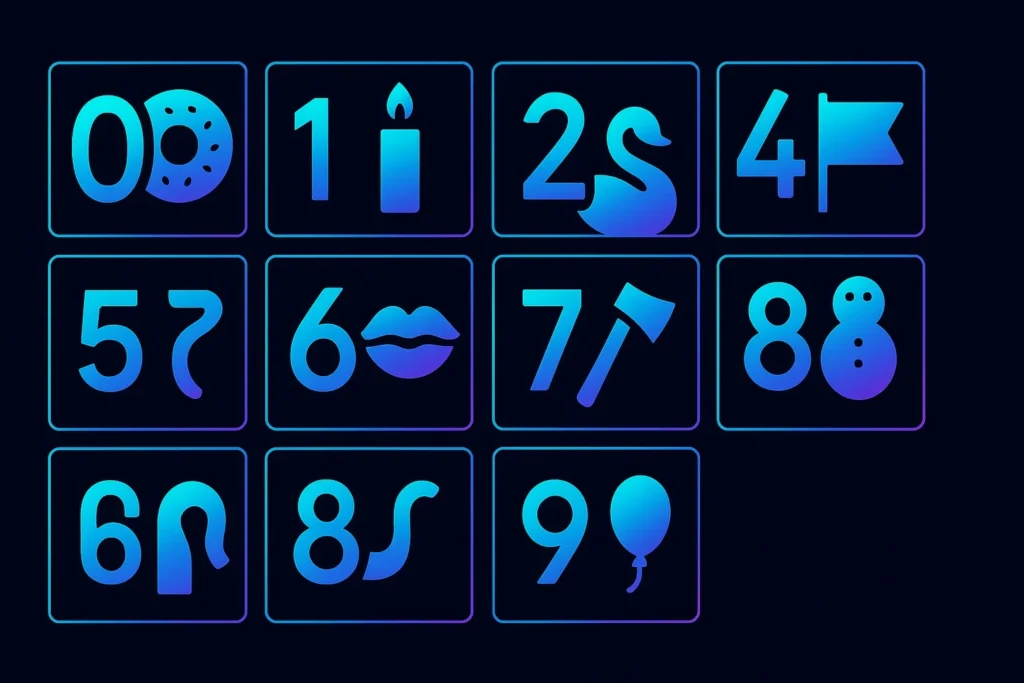
1. Number-Shape System
The number-shape system assigns each digit a picture based on its shape:
- 0 – ring or donut
- 1 – candle or pencil
- 2 – swan
- 3 – lips or a heart sideways
- 4 – sailboat or flag
- 5 – hook or seahorse
- 6 – golf club or elephant trunk
- 7 – axe or boomerang
- 8 – snowman
- 9 – balloon with string
How it helps: Gives you an instant visual hook for every single digit. You no longer stare at “”2793″—you see swan, balloon, hook, and lips. You can then create a tiny scene: a swan holds a balloon hooked onto big lips.
2. The Major System (Digit–Sound–Image)
The major system is more advanced. Instead of single digits, it converts numbers into consonant sounds, then into words and images. For example (one common version):
- 0 = s, z
- 1 = t, d
- 2 = n
- 3 = m
- 4 = r
- 5 = l
- 6 = j, sh, ch
- 7 = k, g (hard)
- 8 = f, v
- 9 = p, b
Example: 32 → 3 (m) + 2 (n) → “moon,” 47 → 4 (r) + 7 (k/g) → “rock”
3. Memory Palaces for Numbers
A memory palace uses a real or imagined place—your home, school, or favorite walk—and places images along a route.
How to use it: Choose a familiar location with clear spots (door, sofa, desk, window…). Assign each spot to a pair or trio of images. As you read the number, drop each image in order along the route.
Example: You want to remember a 12-digit number. You split it into six two-digit chunks, turn them into six images, and place each image in a specific room location.
4. Pattern Spotting and Grouping
Not every number requires heavy mnemonics. Sometimes pattern recognition is enough:
- 2025 → looks like a year
- 0101 → binary pattern
- 2468 → even-number sequence
- 1212 → repeating block
Visual number memory gets a huge boost when you group digits into meaningful visual blocks.
Step-by-Step Routine to Train Your Visual Number Memory
Here’s a simple, practical training plan you can follow with any online number memory test or with your own flash cards.
Establish Your Baseline
Take a basic number memory test a few times. Note the average length you can recall without any strategy (maybe 6–8 digits). This is your starting point, not your limit.
Learn a Simple Number-Shape List (0–9)
Spend a day or two fixing these images in your mind. Walk through them forward and backward (0 to 9, then 9 back to 0). See each number morph into its shape image instantly. Aim: when you see 7, you no longer think “seven,” you immediately think axe (or whatever you chose).
Practise With Short Sequences (5–8 Digits)
Now use a test or random digit generator. Read the sequence once. Immediately convert each digit to its shape image. Link them into a quick cartoon. Recall by replaying the cartoon in your mind. Do 10–15 attempts per day. Track your progress.
Add a Memory Palace for Longer Strings
Once 8 digits feel comfortable, switch to breaking numbers into pairs. Build a small 00–99 picture list (or at least for the most common pairs). Use a short memory palace with, say, 5–10 locations. Now you’re training both visual encoding and spatial structuring.
Gradually Increase Difficulty
Increase the number of digits one step at a time. Mix speeds: sometimes give yourself more time, sometimes less. Occasionally test yourself with a “maximal attempt” to see your new ceiling. Consistency matters more than length. Even 10 minutes a day of focused visual number memory training adds up fast.
Everyday Applications of Visual Number Memory
Strong visual number memory isn’t just a party trick. It quietly boosts lots of everyday tasks:
Studying and Exams
Remembering formulas, constants, years, and statistics by turning them into images.
Work Tasks
Recalling extension numbers, client IDs, order codes, and PINs without constantly checking notes.
Finance and Admin
Remembering card digits, account numbers, or transaction references safely (just don’t share them).
Digital Life
Managing multiple passwords and codes by encoding them visually and storing them in a mental structure.
Anywhere you see numbers, you can ask, “How can I turn this into a picture?”
Common Mistakes and Myths About Visual Number Memory
Reality: Memory skills are mostly trained, not fixed. Memory competitors aren’t born with magical brains; they use structured visual systems and practice regularly. Visual number memory responds incredibly well to training. Studies show that with consistent practice using mnemonic techniques, people can improve their number recall by 300-500% within a few months.
Reality: You don’t need to be an artist or a “visual learner.” Your images can be simple, even cartoonish. What matters is consistency (same image for the same number) and emotion (make it vivid or funny). Research in cognitive psychology shows that even people who don’t consider themselves visual thinkers can significantly benefit from visualization techniques with practice.
Solution: If you treat “472931” as six lonely digits, you overload yourself. Use chunking strategies instead:
- Number-shape for single digits when needed
- Major system or other mappings for pairs
- Grouping and patterns whenever possible (e.g., recognizing 2020 as a year)
This reduces cognitive load and makes recall more efficient.
Solution: You don’t need a perfect 000–999 list on day one. Start with small, manageable steps:
- 0–9 shapes first
- A few 2-digit images for common pairs
- One small memory palace with 5-7 locations
You can expand your system gradually as you become more comfortable with the techniques.
Solution: Like any skill, visual number memory improves with spaced repetition. Revisit your images, palaces and mapping lists regularly so they stay automatic. Research on memory consolidation shows that reviewing material at increasing intervals (1 day, 3 days, 1 week, 2 weeks) significantly improves long-term retention compared to cramming.
Combining Visual and Verbal Memory for Maximum Effect
The best approach usually isn’t purely visual or purely verbal. It’s a hybrid.
You can:
- Use visual images to encode the structure of the number.
- Use your inner voice to double-check the digits or repeat the decoded sequence.
- Add meaning where possible (e.g., recognizing a year or known number).
Example: To remember 201984:
Visual: 20 = nose, 19 = tape, 84 = fairy (using a chosen system).
Story: A nose is taped to a fairy’s wing.
Meaning: 1984 reminds you of the novel “1984.”
Your brain now has three hooks instead of one.
This multi-channel encoding—visual, verbal, spatial, and meaningful—makes the trace much stronger than any one channel alone.
Final Thoughts
Visual number memory is not some mysterious talent reserved for “gifted” people. It’s a set of learnable skills that use the brain’s natural love for images, patterns, and stories. Once you stop trying to hold raw digits in your head and start turning them into pictures, long numbers become surprisingly manageable—and even fun.
By learning a simple number-shape list, experimenting with the major system, and using small memory palaces, you can push far beyond your old digit span limit. Add a short daily practice routine, and you’ll quickly notice that phone numbers, codes, dates, and ID numbers stop feeling like enemies and start feeling like easy puzzles.
The bottom line:
If you can imagine a silly picture, you can build powerful visual number memory. Your brain is already wired for this—you’re just giving it the right language to work with.
Further Reading & Resources
Explore these non-competitive external resources to deepen your understanding of memory techniques:
- American Psychological Association – Memory Topics – Scientific resources on memory research
- NIH: Mnemonic Training Reshapes Brain Networks—Research on how memory training affects the brain
- Association for Psychological Science – Memory Improvement – Evidence-based memory enhancement techniques
Explore Numerical Memory
Discover how the brain processes, stores, and recalls numerical information through research-inspired educational content.
Number Memory Basics
Understand the cognitive mechanisms behind storing and recalling numerical sequences.
Techniques & Practice
Educational approaches for understanding and developing numerical memory skills.
Research Insights
Explore scientific findings about numerical cognition and individual differences in number memory.
Brain Processing
Learn about the brain's capacity and processing speed for numerical information.
Educational Purpose: This content is designed for learning and self-exploration of cognitive processes. Individual results in memory practice vary naturally and are influenced by many factors.
Explore All Number Memory Content →
Touheed Ali
Touheed Ali is the founder and editor of MemoryRush, an educational cognitive science platform. He builds and maintains interactive tools focused on memory, attention, and reaction time.
His work centers on translating established cognitive science concepts into clear, accessible learning experiences, with an emphasis on transparency and responsible design.
MemoryRush
Educational Cognitive Science Platform • Memory • Attention • Reaction Time
Educational Use Only
MemoryRush is created for learning and self-exploration and does not provide medical, psychological, or clinical evaluation.
6 thoughts on “Visual Number Memory”
Comments are closed.