

Cognitive Science Perspective
The Chimp Test illuminates fundamental aspects of human cognition:
Working Memory Architecture
It demonstrates the separation between visual-spatial and verbal working memory systems, as explained in our overview of working memory vs. short-term memory.
Attention-Resource Tradeoffs
Performance reveals how attentional resources are allocated during rapid visual processing, related to concepts in attention blink research.
Evolutionary Cognitive Specialization
The human-chimp performance difference reflects divergent evolutionary paths in cognitive specialization rather than hierarchical superiority.
Test Variations & Formats
While the core mechanics remain consistent, different implementations vary:
Display Time Variations
Standard: 300-500 ms
Challenge: 200-300 ms
Extended: 600-800 ms
Number Range Options
Basic: 4-9 numbers
Advanced: 10-15+ numbers
Adaptive: Progressive difficulty based on performance
Key Limitations & Considerations
Not diagnostic of cognitive disorders or intelligence
Device-dependent (screen size and refresh rate affect timing)
Practice effects significantly influence scores
State-dependent (fatigue, stress, motivation impact performance)
Cultural/educational factors may influence number processing
For broader cognitive assessment context, see our comparison of different memory types.
Experience the Test
To directly experience the cognitive processes described here, try our scientifically designed implementation.
Frequently Asked Questions
What does the Chimp Test measure?
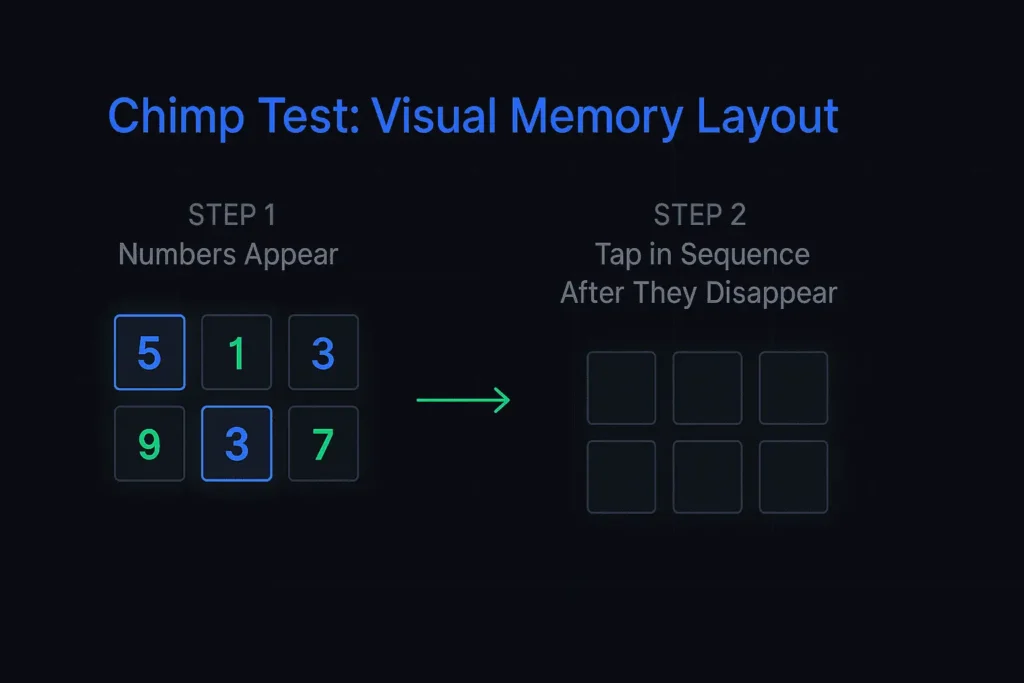
Specifically, it measures visual-spatial working memory—your ability to temporarily hold and manipulate information about object positions under time pressure. It does not assess long-term memory, verbal ability, or general intelligence.
Is the Chimp Test an IQ test?
No. While working memory correlates with some aspects of intelligence, the Chimp Test measures one specific cognitive skill. Comprehensive IQ assessment requires multiple cognitive domain measurements.
Why is it called the Chimp Test?
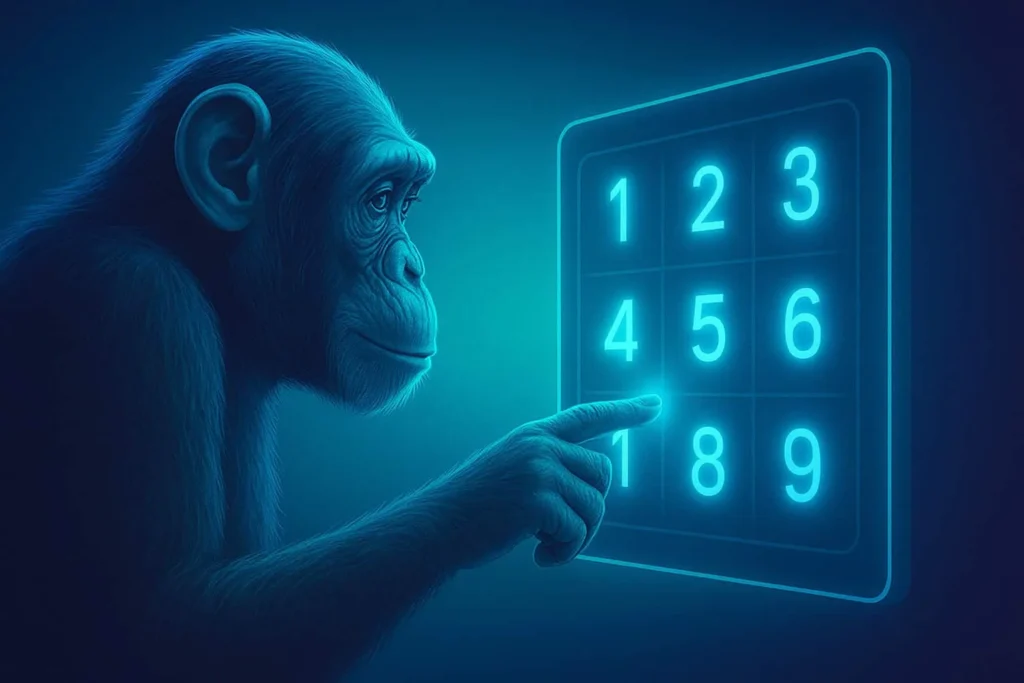
The name originates from primate research where young chimpanzees demonstrated exceptional performance on similar spatial memory tasks, outperforming adult humans in controlled studies.
Why does the test get harder so quickly?
The progressive difficulty (adding numbers, reducing time) systematically tests your working memory limits. This follows the original research methodology for measuring visual memory capacity.
What’s the difference between the Chimp Test and number memory tests?
The Chimp Test focuses on spatial position recall of numbers, while number memory tests typically involve sequential digit recall without spatial components. See our comparison of number memory techniques for details.
External Sources Section
Source 1: Kyoto University – Primate Research Institute
Description: Home of the original chimpanzee visual memory experiment that inspired modern “chimp tests.”
Link:
 Kyoto University Primate Research Institute Publications
 Kyoto University Primate Research Institute Publications
Source 2: National Library of Medicine (PubMed)
Description: Peer-reviewed research on visual working memory, short-term recall, and memory span.
Link:
PubMed Research Database
Source 3: American Psychological Association (APA)
Description: Authoritative psychological explanations of working memory and human cognitive processes.
Link:
APA Psychology Resources

4 thoughts on “What Is the Chimp Test?”
Comments are closed.