What Is Verbal Memory?
Quick Answer Box
If you’re short on time, here’s what you need to know:
-
Core Definition: The cognitive system for processing and recalling language-based information.
-
Key Analogy: Your mind’s language library.
-
The 3 Core Processes: Encode (Learn it) → Store (File it) → Retrieve (find it).
-
Main Types: Verbal Working Memory (your mental scratchpad) and Long-Term Verbal Memory (your permanent archive).

Introduction
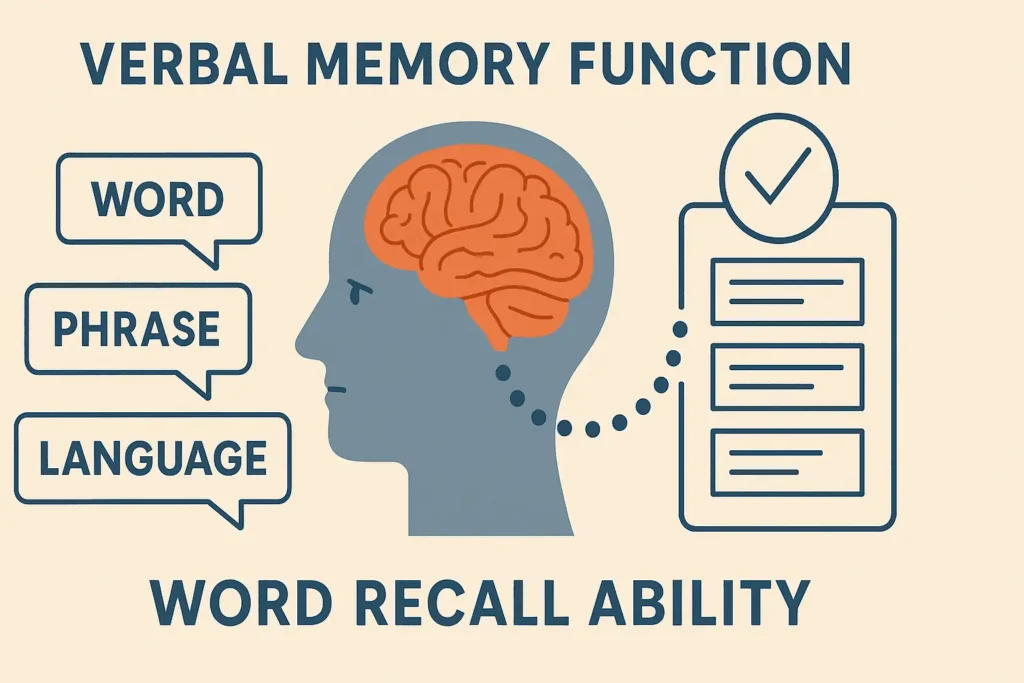
You use verbal memory constantly—when remembering a conversation, learning from a book, or following instructions. But what exactly is it? In simple terms, verbal memory is your brain’s specialized system for encoding, storing, and retrieving information presented through language.
Think of it not as a single drawer in your mind, but as an entire library dedicated to language, with different sections for quick notes you’re currently using and lifelong volumes of stories and facts. This guide will walk you through exactly how it works, why it’s so important, and what makes it unique.
How Verbal Memory Actually Works: The 3-Stage Process
Let’s break down what “encoding, storing, and retrieving” really means with everyday examples.
Stage 1: Encoding—Turning Sound into Signal
This is when your brain first takes in language, whether you hear it or read it. It converts the words into a neural code. Ever noticed how some facts stick immediately while others don’t? That’s “deep processing” versus “shallow processing.” When you connect new words to something you already know (like linking a name to a face), you encode it more deeply.
Stage 2: Storage—Filing the Information Away
Once encoded, information needs a place to live. This happens in two main ways:
Verbal Working Memory: Your brain’s temporary sticky note. It holds information for immediate use, like a phone number you’re about to dial. It’s limited and needs constant rehearsal.
Long-Term Verbal Memory: The permanent filing cabinet. This is where stories, vocabulary, and facts from years ago are stored. For a detailed look at how temporary memory works, see our guide on working memory versus short-term memory.
Stage 3: Retrieval—Finding the Word When You Need It
This is the “tip-of-the-tongue” stage—pulling the information back out when you need it. A word can be perfectly stored but still hard to retrieve if the “path” to it is weak. This frustrating experience, which research helps explain why we forget words, is usually a retrieval failure, not proof that your memory is gone.
The Verbal Memory Family: It’s More Than One Skill
Verbal memory isn’t a single thing. It’s a family of related skills, each handling a different type of language-based information.
Verbal Memory Types Table
| Type of Verbal Memory | What It Is | Everyday Example | Brain’s “Job” |
|---|---|---|---|
| Verbal Working Memory | The mental notepad for immediate, active processing. | Holding a new phone number in your head as you dial it. | Temporary holding & manipulation. |
| Episodic Verbal Memory | Recollection of specific events and personal experiences involving language. | Remembering the details of a funny story a friend told you last week. | Autobiographical filing. |
| Semantic Verbal Memory | Your storehouse of general knowledge, facts, and vocabulary. | Knowing the meaning of “cognitive” or that Paris is France’s capital. | Factual database. |
| Prospective Verbal Memory | Remembering to carry out a future intention based on language. | Recalling you need to pass on a message to a colleague. | Mental reminder system. |
Why Your Verbal Memory Is Fundamental
This cognitive system isn’t just for trivia—it’s woven into the fabric of daily life.
The Foundation of Learning & Education
From childhood to adulthood, verbal memory is crucial. It allows for reading comprehension, following lectures, and mastering new subjects. Academic research, like studies indexed in educational databases, consistently highlights its role as a predictor of learning success.
The Engine of Social Connection
It allows for fluid conversation, remembering names (and the details people share), and building relationships. Forgetting these things isn’t just awkward—it interrupts the social connection process.
A Key Indicator of Cognitive Health
Because it’s so fundamental, scientists often study verbal memory to understand overall brain health. Research indexed by the National Institutes of Health (NIH) has explored its role in understanding cognitive function across the lifespan. This makes it an important, though not solely definitive, aspect of cognitive assessment.
Verbal Memory vs. Visual Memory: What’s the Difference?
It’s easy to mix them up, but they’re distinct systems. Verbal memory handles language (words, stories, instructions). Visual memory handles images (faces, layouts, pictures).
-
Verbal: Remembering a shopping list (“milk, eggs, bread”).
-
Visual: Remembering what the grocery store aisle looks like.
Most tasks use both! To explore this difference further, see our comparison of pattern memory and visual memory.
Frequently Asked Questions
What does “poor verbal memory” mean? Is it serious?
It can mean different things. Occasional lapses (forgetting a name) are normal and can be caused by stress or lack of sleep. More consistent, noticeable problems that impact daily life could warrant a conversation with a healthcare professional to explore the cause.
What’s an example of verbal working memory?
Hold the beginning of this sentence in your mind while you read the end so the whole thing makes sense. That’s your verbal working memory in action right now.
Can you improve verbal memory?
Absolutely. Understanding what it is (which this page covers) is the first step. The next step is targeted training. Explore our science-backed, practical plan in our dedicated guide on how to improve verbal memory.
Disclaimer
Disclaimer: The content provided on MemoryRush is for informational and self-improvement purposes only, based on cognitive science. It is not medical or diagnostic advice. For concerns about memory or cognitive health, please consult a qualified healthcare professional.
The Takeaway
Verbal memory is the sophisticated, multi-part cognitive system that manages everything you hear, say, and read. By understanding its three stages and different types, you gain insight into a fundamental pillar of learning, communication, and thought itself. To move from understanding to action, the logical next step is learning how to strengthen this essential system.
Ready for the next step? Continue your learning with our related foundational guides on what is number memory and what is pattern memory.

Touheed Ali
Touheed Ali is the founder and editor of MemoryRush, an educational cognitive science platform. He builds and maintains interactive tools focused on memory, attention, and reaction time.
His work centers on translating established cognitive science concepts into clear, accessible learning experiences, with an emphasis on transparency and responsible design.
MemoryRush
Educational Cognitive Science Platform • Memory • Attention • Reaction Time
Educational Use Only
MemoryRush is created for learning and self-exploration and does not provide medical, psychological, or clinical evaluation.
2 thoughts on “What Is Verbal Memory? A Simple Guide to How Your Brain Remembers Words”
Comments are closed.