
Why Chimps Are Better at the Chimp Test
Understanding the unique visual memory strengths of chimpanzees
Chimpanzees often surprise people with how quickly they spot patterns in a memory game that many humans struggle with. This topic matters because it highlights how different brains adapt to different strengths. Players on MemoryRush notice something similar: some users excel at quick visual snapshots, while others rely more on analysis. Understanding why chimps perform so well reveals how visual working memory operates.
Quick Answer: Why Chimps Are Better at the Chimp Test
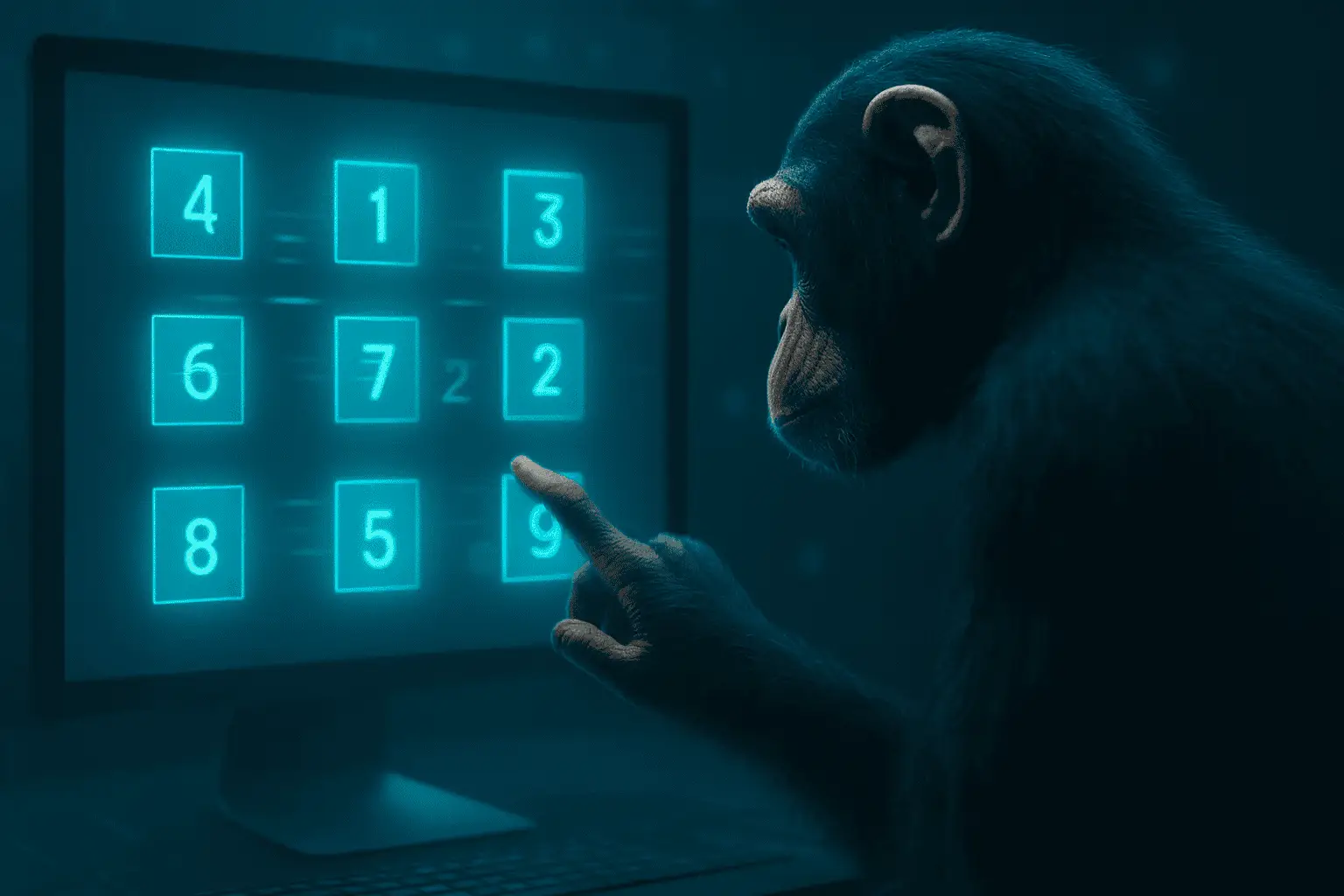
Chimps outperform humans on the chimp test because they rely on extremely fast visual working memory. Young chimpanzees can capture a full sequence of numbers almost instantly, a skill shown repeatedly in chimp memory experiments. Research suggests their evolution favored rapid visual recall, while humans developed broader cognitive abilities like language.
Why Chimps Excel at the Chimp Test
The Unique Visual Memory Strength of Chimps
Chimpanzees display unusually strong visual memory performance, especially in tasks that require rapid sequence recall. Their ability to glance at a board of numbers and instantly map the positions resembles near-photographic processing. This appears similar to patterns we see in MemoryRush users who score highest on ultra-fast visual games—they rely on brief snapshots instead of step-by-step scanning.
How Evolution Shaped Chimp Memory Skills
Evolution created different strengths in primates. Chimps retained sharper short-term visual memory, while humans developed language, planning, and symbolic reasoning. Many scientists believe this evolutionary split explains the chimp memory advantage: their environment rewarded fast pattern spotting, while ours rewarded long-term problem-solving. In essence, both skills evolved for different survival tasks.
Speed Over Strategy: Why Chimps React Faster
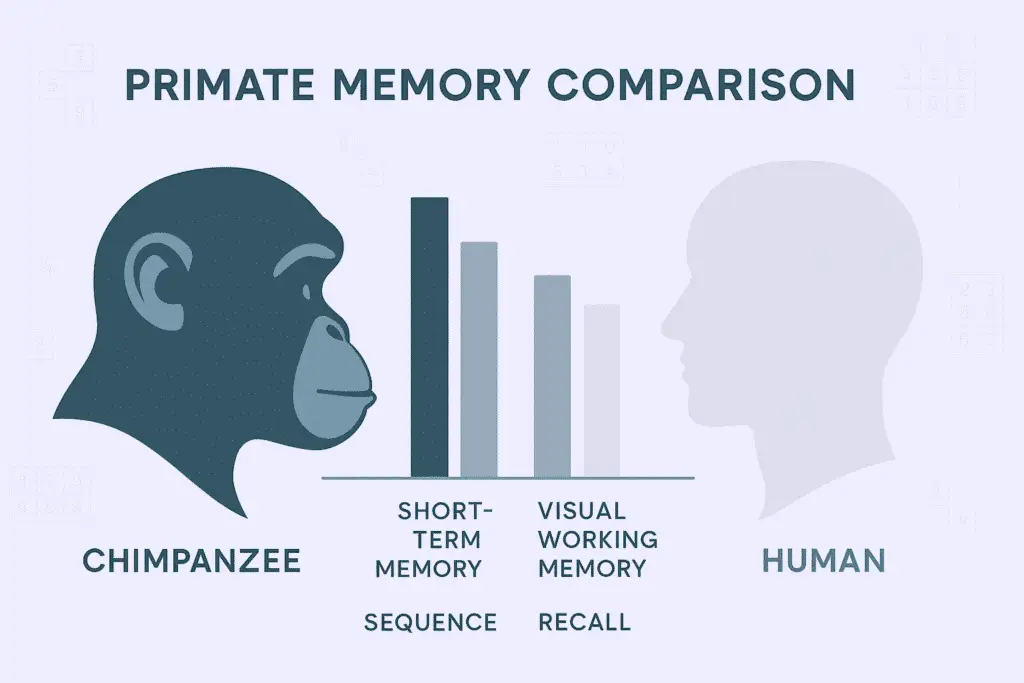
Chimp memory speed is one of the clearest differences in primate memory comparison studies. Chimps respond instantly without deliberation. Humans, however, tend to analyze patterns before acting, which slows performance in short-term memory tasks. This same behavior is visible in MemoryRush gameplay—users who hesitate typically score lower on rapid sequence games.
What the Chimpanzee Memory Experiments Show
In the well-known chimp intelligence study conducted in Japan, young chimps memorized number locations after extremely brief exposure times. Even when humans trained extensively, chimps still performed faster. These experiments demonstrate a strong chimp working memory advantage built around fast visual snapshots rather than verbal or symbolic reasoning. Humans simply process the same information differently.
Humans vs. Chimps: A Cognitive Trade-Off
Chimp visual pattern memory works like a high-speed camera. Humans, by contrast, spread cognitive energy across language, long-term planning, creativity, and abstract thinking. This trade-off explains why chimps win in short-term visual tests but humans excel at flexible thinking. Both systems reflect different forms of intelligence rather than one being globally "better."
FAQ Section
Conclusion
Chimpanzees shine in the chimp test because their minds capture visual information at remarkable speed. This advantage reflects an evolutionary pathway that favored rapid pattern memory. Humans, on the other hand, developed broader cognitive strengths. When you understand these differences, the test becomes a fascinating reminder of how diverse memory systems can be—and how targeted training helps sharpen your own abilities.
Explore Memory Research
MemoryRush offers research-inspired educational content designed for learning and self-exploration. Not a medical assessment.
Chimp Test Research
Explore the cognitive science behind chimpanzee memory studies and what they reveal about primate cognition.
Scientific Insights
Understand what memory research reveals about attention, perception, and cognitive processing in primates.
Learning & Practice
Educational guides for understanding and practicing memory techniques inspired by cognitive research.
Note: This content is for educational self-exploration and learning purposes only. It is not a medical or psychological assessment. Results are based on practice and vary naturally between individuals.
Browse All Chimp Test Content →External Sources
These reputable academic and scientific sources support the cognitive principles behind the Chimp Test and visual short-term memory
1Kyoto University – Primate Research Institute
Home of the original chimpanzee visual memory experiment that inspired modern "chimp tests."
🔗 Kyoto University Primate Research Institute Publications2National Library of Medicine (PubMed)
Peer-reviewed research on visual working memory, short-term recall, and memory span.
🔗 PubMed Research Database3American Psychological Association (APA)
Authoritative psychological explanations of working memory and human cognitive processes.
🔗 APA Psychology Resources
Touheed Ali
Touheed Ali is the founder and editor of MemoryRush, an educational cognitive science platform. He builds and maintains interactive tools focused on memory, attention, and reaction time.
His work centers on translating established cognitive science concepts into clear, accessible learning experiences, with an emphasis on transparency and responsible design.
MemoryRush
Educational Cognitive Science Platform • Memory • Attention • Reaction Time
Educational Use Only
MemoryRush is created for learning and self-exploration and does not provide medical, psychological, or clinical evaluation.
1 thought on “Why Chimps Are Better at the Chimp Test: Visual Memory Advantage”
Comments are closed.