
Why Some People Have Better Number Memory
Quick Answer:
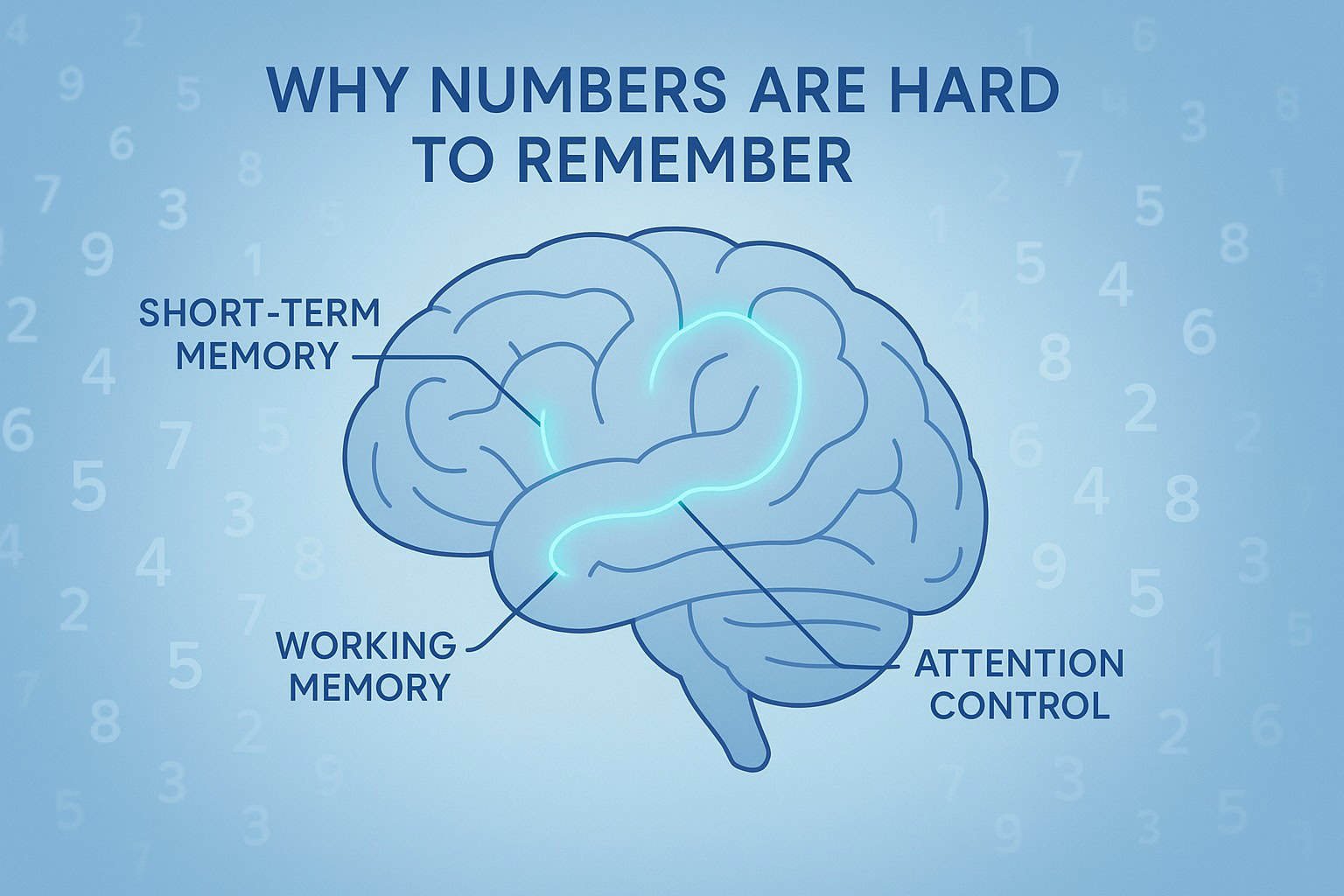
Some people have better number memory because they encode digits more efficiently and lose fewer details to distraction. Differences usually come from working-memory capacity, attention control, familiarity with numbers, and how strongly someone converts digits into patterns or mental representations. Genetics can influence baseline capacity, but strategy use and exposure often explain most real-world differences.
Ever wonder why some friends can rattle off phone numbers effortlessly while others struggle with a simple PIN? The answer isn’t just “natural talent” or “better genes.” It’s a combination of cognitive wiring, mental habits, and life experience.
- This page explains the causes behind differences in remembering digit sequences—focusing on capacity, attention, familiarity, and encoding style.
- What this is not: a techniques guide, score benchmarks, or training plan. Those have their own dedicated pages.
The Four Reasons Number Memory Varies So Much
Natural differences usually stem from one or more of these four areas:
- Capacity: How much information your working memory can hold briefly
- Attention: How stable your focus stays during encoding and recall
- Encoding Style: Whether you process digits as raw symbols or convert them to patterns/images
- Exposure: How often you actively handle and recall numbers in daily life
What Strong Number Memory Actually Looks Like
This matrix breaks down how each factor translates to real-world performance:
| Factor | What It Changes | In Real Life It Looks Like |
|---|---|---|
| Working Memory Capacity | Holds more digits briefly without overload | Can repeat longer strings immediately after hearing them |
| Attention Control | Fewer “drops,” or digit swaps, during recall | Less mixing or reversing digits, especially under pressure |
| Pattern Sensitivity | Sees more structure per glance | Notices repeats (77) or symmetry (1221) almost instantly |
| Familiarity & Exposure | Faster, more automatic encoding | Remembers phone codes, IDs, and short numbers with little effort |
| Stress Sensitivity | Stability of recall across conditions | Performance changes significantly on bad vs. good days |
| Measurement Context | Accuracy under specific test conditions | Device lag or unfamiliar formats can dramatically alter outcomes |
Two Different Advantages: Immediate vs. Long-Term
It’s crucial to distinguish between two types of “better”:
- Capacity Advantage: Some people excel at immediate recall—they can hold many digits in mind for seconds. This is what classic digit span tests measure.
- Retention Advantage: Others are better at keeping numbers accessible over minutes, hours, or days. They might use strategies or have particularly sticky long-term memory for numerical information.
Someone can have one advantage without the other, which explains why test scores don’t always predict real-world performance. For the full definition, see: What Is Number Memory?
Where Digits Get Lost: The 3-Point Failure Model
Most errors happen at specific stages in the cognitive pipeline:
1. Encoding Miss
The digit never properly registers in your cognitive system. This happens with distraction, divided attention, or simply glancing away too quickly. Result: You’re missing a digit from the start.
2. Interference
New information actively overwrites what you’re trying to hold. Your brain’s “mental workspace” has limited space, and incoming digits can push out earlier ones if not properly stored. Result: You remember the last few digits but lose earlier ones.
3. Order Error
You have all the digits, but their sequence gets scrambled—especially under cognitive load. This is why “582” might become “528” or “852.” Result: You recall the right elements in the wrong arrangement.
The Role of Genetics and Brain Development
Research suggests genetics can influence baseline cognitive tendencies. Studies, including those cited in the Journal of Experimental Psychology, indicate that working memory capacity and attentional control have heritable components.
However—and this is crucial—these genetic factors typically set a range of potential, not a fixed destiny. Within that range, experience, strategy development, and consistent practice determine where someone actually performs. The brain’s neuroplasticity means neural pathways for number processing can be strengthened throughout life.
The “Number Life” Effect: Exposure Matters
People who constantly handle digits often develop what looks like natural talent. Their brains become optimized for numerical encoding through sheer repetition and practical necessity.
Common examples include
- Finance & Accounting: Working with figures, accounts, and numerical data daily
- Inventory & Logistics: Remembering SKUs, codes, and quantities
- Gaming & Statistics: Tracking scores, timers, and in-game metrics
- Coding & Technology: Working with numerical identifiers and algorithms
This isn’t about “innate genius”—it’s about the brain adapting to what it does regularly, a principle supported by research on cognitive training and expertise.
Quick Self-Check: Which Factor Affects You Most?
Not a diagnosis—just insight into your cognitive patterns.
You do fine early in a sequence, then suddenly collapse
→ Likely a capacity bottleneck. Your working memory fills up and can’t hold more.
You perform well when calm, much worse when rushed
→ Suggests an attention stability issue. Pressure disrupts your focus during encoding.
You confuse similar-looking digits (6/9/8, 3/8)
→ Points to visual encoding clarity. The initial perceptual registration might be less distinct.
You remember meaningful numbers easily but random ones poorly
→ Highlights the role of meaning and familiarity. Your brain prioritizes information with context.
What This Page Does NOT Cover
To maintain explanatory focus and guide you to the right information:
- How to improve your number memory: See our dedicated training and improvement guide
- Specific memory techniques (chunking, systems, palaces) → Explore our number memory techniques page
- What constitutes a good or average score? → Refer to our score interpretation guide
- Common myths and misconceptions → Debunked in our number memory myths page
- Visual versus verbal number memory differences → Covered in our visual number memory guide
Direct Answers to Common “Why” Questions
Why am I personally good at remembering numbers?
You likely have a favorable combination of the factors above—perhaps stronger working memory capacity, good attention control, natural pattern sensitivity, or high exposure to numbers in your daily life. It’s rarely just one thing.
Is good number memory a sign of intelligence?
Not directly. While working memory correlates with some aspects of cognitive ability, exceptional number memory can be a specialized skill. Someone can have excellent number recall but average performance in other cognitive domains, and vice versa.
Why do I mix digits up (like 58 becoming 85)?
This is typically an “order error” (Point 3 in our process model). It happens when your brain has the right elements but scrambles their sequence under cognitive load—a common challenge when working memory is strained.
Can someone become good without “natural talent”?
Absolutely. Research on expertise, like the work of Ericsson and Chase (1982), shows that dedicated, strategic practice can develop exceptional memory skills, often surpassing initial “natural” advantages.
References & Scientific Sources
This article draws from peer-reviewed research and reputable scientific publications:
- National Institutes of Health. (2023). “Working Memory and Numerical Cognition”—NIH Research Portfolio
- American Psychological Association. (2022). “Genetic Influences on Working Memory “Capacity”—Journal of Experimental Psychology
- ScienceDirect. (2024). “Cognitive Training and Memory Improvement”—Cognition Journal
- Ericsson, K. A., & Chase, W. G. (1982). “Exceptional “memory”—American Scientist
- Frontiers in Neuroscience. (2021). “Neurocognitive Foundations of Number Processing”—Frontiers – Frontiers Research

3 thoughts on “Why Some People Have Better Number Memory”
Comments are closed.