

Why We Forget Words
The Quick Answer
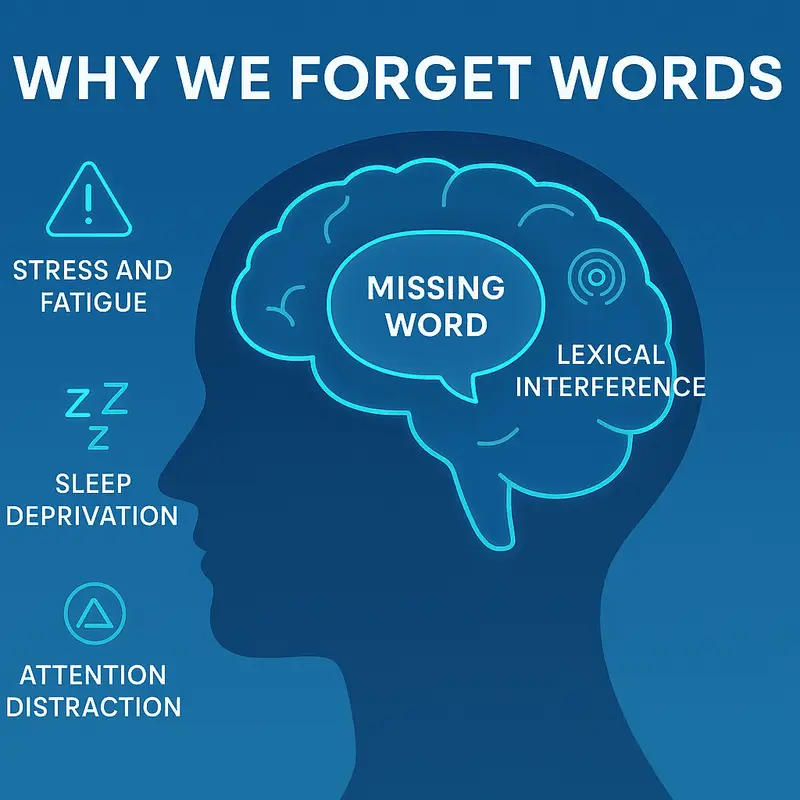
Forgetting words is usually normal, caused by stress or fatigue. That “tip-of-the-tongue” feeling is a retrieval delay, not memory loss. However, persistent issues can signal underlying conditions, from medication side effects to neurological changes. This guide explains the mechanics, clear signs of concern, and actionable steps to take.
We’ve all been there: a word is just out of reach, hovering frustratingly on the tip of your tongue. It happens to everyone. While usually harmless, sometimes it can make you wonder if it’s something more. Let’s break down why it happens and when it might be time to talk to a doctor.
Common Reasons We Forget Words
| Reason | What Happens |
|---|---|
| Stress & Anxiety | Cortisol blocks neural pathways for word retrieval. |
| Fatigue & Poor Sleep | Brain networks slow, delaying access to vocabulary. |
| Interference | Similar-sounding words compete for activation. |
| Multilingual Use | Words from all known languages are activated at once. |
| Medication Side Effects | Certain drugs can dampen cognitive speed and recall. |
| Lack of Use | Infrequently used words develop weaker neural connections. |
| Normal Aging | Processing speed slows, but vocabulary knowledge remains intact. |
How the Brain Retrieves Words
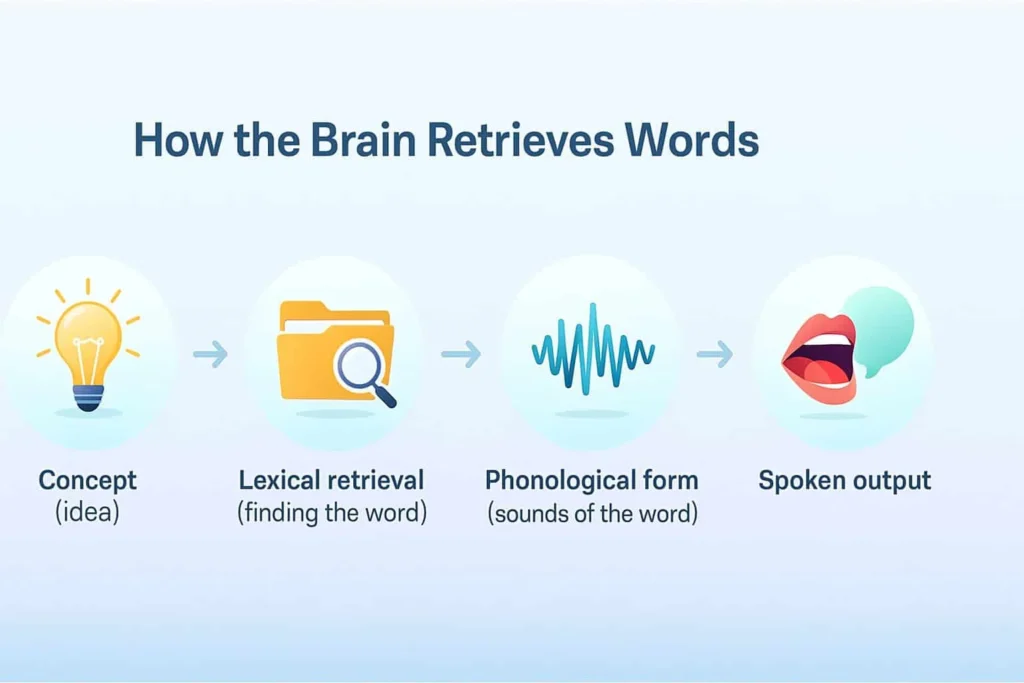
When you want to speak, your brain runs a precise, four-step sequence:
- Concept—An idea or image forms.
- Lexical Selection—Your brain searches its “mental dictionary.”
- Phonological Encoding—You—Your access the word’s sound pattern.
- Articulation—Motor—Your commands produce speech.
Most failures happen at step 2 or 3. The word isn’t lost; the temporary “file path” is blocked. It’s like knowing you own a tool but forgetting which drawer it’s in.
Idea → Word Retrieved → Sound Pattern → Word Spoken
The “Tip-of-the-Tongue” Feeling
That maddening feeling has a name: the Tip-of-the-Tongue (TOT) State.
- What you know: The meaning, first letter, or similar words.
- What’s blocked: The full sound of the word.
This is a universal experience, happening about once a week. It’s a retrieval delay, not memory loss. Most TOT moments resolve on their own, often when you stop trying so hard.
Everyday Reasons You Forget Words
Stress & Anxiety
High cortisol from stress can temporarily disrupt communication between brain areas for memory and word-finding, especially during presentations or tough conversations.
Fatigue & Poor Sleep
Your brain needs sleep to organize memories. Chronic lack of sleep slows down all thinking, including how fast you can pull up words.
Word Interference
Your brain doesn’t search in a vacuum. Trying to recall “cinnamon” might accidentally activate “synonym” or “cinema” first, causing a temporary block.
Multilingual Brain
If you speak multiple languages, your brain is constantly managing them all. Sometimes the word from the wrong language pops up first, blocking the one you need.
Medication Side Effects
Some common medications for allergies, anxiety, or sleep can have side effects that slow down thinking and recall. The National Institute on Aging notes that reviewing medications is a key part of maintaining brain health.
Normal, Healthy Aging
As we age, it’s normal for word retrieval to get a bit slower. This is usually about speed, not loss. Your vocabulary is still there; it just might take a moment longer to access.
When Forgetting Words Signals a Deeper Issue
While tip-of-the-tongue moments are normal, a significant, persistent, and worsening change is different. The goal here isn’t to scare you but to give you clear information.
| Normal | Concerning |
|---|---|
| Occasional pauses | Daily trouble with common words (like "toaster") |
| You know the meaning | Not understanding words you hear |
| Happens when stressed/tired | Happens even when you are calm and rested |
| Gets better later | Gets progressively worse over weeks/months |
| Can describe the word | Using the wrong word frequently (e.g., "clock" for "watch") |
What Could Be Causing It?
A doctor’s checkup looks for causes, which generally fall into two groups:
- Reversible or Treatable Conditions: Often the first things checked.
- Medication side effects.
- Vitamin deficiencies (like B12).
- Thyroid problems or uncontrolled diabetes.
- Depression, anxiety, or chronic stress.
- Untreated sleep apnea.
- Neurological Conditions: Require specialist diagnosis.
- Stroke or “mini-stroke” (TIA).
- Primary Progressive Aphasia (PPA): A dementia that starts with language problems, not memory loss. The Alzheimer’s Association provides clear information on different dementia types.
- Other forms of dementia (Alzheimer’s disease).
- Mild Cognitive Impairment (MCI).
How to Improve & Protect Your Word Recall
Simple, evidence-based habits can strengthen your brain’s resilience:
 Prioritize Sleep: Aim for 7-9 hours. Sleep is when your brain files away memories.
- Manage Stress: Try mindfulness or deep breathing. Chronic stress is hard on your memory.
- Use Words Actively: Don’t just read a new word—try to use it in a sentence or explain it to someone. This “effortful recall” strengthens the memory.
- Manage Overall Health: Control blood pressure and blood sugar. Address hearing loss. Talk to your doctor about any medication concerns.
 Prioritize Sleep: Aim for 7-9 hours. Sleep is when your brain files away memories.
 Manage Stress: Try mindfulness or deep breathing. Chronic stress is hard on your memory.
 Use Words Actively: Don’t just read a new word—try to use it in a sentence or explain it to someone. This “effortful recall” strengthens the memory.
 Manage Overall Health: Control blood pressure and blood sugar. Address hearing loss. Talk to your doctor about any medication concerns.
To understand the system you’re training, learn about working memory vs. short-term memory. For a structured plan, see our guide on how to improve verbal memory.
FAQs: Your Top Questions Answered
Is it normal to forget words?
Yes, completely. The tip-of-the-tongue feeling is a universal human experience, not a sign of serious illness on its own.
Is forgetting words always dementia?
No, absolutely not. Dementia is just one possible cause, and not the most common. Reversible issues like stress, medication, or sleep problems are far more frequent reasons for worsening word-finding.
Is forgetting words an ADHD thing?
It can be. ADHD, especially in adults, involves challenges with working memory and focus, which can make it harder to quickly find the right word during conversation.
When should I be worried?
Use the “Red Flags” list as a guide. If the problem is new, persistent, worsening, and impacts your daily life—especially if you’re using wrong words or not understanding them—it’s wise to get a doctor’s opinion.
Final Takeaway
Forgetting words is one of the most common—and usually most harmless—things our brains do. The system is complex, and occasional glitches are normal. Knowing the difference between a normal hiccup and a possible warning sign is powerful. With the right habits and knowing when to seek help, you can keep your communication clear.

Touheed Ali
Touheed Ali is the founder and editor of MemoryRush, an educational cognitive science platform. He builds and maintains interactive tools focused on memory, attention, and reaction time.
His work centers on translating established cognitive science concepts into clear, accessible learning experiences, with an emphasis on transparency and responsible design.
MemoryRush
Educational Cognitive Science Platform • Memory • Attention • Reaction Time
Educational Use Only
MemoryRush is created for learning and self-exploration and does not provide medical, psychological, or clinical evaluation.
1 thought on “Why We Forget Words”
Comments are closed.